Videos
Browse videos by topic
All Videos
Showing 865-888 of 1435 videos

Why do Plain Language Clinical Trial Summaries matter?
Cactus Communications
/@CactusCommunications
Jan 27, 2022
This video provides an in-depth exploration of the critical importance of plain language clinical trial summaries, particularly in the context of new European Union regulations. The main purpose is to highlight how these summaries are essential for improving health literacy, fostering public trust in the pharmaceutical industry, and ensuring compliance. The discussion begins by establishing the current state of public perception towards pharma, revealing a significant trust deficit primarily attributed to a lack of understanding of complex scientific information. The core theme revolves around the concept of health literacy, defined as an individual's ability to find, understand, and utilize health information for informed decision-making. The video posits that lower health literacy directly correlates with reduced trust in information sources, leading people to rely on less credible channels like social media for health-related insights. This environment, where misinformation spreads rapidly, significantly impacts how the public views pharmaceutical companies. The speaker emphasizes that for pharma to regain trust, it must communicate clearly and effectively in ways that the general public can readily comprehend. The video then transitions into practical advice on how to achieve plain language communication. It suggests imagining explaining a study to a 12-year-old, focusing on answering basic questions logically, maintaining consistency, and keeping explanations short and simple. The use of illustrations and visuals is also recommended to enhance understanding. A significant driver for the increased interest in plain language summaries is the new EU Clinical Trials Regulation, which came into effect on January 31, 2022. This regulation mandates the submission of layperson summaries of clinical trials within one year of trial completion. The ultimate goal of these summaries is to empower patients to understand and interpret the implications of trials on their health, thereby fostering transparency, partnership, engagement, and ultimately, trust in the pharmaceutical sector. The video concludes with a call to action, urging the industry to prioritize making science and medicine easier to understand, as comprehension is the foundation for trust and better health decisions for everyone. Key Takeaways: * **Regulatory Mandate:** The new EU Clinical Trials Regulation, effective January 31, 2022, legally requires the submission of plain language summaries of clinical trials within one year of completion, making this a critical compliance area for pharmaceutical companies. * **Trust Deficit in Pharma:** A significant portion of the public (51% of Americans surveyed) holds a negative view of the pharmaceutical industry, largely due to a fundamental lack of understanding of scientific and medical information. * **Importance of Health Literacy:** Health literacy is crucial for individuals to find, understand, and use health information effectively. Low health literacy directly erodes trust in scientific sources and healthcare professionals, making people more susceptible to misinformation from less credible sources like social media. * **Strategy for Clear Communication:** To rebuild trust, pharmaceutical companies must adopt plain language communication. This involves simplifying complex scientific content to be quick, easy to skim, read, and understand, ensuring it resonates with a broad audience. * **Audience-Centric Approach:** When preparing summaries, it's recommended to frame the explanation as if talking to a 12-year-old. This helps in breaking down complex concepts into their most basic components, answering fundamental questions in a logical, accessible manner. * **Principles of Plain Language:** Effective plain language communication requires consistency in messaging, sticking to the main point, and keeping content short and simple. Visual aids and illustrations are highly effective tools for increasing comprehension and engagement. * **Role of Medical Affairs:** Medical affairs teams are positioned to integrate plain language clinical trial summaries into their strategic communication efforts, serving as a bridge between complex scientific data and public understanding. * **Benefits of Transparency:** Providing plain language summaries fosters transparency, promotes partnership and engagement with patients, and ultimately builds greater trust in the pharmaceutical industry, leading to better-informed health decisions. * **Combating Misinformation:** In an age where misinformation spreads rapidly via social media, clear and understandable communication from authoritative sources is vital to counteract false narratives and ensure the public receives accurate health information. * **Foundation of Trust:** The video strongly emphasizes that gaining public trust starts with comprehension. When people understand the science and the implications of clinical trials, they are more likely to trust the information and the organizations providing it. Key Concepts: * **Plain Language Clinical Trial Summaries:** Simplified, easy-to-understand summaries of complex clinical trial results, designed for a lay audience rather than scientific experts. * **Health Literacy:** The degree to which individuals have the capacity to obtain, process, and understand basic health information and services needed to make appropriate health decisions. * **EU Clinical Trials Regulation:** A European Union regulation (EU No 536/2014) that came into effect on January 31, 2022, which includes a mandate for the submission of layperson summaries of clinical trial results. Examples/Case Studies: * **Public Perception of Pharma:** A survey indicating that 51% of Americans hold a very negative view of the pharmaceutical industry, primarily due to a lack of understanding. * **"Explain to a 12-year-old" analogy:** A practical framework for simplifying complex scientific information by answering basic questions about a study in a logical, accessible manner.

Vault Clinical Operations to RIM Connection Demo
Veeva Systems Inc
/@VeevaSystems
Jan 26, 2022
This video provides an in-depth demonstration of the Veeva Vault Clinical Operations to RIM (Regulatory Information Management) Connection, showcasing how it seamlessly links critical information and documents between these two crucial functional areas within pharmaceutical and life sciences organizations. The main purpose is to illustrate how this integration addresses the common challenge of disparate systems where clinical and regulatory teams often maintain overlapping data and documents, leading to inefficiencies and compliance risks. The presenter walks through practical examples, highlighting the automation of data entry and document uploading processes to streamline workflows and improve collaboration. The demonstration begins by illustrating the creation of a new product family record in the Regulatory Vault. The key insight here is that this action automatically triggers the creation of the same product record in the Clinical Vault. This ensures that clinical teams have immediate access to necessary product information when identifying candidate studies, eliminating manual re-entry. The video further explains that any subsequent updates to metadata on the product record in the RIM Vault would similarly propagate to the Clinical Vault, maintaining data consistency. The progression then shifts to the clinical side, where the creation of a new clinical study and associated countries or sites within the Clinical Vault automatically duplicates this information back into the Regulatory Vault, providing regulatory teams with up-to-date study details. Beyond data records, a significant portion of the demo focuses on automating document processes. The video shows a clinical operations person uploading a document, such as an investigator CV from a site, into the Clinical Vault, classifying it by study, country, and site. Crucially, once this document passes its quality control (QC) process and reaches an approved lifecycle state in the Clinical Vault, the Vault Connection automatically creates a cross-link to this document in the Regulatory Vault. This cross-link is presented as a PDF rendition of the source file, providing regulatory teams with immediate access to essential documents required for submissions, such as 1572 forms or investigator CVs. The system also facilitates the automatic matching of these cross-linked documents directly into regulatory content plans, notifying regulatory teams of new documents ready for filing, thereby significantly reducing manual effort and potential errors in submission preparation. Key Takeaways: * **Automated Data Synchronization:** The Veeva Vault Clinical Operations to RIM Connection automates the transfer of critical data records, such as product families and clinical study/site information, between the Regulatory Information Management (RIM) Vault and the Clinical Operations Vault. * **Elimination of Manual Data Entry:** By automatically propagating data from one vault to another upon creation or update, the connection significantly reduces the need for manual data entry by different business teams, saving time and improving efficiency. * **Reduced Risk of Errors:** Automating data transfer minimizes the risk of human error, such as typos or inconsistencies, that often arise from manual re-entry of the same information across multiple systems. * **Single Source of Truth:** The integration ensures that a single, authoritative source of truth is maintained for both data records and documents across clinical and regulatory functions, preventing discrepancies and ensuring data integrity. * **Streamlined Regulatory Submissions:** The connection directly supports regulatory compliance by automatically making clinical documents (e.g., investigator CVs) available and cross-linked in the RIM Vault once approved in the Clinical Vault, facilitating faster and more accurate submission preparation. * **Enhanced Cross-Functional Collaboration:** By providing seamless access to shared data and documents, the connection fosters better collaboration between clinical and regulatory teams, allowing them to work together more quickly and effectively. * **Automated Document Cross-Linking:** Approved documents in the Clinical Vault are automatically cross-linked as PDF renditions into the Regulatory Vault, providing regulatory teams with immediate access to the necessary files for their processes. * **Integration with Content Plans:** Cross-linked documents can be automatically matched into regulatory content plans, streamlining the process of assembling submission packages and ensuring all required documents are accounted for. * **Proactive Notifications:** The system can notify regulatory teams when new documents or data have been transferred from the clinical side, allowing them to proactively plan for filing or submission activities. * **Operational Efficiency:** The overall value proposition lies in saving time for both regulatory (preparing submissions) and clinical (conducting studies) teams, leading to greater operational efficiency across the organization. Tools/Resources Mentioned: * Veeva Vault (specifically RIM Vault and Clinical Operations Vault) * Veeva Vault Connections (the integration mechanism) Key Concepts: * **Vault to Vault Connection:** A feature within Veeva Vault that enables automated data and document synchronization between different Vault applications (e.g., Clinical Operations and RIM). * **Regulatory Information Management (RIM):** A system used to manage all information related to regulatory submissions, product registrations, and compliance activities. * **Clinical Operations:** The processes and systems involved in managing clinical trials, including study setup, site management, and document collection. * **Cross-linking:** A mechanism within Veeva Vault where a document in one vault is linked to another vault, typically as a rendition (e.g., PDF), allowing access without duplicating the source file. * **Single Source of Truth:** The principle that all data and documents should originate from and be maintained in one authoritative location to ensure consistency and accuracy. * **Content Plan:** A structured plan within regulatory systems that outlines all documents and information required for a specific regulatory submission. Examples/Case Studies: * **Product Family Creation:** A product family named "Solflex Attacks" is created in the RIM Vault, automatically appearing in the Clinical Vault. * **Clinical Study Creation:** A clinical study named "SOL5959" is created in the Clinical Vault, automatically appearing in the RIM Vault. * **Document Upload and Cross-linking:** An investigator CV for "Dr. Smith" is uploaded and approved in the Clinical Vault, automatically creating a cross-link in the Regulatory Vault for submission purposes.
Vault eTMF Completeness
Veeva Systems Inc
/@VeevaSystems
Jan 26, 2022
This video provides an in-depth exploration of how Veeva Vault eTMF supports the tracking and management of Trial Master File (TMF) completeness, emphasizing efficiency and accuracy in clinical operations. The demonstration begins by showcasing the TMF homepage within a clinical operations Vault, where users gain immediate oversight and visibility into critical TMF health metrics through intuitive graphs visualizing timeliness, completeness, and quality. The core focus is on the completeness aspects, illustrating how the system leverages milestones and Expected Document Lists (EDLs) to provide actionable insights and proactive management of the TMF throughout a study's lifecycle. The presentation progresses by detailing the functionality of milestones, which are created from configurable templates within Vault. These milestones, when hovered over, reveal crucial information such as overall percentage completeness, dependencies, associated expected documents, and any related tasks. This templated approach ensures that as a study, country, or site is planned, the relevant milestones and EDLs are automatically released, guiding users to maintain TMF completeness from the outset. The video highlights how users can drill down into specific milestones to view key dates, dependencies, and a comprehensive list of all expected documents, which are fundamental for accurately reporting on TMF completeness. A significant portion of the demonstration is dedicated to Expected Document Lists (EDLs), which serve as a dynamic checklist of documents expected (or not expected) for a specific study, country, site, person, organization, or product. The video illustrates how users can easily modify the "requiredness" status of documents from a template's starting basis or for those pending decision, as well as update the number of expected documents. Vault eTMF automatically calculates the number of final documents and the overall document count, providing a clear completeness status via intuitive icons. These icons—green circles for final completed documents, orange semicircles for in-progress documents, and red open circles for unfunded documents—offer a quick visual assessment of TMF health. The video concludes by demonstrating a streamlined drag-and-drop feature for filing documents, where metadata is largely pre-filled, and showcases Vault's robust reporting capabilities, allowing users to analyze TMF completeness at various levels, including the entire trial, individual sites, and different document types. Key Takeaways: * **Centralized TMF Oversight:** Veeva Vault eTMF provides a single, centralized view of key TMF health metrics, including timeliness, completeness, and quality, enabling clinical operations teams to maintain continuous oversight. * **Milestone-Driven Management:** The system utilizes configurable milestones, generated from templates, to guide TMF planning and execution. These milestones provide detailed information on completeness, dependencies, and associated tasks, ensuring a structured approach. * **Dynamic Expected Document Lists (EDLs):** EDLs serve as a critical checklist, defining documents expected or not expected for specific study contexts (e.g., study, country, site, person). They are dynamic and can be customized to reflect trial-specific requirements. * **Proactive Completeness Tracking:** EDLs allow for the proactive planning and tracking of TMF completeness, moving beyond reactive checks by outlining what documents are needed at each stage of a trial. * **Visual Status Indicators:** Intuitive completeness status icons (green for final, orange for in-progress, red for not filed) provide immediate visual feedback on the state of each expected document, facilitating quick identification of outstanding items. * **Streamlined Document Filing:** The platform offers efficient document filing through a drag-and-drop interface. Metadata is largely pre-filled based on the expected document, significantly reducing manual data entry and potential errors. * **Robust Multi-Level Reporting:** Veeva Vault eTMF provides powerful reporting capabilities that allow users to analyze TMF completeness at various granularities, including overall trial completeness, site-specific performance, and breakdown by document type. * **Ensuring Regulatory Readiness:** By systematically tracking TMF completeness, the system helps organizations maintain a state of continuous regulatory readiness, crucial for audits and inspections by bodies like the FDA and EMA. * **Template-Based Consistency:** The use of templates for milestones and EDLs ensures consistency across studies, countries, and sites, standardizing TMF setup and management processes. * **Actionable Insights:** The combination of visual metrics, milestone tracking, and detailed EDLs provides actionable insights, allowing teams to quickly identify gaps and prioritize tasks to maintain TMF health. Tools/Resources Mentioned: * Veeva Vault eTMF * TMF Homepage (within Clinical Operations Vault) * Expected Documents List (EDL) Key Concepts: * **TMF (Trial Master File):** A collection of essential documents that individually and collectively permit the evaluation of the conduct of a clinical trial and the quality of the data produced. * **eTMF (electronic Trial Master File):** A digital system for managing and storing the TMF, offering advantages in accessibility, searchability, and compliance. * **Milestones:** Key events or stages in a clinical trial that trigger specific TMF documentation requirements and provide a framework for tracking progress. * **Expected Documents List (EDL):** A configurable checklist within Veeva Vault eTMF that defines all documents anticipated for a specific study, country, site, or other context, serving as a guide for TMF completeness. * **Completeness Status Icons:** Visual indicators (green, orange, red circles/semicircles) that quickly convey the filing status and finality of expected documents within the eTMF system. * **Metadata:** Data that provides information about other data; in this context, descriptive information about documents (e.g., document type, study, site) that aids in organization and searchability.
End to End Trials with Vault CTMS
Veeva Systems Inc
/@VeevaSystems
Jan 26, 2022
This video provides an in-depth exploration of Veeva Vault CTMS (Clinical Trial Management System), showcasing its capabilities for end-to-end management of clinical trials within the life sciences industry. The presentation highlights how Vault CTMS, as part of the broader Vault Clinical Suite, unifies clinical information, streamlines processes, and offers comprehensive visibility across the entire clinical trial portfolio. The speaker emphasizes the system's ability to provide actionable data and tasks directly upon login, ultimately enabling faster and more compliant trials. The demonstration begins by illustrating the perspective of a trial manager, who gains immediate insights into trial activity through a role-specific dashboard. This dashboard presents critical metrics such as subject enrollment values against planned targets, the status of trip report completion, a clear view of clinical milestones with drill-down capabilities, and a graphical representation of subject status over time compared to forecasts. The video then transitions to the study's profile page, detailing how users can track the study's life cycle, build out the study team roster, and manage data access permissions. A key feature discussed is the integrated risk assessment functionality, which allows leveraging pre-existing risks from a library and assessment templates, facilitating easy adjustments and generating a document readout to the Trial Master File (TMF) with an automatically calculated risk score. Further into the presentation, the focus shifts to the operational aspects of trial execution, particularly for site monitors and Clinical Research Associates (CRAs). After study setup, site monitors receive their own dedicated homepage, tailored with metrics relevant to their assigned sites and planning for upcoming visits. This includes key date information, enrollment tracking, their monitoring plan, and trending issues logged for specific sites. The system facilitates daily tasks, such as generating new records or drilling into data like communication logs and TMF-filed documents. The video meticulously walks through the CRA's workflow for authoring a trip report, demonstrating how all necessary information is readily available for compliant completion, including adding visits to calendars, capturing attendees, and performing Source Document Verification (STV) directly in Vault EDC via a linked interface. The seamless connection ensures STV data and deviations are transferred back to Vault CTMS in near real-time. Finally, the system prompts users with help text or required information during report completion, ensuring data quality and completeness, with all details logged against the site and included in the trip report. The process concludes with a collaborative review and approval workflow, where study managers or lead CRAs can leave annotations before manager approval, which automatically creates a trip report document in the TMF, immediately accessible to TMF users. The video concludes by emphasizing the system's ability to aggregate all records and activities into comprehensive reports and dashboards, providing insights into trial metrics, document and data collection, cycle times, and compliance values against the monitoring plan. Key Takeaways: * **Centralized Clinical Trial Management:** Veeva Vault CTMS acts as a unified platform for managing all aspects of clinical trials, integrating data and processes across various functions to provide a single source of truth. * **Role-Specific Dashboards for Enhanced Visibility:** The system offers tailored dashboards for different user roles, such as trial managers and site monitors, providing immediate, relevant insights into trial activity, subject enrollment, milestone progress, and site-specific metrics. * **Automated Data Tracking and Forecasting:** Vault CTMS automates the tracking of critical metrics like planned versus actual subject enrollment, leveraging feeds from EDC systems, and provides graphical representations of subject status over time compared to forecasts. * **Integrated Risk Assessment and Management:** The platform includes a robust risk assessment feature, allowing users to track and reuse risks from a central library, utilize assessment templates, and automatically calculate risk scores, which are then documented in the TMF. * **Seamless Integration with Veeva Clinical Suite:** The video highlights the inherent data sharing capabilities within the Vault Clinical Suite, specifically demonstrating near real-time data transfer between Vault CTMS, Vault EDC (Electronic Data Capture), and the TMF (Trial Master File). * **Streamlined Site Monitoring Workflows:** Site monitors benefit from dedicated homepages that organize key date information, enrollment tracking, monitoring plans, and trending issues, facilitating efficient planning and execution of site visits. * **Compliant Trip Report Authoring and Approval:** CRAs can author trip reports with all necessary information at their fingertips, ensuring compliant completion. The system supports capturing attendees, performing STV via direct links to Vault EDC, and includes help text and required fields to ensure data quality. * **Automated TMF Document Creation:** Upon manager approval, trip reports are automatically created as documents within the TMF side of Vault Clinical's shared database, ensuring immediate availability and accessibility for TMF users. * **Collaborative Review and Annotation:** The system supports collaborative workflows, allowing study managers or lead CRAs to leave in-line annotations on authored reports, which are reviewed and resolved before final manager approval. * **Comprehensive Reporting and Compliance Tracking:** All trial records and activities can be aggregated into comprehensive reports and dashboards, offering insights into trial metrics, document and data collection, cycle times, and compliance against monitoring plans. * **Efficiency and Regulatory Adherence:** The overarching benefit of Vault CTMS is its ability to streamline clinical operations, reduce manual effort, enhance data visibility, and ensure adherence to regulatory standards throughout the trial lifecycle. Tools/Resources Mentioned: * Veeva Vault CTMS * Veeva Vault Clinical Suite * Veeva Vault EDC (Electronic Data Capture) * Veeva Vault TMF (Trial Master File) Key Concepts: * **CTMS (Clinical Trial Management System):** A software system used by pharmaceutical and biotechnology companies to manage and track the progress of clinical trials. * **EDC (Electronic Data Capture):** A computerized system designed for collecting clinical trial data in an electronic format. * **TMF (Trial Master File):** A collection of essential documents that individually and collectively permit the evaluation of the conduct of a clinical trial and the quality of the data produced. * **STV (Source Document Verification):** The process of comparing data entered into the EDC system with the original source documents to ensure accuracy and completeness. * **Risk Assessment:** The process of identifying, analyzing, and evaluating risks associated with a clinical trial to minimize potential negative impacts. * **Clinical Milestones:** Key events or achievements in the clinical trial timeline, such as first patient in, last patient out, or database lock. * **Trip Reports:** Documents prepared by CRAs after site visits, detailing observations, issues, and actions taken during the visit.
Vault eTMF Product Demo
Veeva Systems Inc
/@VeevaSystems
Jan 26, 2022
This video provides an in-depth demonstration of Veeva Vault eTMF, a cloud-based electronic trial master file system designed to streamline the management of clinical trial documentation for sponsors and Contract Research Organizations (CROs). The presenter walks through the system's capabilities, emphasizing its role in ensuring real-time access to critical documents, maintaining inspection readiness, enhancing visibility and oversight, and improving collaboration throughout the trial lifecycle—from setup and execution to archival. The core message revolves around eTMF being an active content management system rather than a mere repository, facilitating the full lifecycle management of documents with integrated workflows and, notably, leveraging artificial intelligence for automated classification. The demonstration begins with an overview of the TMF homepage, showcasing its ability to display critical real-time information such as upcoming milestones, expected document details derived from templates, and dynamic charts visualizing completeness, timeliness, and quality metrics. Users can also view and act on outstanding tasks directly from this dashboard. The video then transitions to document viewing and management, illustrating how the TMF viewer allows users to browse through configured document type hierarchies for specific studies, countries, or sites. An alternative, more unstructured approach is presented through the document library tab, which offers robust searching and filtering capabilities to narrow down content. A key highlight of the demo is the system's active content management approach. Unlike traditional repositories, Vault eTMF supports the entire document lifecycle, from authoring and review to quality control (QC) and final approval, with integrated workflows. The presenter demonstrates various methods for uploading documents, including a standard uploader, drag-and-drop functionality, and a bulk document inbox capable of handling up to 250 documents at once. A particularly innovative feature showcased is the "TMF bot," which utilizes artificial intelligence to automatically classify uploaded documents by applying type, subtype, and classification based on a trained model, significantly reducing manual effort and improving data consistency. The video concludes by highlighting Vault eTMF's standard reporting and dashboard capabilities, which offer out-of-the-box metrics and the flexibility for users to create custom reports to visualize specific key performance indicators, with dynamic drill-down functionality and export options. Key Takeaways: * **Comprehensive Clinical Document Management:** Veeva Vault eTMF functions as a robust, cloud-based electronic trial master file system, providing sponsors and CROs with real-time access to all clinical documentation throughout the entire trial lifecycle, from initial setup to archival. * **Ensuring Inspection Readiness:** The system is specifically designed to maintain a constant state of inspection readiness by centralizing documentation, ensuring its completeness and quality, and providing clear audit trails and version control. * **Enhanced Visibility and Oversight:** Users gain critical insights through the TMF homepage, which offers dynamic charts visualizing document completeness, timeliness, and quality, alongside upcoming milestones and expected document information, enabling proactive management. * **Active Content Lifecycle Management:** Vault eTMF goes beyond being a simple document repository; it's an active content management system that supports the full lifecycle of eTMF documents, including authoring, review, quality control, and final approval, all managed through integrated life cycles and workflows. * **AI-Powered Document Classification:** A standout feature is the "TMF bot," which leverages artificial intelligence to automatically classify uploaded documents (assigning type, subtype, and classification) based on a trained model, drastically reducing manual data entry and improving data accuracy and consistency. * **Streamlined Document Upload and Processing:** The system offers multiple convenient ways to upload documents, including a standard uploader, drag-and-drop functionality, and a bulk document inbox that can process up to 250 documents simultaneously, enhancing operational efficiency. * **Flexible Document Viewing and Management:** Users can navigate and manage documents through a structured TMF viewer with configurable document type hierarchies or utilize a more flexible document library tab with powerful searching and filtering capabilities. * **Robust Reporting and Business Intelligence:** Vault eTMF provides standard out-of-the-box reports and dashboards for key TMF metrics, alongside the ability for users to create custom reports and dashboards, offering dynamic drill-down capabilities and export options for actionable insights. * **Improved Collaboration:** The system is designed to foster better collaboration between sponsors and CROs by providing a centralized platform for document access, management, and workflow execution. * **Metadata Integration:** Each document within the system is associated with comprehensive metadata, which enhances searchability, organization, and compliance tracking throughout its lifecycle. Tools/Resources Mentioned: * Veeva Vault eTMF * TMF bot (AI component within Veeva Vault eTMF) Key Concepts: * **Electronic Trial Master File (eTMF):** A digital system for managing all essential documents of a clinical trial, ensuring compliance with regulatory requirements and facilitating trial oversight. * **Inspection Readiness:** The state of having all necessary documentation and processes in place to successfully pass regulatory inspections at any given time. * **Active Content Management:** A system that manages the entire lifecycle of content, from creation and review to approval, distribution, and archival, rather than just storing final versions. * **AI-powered Document Classification:** The use of artificial intelligence algorithms to automatically categorize and tag documents based on their content, structure, and context, improving efficiency and accuracy.
Vault Clinical Operations Global Directory Demo
Veeva Systems Inc
/@VeevaSystems
Jan 26, 2022
This video provides an in-depth exploration of the Veeva Vault Clinical Operations Global Directory, showcasing its capabilities as a centralized backbone for managing critical information in clinical trials. The presenter details how this system aims to eliminate reliance on disparate Excel spreadsheets, enabling the reuse of institutional, vendor, investigator, and other contact information across multiple trials. The core objective is to drive significant trial efficiencies through data consistency, automation, and historical metric analysis for feasibility studies. The demonstration begins by outlining the process of building out these records, highlighting various methods for data ingestion, including bulk uploads via the Vault loader tool, API integrations, or manual creation. It then delves into the structure of organization records, such as institutions, vendors, and IRBs, explaining how high-level information can be maintained and linked to multiple addresses, equipment, labs, and associated staff. A key emphasis is placed on the ability to collect information once and reuse it, ensuring data integrity and reducing redundant data entry across different vaults and studies. Subsequently, the video focuses on personnel records within the global directory, covering investigators, internal staff, and other contacts. It illustrates how comprehensive profiles can be maintained, including multiple contact details, credentials, and a historical view of documents collected for each individual. A significant feature highlighted is the automated reuse of documentation; once an investigator is associated with a new site, their relevant documents are instantly tagged to the new Trial Master File (TMF). Beyond document management, the video demonstrates how this centralized personnel information can be leveraged for study team rosters within Clinical Trial Management Systems (CTMS) to track roles and even automate security access based on start and end dates. Finally, it showcases how historical data from the global directory can be visualized in study startup dashboards for feasibility analysis, providing insights into average enrollment metrics, site performance, and issue tracking against other sites. Key Takeaways: * The Veeva Vault Clinical Global Directory serves as a central repository for all reusable information related to institutions, vendors, investigators, and other contacts, acting as a single source of truth for clinical operations. * It effectively eliminates the need for fragmented Excel spreadsheets, consolidating critical data into a structured and easily accessible system, thereby reducing manual effort and potential errors. * Data can be efficiently ingested into the global directory through various methods, including bulk uploads using the Vault loader tool, API integrations for automated data transfer, or manual creation by authorized users. * Organization records (e.g., institutions, vendors, IRBs) can maintain high-level information and link to multiple addresses, each capable of tracking location-specific details such as equipment, labs, and associated staff. * Personnel records for investigators and internal staff can store comprehensive profiles, including multiple contact details, professional credentials, and a historical overview of documents collected for them. * A significant efficiency gain is achieved through automated document reuse; when an investigator is associated with a new site, their previously collected documents are instantly tagged and linked to the new Trial Master File (TMF). * The global directory's personnel information is invaluable for managing study team rosters within Clinical Trial Management Systems (CTMS), allowing for role assignment, tracking, and even automated security access based on predefined start and end dates. * Historical site data, derived from the global directory, can be leveraged for robust feasibility analysis during study startup, presented through dashboards that display average enrollment metrics, site performance, and issue performance. * These dashboards also enable benchmarking, allowing users to compare a site's performance against other sites within the same country or region, aiding in strategic decision-making for trial planning. * The system's ability to maintain an up-to-date global directory is crucial for maximizing its power, ensuring that all clinical departments benefit from consistent, accurate, and readily available information. Tools/Resources Mentioned: * Veeva Vault Clinical Operations Suite * Vault Clinical Global Directory * Vault loader tool * API (Application Programming Interface) * CTMS (Clinical Trial Management System) * TMF (Trial Master File) Key Concepts: * **Global Directory:** A centralized, comprehensive database within Veeva Vault Clinical designed to store and manage master data for clinical operations, such as information on institutions, vendors, investigators, and staff. * **Reusable Information:** The principle that data and documents, once entered into the global directory, can be accessed and utilized across multiple clinical trials, sites, and systems without re-entry, promoting consistency and efficiency. * **Feasibility:** The process of assessing the practicality and likelihood of success for a clinical trial by analyzing historical data, performance metrics, and site capabilities, often supported by dashboards and analytics. * **Study Team Roster:** A detailed list of all personnel involved in a clinical study, outlining their roles, responsibilities, and associated security access, often managed within a CTMS. * **Document Reuse:** The automated process of linking existing documents (e.g., investigator credentials) to new study sites or Trial Master Files (TMFs) when personnel are assigned, eliminating redundant document collection and filing. Examples/Case Studies: * Maintaining detailed records for institutions, vendors, and IRBs, including their high-level information and multiple linked addresses. * Tracking specific location-based details such as equipment, labs, and associated staff within address records. * Collecting comprehensive investigator profiles, including multiple contact details, credentials, and a historical view of documents. * Automatically tagging an investigator's existing documents to a new TMF upon their association with a new study site. * Utilizing global directory personnel information to build study team rosters in CTMS, assigning roles, and granting security access based on start/end dates. * Viewing dashboards in study startup that display average enrollment metrics, site performance, and issue performance, allowing for comparison against other sites in the same country.

Unified Vault eTMF and Vault CTMS Demo
Veeva Systems Inc
/@VeevaSystems
Jan 26, 2022
This video provides an in-depth exploration of the unified Veeva Vault eTMF and Vault CTMS solution, demonstrating how combining these critical clinical trial management systems into a single application enhances operational efficiency and ensures robust evidence of compliance. The presentation highlights the elimination of data silos between the Trial Master File (TMF) and Clinical Trial Management System (CTMS), streamlining end-to-end clinical trial processes from study startup through execution and monitoring. The speaker's approach is highly demonstrative, walking viewers through various features and workflows within the integrated platform. The demonstration begins by showcasing the TMF viewpoint and homepage, emphasizing how TMF users can actively manage inspection readiness for each study. This is achieved through the utilization of milestones and expected documents, which clearly highlight missing documents and allow for the tracking of trending quality issues or assigned tasks. The video then transitions to the shared study profile page, illustrating how a single record provides immediate access to study data collected from both TMF and CTMS, ensuring consistency and accessibility across both functional areas. This shared profile also serves as the central hub for building out the study team roster, defining personnel roles, and managing security around user access to the trial and its related information. As the trial progresses into planning efforts, the video demonstrates the combined workflow across both applications. CTMS users can plan enrollment metrics by type, while TMF users plan expected content lists. The system facilitates the calculation of actual enrollment values by integrating data from Electronic Data Capture (EDC) systems, allowing for granular tracking on a monthly or weekly basis. From the TMF perspective, milestones and expected document lists are released according to trial time points, with the ability to update templates based on study specifics. Crucially, documents sourced from CTMS activities, such as monitoring reports, are included in these requirements. The platform simplifies document management by allowing TMF users to quickly identify missing documents and upload them via drag-and-drop, which pre-fills metadata points and routes documents through quality review workflows, tracking quality items as tasks and through trend reports. The demonstration then shifts to the CTMS side, focusing on the Clinical Research Associate (CRA) experience. CRAs are provided with a dedicated landing page tailored to their job function, enabling them to manage site activity and subject statuses directly from EDC data. This page streamlines the planning and authoring of monitoring trip reports, automatically populating data from the system, such as visit participants from the team roster and subject data from connected Vault EDC. The system guides CRAs through response sections with help text and conditional record creation prompts. Upon completion of the review and e-signature workflow, Vault systematically generates the trip report document, immediately filing it to the TMF classification structure and counting it against expected document items, thereby eliminating the need for manual transfer to a separate system. This complete harmonization of Veeva Vault eTMF and CTMS into one system and database significantly enhances the ease and speed of the overall clinical process. Key Takeaways: * **Unified System for Efficiency and Compliance:** Combining Veeva Vault eTMF and CTMS into a single application significantly improves operational efficiencies by eliminating data silos and providing a unified view of clinical trial data, which is critical for demonstrating compliance. * **Proactive Inspection Readiness:** The platform enables active management of inspection readiness through features like milestones and expected document lists, allowing users to quickly identify and address missing documents and track quality issues. * **Centralized Study Profile:** A shared study profile page acts as a single source of truth for all study data, accessible to both TMF and CTMS users, ensuring data consistency and simplifying information retrieval. * **Integrated Planning Workflows:** The system combines planning efforts, allowing CTMS users to plan enrollment metrics and TMF users to plan expected content lists within the same application, fostering better coordination. * **Automated Data Integration:** Actual enrollment values are automatically calculated by feeding data from Electronic Data Capture (EDC) systems into the CTMS, providing real-time insights and reducing manual data entry. * **Streamlined Document Management:** Users can easily identify missing documents, upload them via drag-and-drop with automatic metadata pre-fill, and route them through various workflow channels, including quality reviews, ensuring proper documentation and tracking. * **Real-time Quality Tracking and Resolution:** Quality items are immediately sent as tasks and tracked through trend reports, helping identify lags in resolution and trending types of issues, which is crucial for maintaining trial integrity. * **CRA-Centric Workflows:** Clinical Research Associates (CRAs) benefit from a dedicated landing page and guided workflows for authoring monitoring trip reports, with automatic data population from other connected systems like Vault EDC and the team roster. * **Automated Trip Report Generation and Filing:** Upon completion and e-signature, the system systematically generates trip report documents and immediately files them to the correct TMF classification structure, simultaneously counting them against expected documents, eliminating manual transfer and ensuring compliance. * **Enhanced Security and Access Control:** The platform allows for granular management of security and user access to the trial and its related information, ensuring that only authorized personnel can view or modify sensitive data. * **Elimination of Silos for Speed:** The full harmonization of eTMF and CTMS into one system and database allows for unprecedented ease and speed in managing the overall clinical process, reducing administrative burden and accelerating trial execution. Tools/Resources Mentioned: * Veeva Vault eTMF * Veeva Vault CTMS * Veeva Vault EDC (as a data source) Key Concepts: * **eTMF (electronic Trial Master File):** A system designed to manage and store essential documents and records related to a clinical trial in an electronic format, ensuring regulatory compliance and inspection readiness. * **CTMS (Clinical Trial Management System):** A software system used by pharmaceutical and biotechnology companies to manage and track the operational aspects of clinical trials, including study planning, site management, subject enrollment, and monitoring. * **Inspection Readiness:** The continuous state of preparedness for regulatory inspections, ensuring that all trial documentation is complete, accurate, and readily accessible for review. * **Milestones:** Significant events or achievements in the clinical trial timeline that serve as progress markers and often trigger specific actions or document requirements. * **Expected Documents:** A predefined list of documents anticipated to be generated and filed at various stages of a clinical trial, crucial for tracking completeness and compliance. * **EDC (Electronic Data Capture):** A system used to collect clinical trial data from participating sites directly into an electronic format, replacing paper-based methods and improving data quality and efficiency. * **CRA (Clinical Research Associate):** A professional responsible for monitoring the conduct of clinical trials at investigator sites, ensuring adherence to the protocol, Good Clinical Practice (GCP), and regulatory requirements. * **Monitoring Trip Reports:** Documents prepared by CRAs after site visits, detailing observations, findings, actions taken, and follow-up items related to the trial's progress and compliance at a specific site.
Vault Study Startup Feasibility Surveys
Veeva Systems Inc
/@VeevaSystems
Jan 26, 2022
This video provides a detailed demonstration of the Veeva Vault Study Startup application's feasibility feature set, specifically focusing on how it streamlines the process of distributing, receiving, and tracking surveys from investigator sites. The primary goal is to enhance the efficiency of identifying suitable clinical trial sites more rapidly and seamlessly connect this selection process to the subsequent site activation phase. A key innovation highlighted is the system's ability to engage external contacts—individuals who are not full users within the sponsor's clinical vault—to complete these crucial surveys securely. The demonstration walks through the entire workflow from the perspective of a feasibility lead. It begins with a view of prospective sites in a "candidate" state within a specific study country. Once a site is deemed ready for qualification, an action is taken, moving the site to an "invited" state. This triggers the automatic dispatch of an initial outreach survey to identified contacts within that organization. The video details how to manage and update these contact lists, emphasizing the importance of email addresses and survey responder types. Upon completion of the outreach survey, if interest is expressed, a link to the more comprehensive "full feasibility survey" is automatically sent. From the site's perspective, the video showcases the user-friendly interface for completing surveys within a highly secure, dedicated section of the clinical vault. Features like auto-saving responses, conditional fields (where selecting one option reveals additional questions), free comment sections, and the ability for sites to upload attachments (e.g., CVs, medical licenses) are demonstrated. Back on the sponsor side, the system tracks the survey status, identifies "fast track" sites based on prior experience, and automatically calculates a "feasibility score" upon survey completion. The video concludes by illustrating how sponsor users can review survey responses either directly or via integrated reports. Workflow actions are available based on specific conditions, allowing for dynamic progression. Ultimately, when ready, the action to select a site can be taken, which then automatically generates a full set of startup milestones. The entire process, from initial outreach to final site selection and milestone generation, can be tracked at a granular level and displayed graphically within a comprehensive feasibility dashboard, offering real-time insights into progress and bottlenecks. Key Takeaways: * **Streamlined Site Selection and Activation:** Vault Study Startup significantly improves the efficiency of finding the right investigator sites by automating the survey process and seamlessly connecting site selection to activation, reducing manual effort and accelerating study startup timelines. * **Secure External User Engagement:** The platform allows non-clinical vault users (site contacts) to securely access and complete surveys through unique, configurable links, eliminating the need for full user licenses while maintaining data integrity and security. * **Automated Multi-Stage Survey Workflow:** The system automates the distribution of both initial "outreach surveys" and subsequent "full feasibility surveys" based on site responses and qualification progress, ensuring timely and relevant information gathering. * **Configurable Communications and Surveys:** Outreach email notifications and the surveys themselves are fully configurable, enabling sponsors to tailor content, questions, and branding to specific study requirements and organizational standards. * **Enhanced Data Capture Features:** Surveys support advanced functionalities such as auto-saving responses to prevent data loss, conditional logic (e.g., revealing sub-questions based on previous answers), free-text comments, and the ability to upload attachments like CVs or medical licenses, ensuring comprehensive data collection. * **Data-Driven Site Qualification:** The system automatically calculates a "feasibility score" upon survey completion, providing an objective metric for site evaluation. It also identifies "fast track" sites based on prior experience, allowing for differentiated qualification paths and potentially expedited processes. * **Comprehensive Sponsor-Side Tracking and Review:** Sponsor users have a full view of qualification details, including survey status, completion dates, qualification notes, and the calculated feasibility score. They can review survey responses directly within the system or via integrated reports for detailed analysis. * **Granular Process Tracking and Visualization:** The entire study startup process, from candidate identification through site selection and milestone generation, is tracked at a granular level and visualized through a dedicated feasibility dashboard, offering real-time insights into progress and potential bottlenecks. * **Automated Milestone Generation:** Upon final site selection, the system automatically generates a full set of startup milestones, ensuring consistency, reducing administrative overhead, and accelerating the initiation of the clinical trial. * **Importance of Contact Management:** Accurate and up-to-date site contact information, including correct email addresses and defined survey responder types, is crucial for the effective distribution and tracking of feasibility surveys and overall communication. Tools/Resources Mentioned: * **Vault Study Startup:** The core application demonstrated, part of the Veeva Vault suite, designed to manage clinical study startup processes. * **Clinical Vault:** The broader Veeva platform within which Vault Study Startup operates, providing a secure, compliant environment for managing clinical operations and data. * **Feasibility Dashboard:** A visualization tool within Vault Study Startup that provides graphical representations and granular tracking of the feasibility process, offering real-time insights. Key Concepts: * **Feasibility Surveys:** Questionnaires distributed to potential investigator sites to assess their capabilities, resources, and interest in participating in a clinical trial. These are critical for initial site evaluation. * **Study Startup:** The initial phase of a clinical trial, encompassing all activities from protocol finalization to site activation and first patient enrollment. Efficiency in this phase is crucial for overall trial timelines. * **Site Activation:** The process of getting an investigator site fully ready to enroll patients in a clinical trial, including obtaining regulatory approvals, executing contracts, and providing necessary training and supplies. * **Investigator Sites:** Clinical research sites or institutions where clinical trials are conducted, typically led by a principal investigator. * **Clinical Vault:** A secure, cloud-based content management and application suite by Veeva Systems, specifically designed for managing clinical operations and data in a regulated environment. * **Sponsor:** The individual, company, institution, or organization that takes responsibility for the initiation, management, and/or financing of a clinical trial. * **Site Contact:** An individual at an investigator site responsible for receiving and responding to communications and surveys related to clinical trial participation. * **Fast Track Site:** A designation for an investigator site with which the sponsor has significant prior positive experience, potentially allowing for an expedited qualification process due to established trust and familiarity. * **Feasibility Score:** An automatically calculated metric that quantifies a site's suitability or readiness based on their responses to feasibility surveys, providing an objective basis for comparison and decision-making.

Vault eTMF Viewer Demo
Veeva Systems Inc
/@VeevaSystems
Jan 26, 2022
This video provides a concise demonstration of the Veeva Vault eTMF Viewer, a feature designed to streamline the management and navigation of Trial Master File (TMF) content within Veeva's clinical vault environment. The primary purpose of the eTMF Viewer is to offer a dynamically organized, user-friendly interface for browsing, searching, and filtering TMF documents, significantly reducing the administrative burden associated with traditional binder creation and maintenance. The presenter emphasizes its utility for supporting regulatory inspections, allowing both inspectors and study personnel to efficiently navigate the TMF content. The demonstration begins by illustrating how users can access the TMF Viewer via the study management tab within their clinical vault. It highlights the ability to filter content by study, study country, and study site, enabling users to drill down to granular levels of information. A key feature showcased is the dynamic folder structure on the left-hand side, which intelligently adjusts to display only sections containing actual content, thereby preventing confusion from empty folders. The video further details the flexibility in viewing document structures, allowing users to select from various TMF Reference Model versions or Veeva's proprietary "Veeva Clinical Docs" hierarchy. The "expand all" button is presented as a useful tool for quickly viewing all subsections within folders. The core functionality for efficient TMF management is demonstrated through practical use cases. The presenter illustrates how a study manager can utilize the search bar to find specific documents, such as investigator CVs, and then apply advanced filters, like sorting by expiration date, to identify documents requiring immediate action (e.g., expired CVs). Another example shows how to locate all informed consent forms, with the ability to expand and view different versions of a document. A crucial aspect highlighted is that the eTMF Viewer respects security and permissions, ensuring users only access documents they are authorized to view. Finally, the video demonstrates the capability to take direct actions on documents from within the viewer, such as logging a quality issue, and the convenient feature of exporting document lists to Excel with hyperlinks that lead directly back to the documents in Vault, enhancing traceability and auditability. Key Takeaways: * **Centralized TMF Management:** The Veeva Vault eTMF Viewer provides a centralized, electronic platform for managing Trial Master File content, moving away from manual binder creation and maintenance, which significantly reduces administrative overhead. * **Enhanced Inspection Readiness:** The viewer is specifically designed to support regulatory inspections by offering dynamically organized content and flexible navigation options, accommodating both self-guided inspector navigation and guided tours by study personnel. * **Dynamic Content Organization:** TMF content is dynamically organized, and users can switch between multiple configured hierarchies, including various TMF Reference Model versions and Veeva's own "Veeva Clinical Docs" structure, to suit specific viewing preferences or regulatory requirements. * **Granular Filtering and Navigation:** Users can filter TMF content by study, study country, and study site, allowing for precise drill-down capabilities to access relevant documents efficiently. The folder structure intelligently displays only sections with content, avoiding visual clutter from empty folders. * **Powerful Search and Advanced Filtering:** The integrated search bar, combined with advanced filtering capabilities (e.g., by expiration date), enables proactive TMF management. For instance, study managers can quickly identify and act on documents like investigator CVs nearing or past their expiration dates. * **Security and Permissions Enforcement:** The eTMF Viewer strictly adheres to security and permission settings, ensuring that users can only view and interact with documents for which they have explicit authorization, maintaining data integrity and compliance. * **In-Viewer Document Actions:** Users can perform various actions directly from within the viewer, such as logging a quality issue related to a specific document, streamlining workflows and reducing the need to navigate away from the TMF interface. * **Export with Hyperlinks for Auditability:** The ability to export lists of documents to Excel, with embedded hyperlinks that lead directly back to the respective documents within Veeva Vault, greatly enhances auditability, collaboration, and external sharing while maintaining traceability. * **Support for Critical Clinical Operations:** The viewer facilitates efficient management of essential clinical documents, such as informed consent forms, by allowing users to easily search, view versions, and ensure all necessary documentation is in order. Tools/Resources Mentioned: * Veeva Vault eTMF Viewer * Veeva Clinical Vault * TMF Reference Model * Veeva Clinical Docs Key Concepts: * **TMF (Trial Master File):** A collection of essential documents that individually and collectively permit the reconstruction and evaluation of the conduct of a clinical trial. * **eTMF (electronic Trial Master File):** The digital equivalent of a paper TMF, managed through specialized software like Veeva Vault, offering enhanced searchability, security, and compliance features. * **TMF Reference Model:** An industry-standard, universally accepted taxonomy and metadata for the TMF, providing a standardized structure for TMF content. * **Clinical Vault:** Refers to Veeva's cloud-based content and data management solution specifically tailored for clinical operations in the life sciences industry. * **Inspection Readiness:** The state of being prepared to present TMF documentation to regulatory authorities during an inspection, demonstrating compliance with good clinical practice (GCP) and other regulations.

Veeva Vault for Clinical Operations
Veeva Systems Inc
/@VeevaSystems
Jan 26, 2022
This video provides an in-depth look at the challenges inherent in managing global clinical trials and introduces the Veeva Vault Clinical Suite as the solution for modernizing clinical operations. Historically, managing complex trials has required companies to rely on multiple, disconnected systems: one for creating study documents (like protocols), another for collecting site content (such as CVs and financial documents), a third for driving study milestones across sites, and a fourth for documenting compliance with local regulatory requirements. This fragmentation results in severe information silos, forcing teams to spend endless hours sifting through various systems, spreadsheets, emails, and even physical mail just to gain a full, accurate view of a single study, let alone an entire program of studies. The core technological problem identified is that previous application platforms were limited, managing either structured data (like trial activities and milestones) or unstructured content (like documents and regulatory files), but not both simultaneously. This limitation necessitated the maintenance of separate, non-communicating systems, which significantly hinders the speed and efficiency required to bring products to market faster. The pressure to accelerate trial execution is constantly mounting, making these fragmented processes unsustainable. The solution presented is the Veeva Vault Clinical Suite, which is positioned as the industry's first and only unified platform that brings together Clinical Trial Management System (CTMS), electronic Trial Master File (eTMF), and Study Startup applications. This integration is made possible by the unique architecture of the Veeva Vault platform, which is capable of managing both content and data within a single environment. By unifying these three critical functions, the suite establishes "one process, one system, and one view" across all clinical operations, effectively eliminating information silos and streamlining complex clinical processes. The operational benefits of this unified approach are substantial. It creates a single source of truth for all trial content and data, ensuring that sponsors, investigators, and Contract Research Organizations (CROs) are all working within the same system. Investigators receive real-time study updates, only need to enter trial information once (which is then leveraged across different sites and countries), and can ensure that all required content is collected and current. For organizations, this real-time visibility allows them to quickly assess trial status, proactively identify site issues, take immediate corrective action to meet study milestones, and ultimately make faster, more informed decisions, thereby accelerating overall trial execution. Key Takeaways: • The primary challenge in global clinical trials is the reliance on fragmented systems for document creation, site content collection, milestone tracking, and compliance documentation, leading to significant administrative overhead and delays. • Historical technology limitations prevented the simultaneous management of structured data (activities, metrics) and unstructured content (documents, regulatory files), necessitating the maintenance of separate systems and creating information silos. • The Veeva Vault Clinical Suite unifies three core clinical functions—CTMS, eTMF, and Study Startup—into a single platform, eliminating the need for manual reconciliation and data transfer between disparate applications. • This unification establishes a "single source of truth" for both operational data and regulatory content, which is crucial for maintaining audit readiness and ensuring adherence to global regulatory requirements (e.g., GxP, FDA, EMA). • By integrating data and content, the platform provides comprehensive, real-time visibility into study operations globally, allowing sponsors and CROs to quickly assess trial status and identify potential bottlenecks or site issues. • Investigators benefit significantly from streamlined workflows, receiving real-time updates and only needing to enter trial information once, which reduces administrative burden and improves data quality across sites and countries. • The ability to quickly identify site issues and take corrective action is a key feature, directly supporting the goal of meeting steady milestones and accelerating the overall timeline for product development. • The platform supports regulatory compliance by ensuring that all required content is collected, current, and properly documented within the unified system, addressing the complexity of documenting compliance with varying local requirements. • For firms specializing in data engineering and AI, the unified data and content model within Vault provides a cleaner, more robust foundation for building advanced analytics dashboards and leveraging LLMs for tasks like automated compliance tracking or generating insights from TMF documents. • The solution is designed to enhance collaboration, allowing sponsors, investigators, and CROs to work seamlessly within the same environment, improving communication and coordination across functional areas. Tools/Resources Mentioned: * Veeva Vault Clinical Suite * CTMS (Clinical Trial Management System) * eTMF (electronic Trial Master File) * Study Startup Applications Key Concepts: * **Information Silos:** The state where different functional areas (e.g., document management, activity tracking) use separate, non-communicating systems, leading to fragmented data and content. * **Single Source of Truth:** A unified system where all stakeholders can access the most current, accurate version of both operational data and regulatory content related to a clinical trial. * **CTMS (Clinical Trial Management System):** Software used to manage and track the operational aspects of a clinical trial, including milestones, site performance, and financial data. * **eTMF (electronic Trial Master File):** A digital system used to store, manage, and track all essential documents required to demonstrate that a clinical trial was conducted in compliance with regulatory standards.

Vault eTMF Homepage Demo 1
Veeva Systems Inc
/@VeevaSystems
Jan 26, 2022
This video provides an in-depth demonstration of the Vault eTMF (electronic Trial Master File) homepage, showcasing its utility as a centralized command center for TMF managers focused on maintaining inspection readiness. The core purpose of the dashboard is to visualize critical TMF metrics—timeliness, completeness, and quality—in real time, alongside actionable tasks and upcoming milestones. The interface is designed to provide an immediate, at-a-glance insight into the TMF's health, allowing managers to quickly assess team progress and prioritize the most crucial action items. The dashboard’s structure facilitates focused oversight through a top-level study selector, enabling users to filter all displayed information—including tasks, metrics, and milestones—down to a specific study, country, or site. A key feature is the visualization of upcoming inspection readiness milestones. By hovering over these milestones, users can access detailed information, including the overall percentage completeness, any associated milestone dependencies, and a list of expected documents required for completion, allowing for proactive management and progression of trial phases. The system provides granular metrics across the three pillars of TMF management. Completeness is quantified by displaying the number of unapproved documents and the overall percentage completeness relative to the expected document list and their required states. Timeliness is measured by tracking the percentage of documents approved within a configurable threshold, a crucial feature for ensuring adherence to internal SOPs and regulatory timelines. Quality management is addressed through a visualization of issues logged during the QC review process, allowing managers to track open versus closed quality issues and filter issues assigned specifically to them, thereby streamlining the resolution process. Finally, the homepage integrates robust task management capabilities, separating tasks assigned directly to the user from tasks relevant to the entire study. The study-wide task view categorizes items into overdue, unassigned, and those due today. A significant utility of the homepage is its direct actionability; users can click into any widget or task listing to take immediate action or drill down into the details without navigating away from the central dashboard, establishing the eTMF homepage as an efficient tool for continuous compliance and oversight in clinical operations. Key Takeaways: * **Centralized Inspection Readiness View:** The Vault eTMF homepage serves as a single source of truth, aggregating real-time data on timeliness, completeness, and quality, which are the three primary indicators of TMF inspection readiness required by regulatory bodies. * **Proactive Milestone Tracking:** Managers can track upcoming inspection readiness milestones, gaining visibility into associated dependencies and expected documentation, enabling them to proactively allocate resources and address potential delays before they impact regulatory submission timelines. * **Configurable Timeliness Enforcement:** The system allows organizations to define and monitor a configurable threshold for document approval times, ensuring that TMF documents are processed and approved promptly, which is essential for maintaining the contemporaneous nature of the TMF. * **Quality Control Issue Management:** The dashboard provides clear visualization of quality issues logged during the QC review process, distinguishing between open and closed items. This functionality helps TMF managers quickly identify persistent quality problems or bottlenecks in the review workflow. * **Granular Data Filtering:** The study selector feature enables TMF managers to filter all metrics and tasks down to the level of a specific study, country, or site, which is critical for managing large, global clinical trials and performing targeted audits. * **Completeness Based on Document State:** Completeness is measured accurately against the percentage of expected documents that have reached their required approved state, rather than simply counting filed documents, providing a more mature assessment of TMF status. * **Direct Actionability on Tasks:** The integrated task management system displays overdue, unassigned, and due tasks for the entire study, allowing managers to click directly into these widgets and take immediate action on the underlying items without leaving the homepage interface. * **Support for Regulatory Compliance:** By focusing on the continuous monitoring of timeliness, completeness, and quality, the eTMF homepage directly supports the GxP requirement for maintaining an accurate, complete, and readily accessible Trial Master File for audit purposes. Tools/Resources Mentioned: * Veeva Vault eTMF (electronic Trial Master File) Key Concepts: * **Trial Master File (TMF):** The collection of essential documents that permit the reconstruction and evaluation of the conduct of a clinical trial and the quality of the data produced, mandated by regulatory guidelines. * **Inspection Readiness:** The continuous state of having a TMF that is complete, accurate, and organized enough to withstand a regulatory audit or inspection (e.g., by the FDA or EMA) at any time. * **Timeliness:** A metric measuring the speed at which documents are filed and approved relative to the date of the activity they document, crucial for ensuring the TMF is contemporaneous. * **Quality Control (QC) Review:** The systematic process of reviewing TMF documents for accuracy, adherence to protocol, and compliance with regulatory standards, with any deviations logged as quality issues.

Vault eTMF Archive Demo
Veeva Systems Inc
/@VeevaSystems
Jan 26, 2022
This video provides an in-depth demonstration of the Veeva Vault eTMF Archive functionality, a critical component within the Vault Clinical Operations suite designed to manage the long-term retention and regulatory compliance of clinical trial documentation. The primary purpose of the feature is to streamline the complex process of archiving the Trial Master File (TMF) upon study completion, ensuring data integrity and audit readiness. The presenter walks through the workflow from a study preparing for archival to the final archived state, emphasizing the automated controls and security measures built into the platform. The demonstration highlights the importance of built-in prerequisites that enforce archival readiness. Before a study can be archived, the system mandates checks to ensure regulatory compliance. These prerequisites include verifying that all study milestones have an actual finish date and confirming that no associated documents are currently checked out, under legal hold, or involved in an active workflow. This automated gatekeeping prevents the archival of incomplete or compromised TMFs. Once these conditions are met, the archival process is initiated with a single button click from the study’s action menu, triggering a comprehensive backend operation. Behind the scenes, Vault automatically archives the study, its associated countries, and study sites. Crucially, the system simultaneously locks all documents and their corresponding metadata. This locking mechanism ensures that the content and descriptive data are immutable, fulfilling strict regulatory requirements for electronic record integrity (such as those outlined in 21 CFR Part 11). Once archived, the study transitions to an "archive state." Documents are moved from the standard document section to a new, dedicated "archived document section" and an overarching "archive tab." This segregation maintains controlled access to the archived data, which can still be searched, filtered, and reported on, providing essential traceability for future audits. Archived documents are visually identified by a file cabinet icon and display the archival date within their metadata. While standard users cannot edit the archived content, users with specific "manage archive permission" retain the controlled ability to unarchive a document if necessary. The system also supports standard reporting and dashboard capabilities for trending and reporting on archived studies and content. Key Takeaways: • **Automated Compliance Gatekeeping:** Veeva Vault eTMF enforces mandatory prerequisites—such as requiring all milestones to have a finish date and checking for active legal holds or checked-out documents—before allowing archival, which is essential for ensuring the TMF is complete and compliant prior to locking. • **Single-Click Process Efficiency:** The system automates the traditionally manual and complex archival process into a single button click, significantly reducing administrative burden and minimizing the potential for human error during the critical transition to long-term storage. • **Immutable Data and Metadata Integrity:** Upon archival, the system locks both the content and the metadata of all associated documents, ensuring the TMF is tamper-proof and static, a fundamental requirement for maintaining regulatory integrity (e.g., GxP and 21 CFR Part 11 compliance). • **Comprehensive Archival Scope:** The archival process extends beyond just the documents, encompassing the entire study structure, including study countries and study sites, ensuring that the full context of the clinical trial is preserved in the archive state. • **Segregated and Controlled Access:** Archived documents are relocated to a dedicated "archived document section" and "archive tab," segregating them from active study documents while still allowing users to search, filter, and view the content under controlled permissions. • **Visual Traceability:** Archived documents are clearly marked with a distinct file cabinet icon and the archival date is explicitly recorded in the metadata, providing immediate visual confirmation of the document’s status and history for users and auditors. • **Restricted Unarchival Capability:** The ability to reverse the archival process (unarchive) is strictly limited to users possessing the "manage archive permission," establishing a necessary control mechanism to prevent unauthorized changes while allowing for legitimate retrieval when required for regulatory or business needs. • **Audit-Ready Reporting:** The platform supports standard reporting and dashboard capabilities specifically for archived studies and content, allowing organizations to trend archival metrics, track retention periods, and generate necessary reports for internal review and regulatory inspections. Tools/Resources Mentioned: * Veeva Vault eTMF * Veeva Vault Clinical Operations Suite Key Concepts: * **eTMF (electronic Trial Master File):** The digital repository of essential documents required to reconstruct and evaluate the conduct of a clinical trial, which must be maintained and archived according to regulatory guidelines. * **Archival Readiness Prerequisites:** System-enforced checks (e.g., milestone completion, document status) that must be satisfied to ensure the TMF is complete, accurate, and ready for long-term, compliant storage. * **Metadata Locking:** The process of making the descriptive data (metadata) associated with a document immutable upon archival, alongside the document content, to guarantee the integrity and regulatory compliance of the electronic record.

CTMS Reporting Demo
Veeva Systems Inc
/@VeevaSystems
Jan 26, 2022
This video provides an in-depth demonstration of the reporting and dashboard capabilities inherent within Veeva Vault CTMS (Clinical Trial Management System). The main purpose is to showcase how users can leverage the powerful and flexible reporting tools to analyze CTMS data, gain real-time views of study progress, and identify actionable insights for further activity. The demonstration emphasizes that, like other Vault applications, CTMS reporting is designed to be intuitive, allowing users to move seamlessly from high-level dashboard metrics to the underlying data records. The presentation details how reporting views are tailored to specific user roles within clinical operations. For a Site Monitor (CRA) focus, dashboards aggregate monitoring activities and progress across all assigned studies and sites into a single viewpoint. This allows CRAs to quickly identify the status of trip reports, track outstanding comments or issues, and flag sites that fall into predefined risk thresholds. The perspective then shifts to the Study Manager, who utilizes similar data but focuses on tracking the activity of their assigned CRAs. Study Manager dashboards provide metrics on the average time required for site monitors to complete tasks, identify missing or overdue monitoring events, and track compliance broken down to an individual CRA level. Beyond monitoring activity, the reporting functionality supports comprehensive study management metrics, including timelines, enrollment status, and overall risk. Vault CTMS allows managers to track milestone completion and enrollment progress, potentially against defined thresholds, for single or multiple studies simultaneously. A key architectural advantage highlighted is the seamless integration of Vault CTMS with other clinical Vault applications, enabling a holistic view of study health. This includes capturing metrics around TMF (Trial Master File) document tracking against expected documents, integrating subject enrollment status, and tracking milestones across all clinical applications turned on (such as Site Start-Up or SSU). The final segment details the user-friendly configuration features, emphasizing that users with appropriate access can utilize point-and-click configuration to generate personalized reports and dashboards, using any record or field (including newly configured items) as filters or columns. Key Takeaways: • **Role-Specific Operational Insights:** Vault CTMS reporting provides distinct dashboards tailored to operational roles, such as Site Monitors (CRAs) focusing on trip report status and site risk thresholds, and Study Managers focusing on CRA task completion times and compliance rates. • **Real-Time Risk Identification:** Dashboards are crucial for identifying sites that cross predefined risk thresholds, enabling proactive intervention by study managers to maintain study integrity and adherence to protocol. • **Integrated Clinical Data View:** Because Vault CTMS is not a siloed system, it allows for comprehensive study metrics by integrating data across the entire clinical Vault ecosystem, including TMF document tracking against expected documents and milestone tracking across SSU and other applications. • **Monitoring Compliance and Efficiency:** Study managers can utilize reporting to assess the efficiency of their monitoring staff by tracking metrics like the average time required for CRAs to complete tasks and identifying patterns of missing or overdue monitoring events, facilitating resource optimization. • **Actionable Data Drill-Down:** The reporting structure allows users to drill down from high-level dashboard metrics directly into the underlying detailed report, which includes links to the source data records, enabling immediate action such as adjusting milestone timelines. • **User-Driven Customization:** Reports and dashboards are highly customizable using a point-and-click configuration interface, allowing users to easily select any available record or field (including custom fields created during or after implementation) to generate metrics relevant to their specific job function. • **Automated Notification and Distribution:** Reports can be scheduled to run automatically, acting as notifications delivered directly to a user's email inbox, ensuring timely alerts regarding critical study metrics or compliance issues. • **Comprehensive Study Milestone Tracking:** The system tracks milestone completion and enrollment status, allowing study managers to compare actual progress against established timelines and enrollment thresholds across single or multiple studies. • **Data Export Flexibility:** All generated reports and dashboards are exportable into various formats, facilitating external sharing, archival, or further analysis outside the Vault environment. Tools/Resources Mentioned: * Veeva Vault CTMS (Clinical Trial Management System) * Veeva Vault TMF (Trial Master File) * Veeva Vault SSU (Site Start-Up) * Veeva Vault (General application platform) Key Concepts: * **CTMS Reporting:** The process of generating analytical views and metrics from clinical trial management data, focusing on operational efficiency, site performance, and regulatory compliance. * **Risk Thresholds:** Predefined criteria within the system that, if met by a site or study, trigger an alert or flag, indicating elevated risk requiring immediate management attention. * **TMF Document Tracking:** The ability to measure the completeness and timeliness of required documents within the Trial Master File against expected document lists, ensuring audit readiness. * **Point-and-Click Configuration:** A user interface methodology that allows non-technical users to build or adjust reports and dashboards without needing to write code, maximizing user adoption and self-service BI.
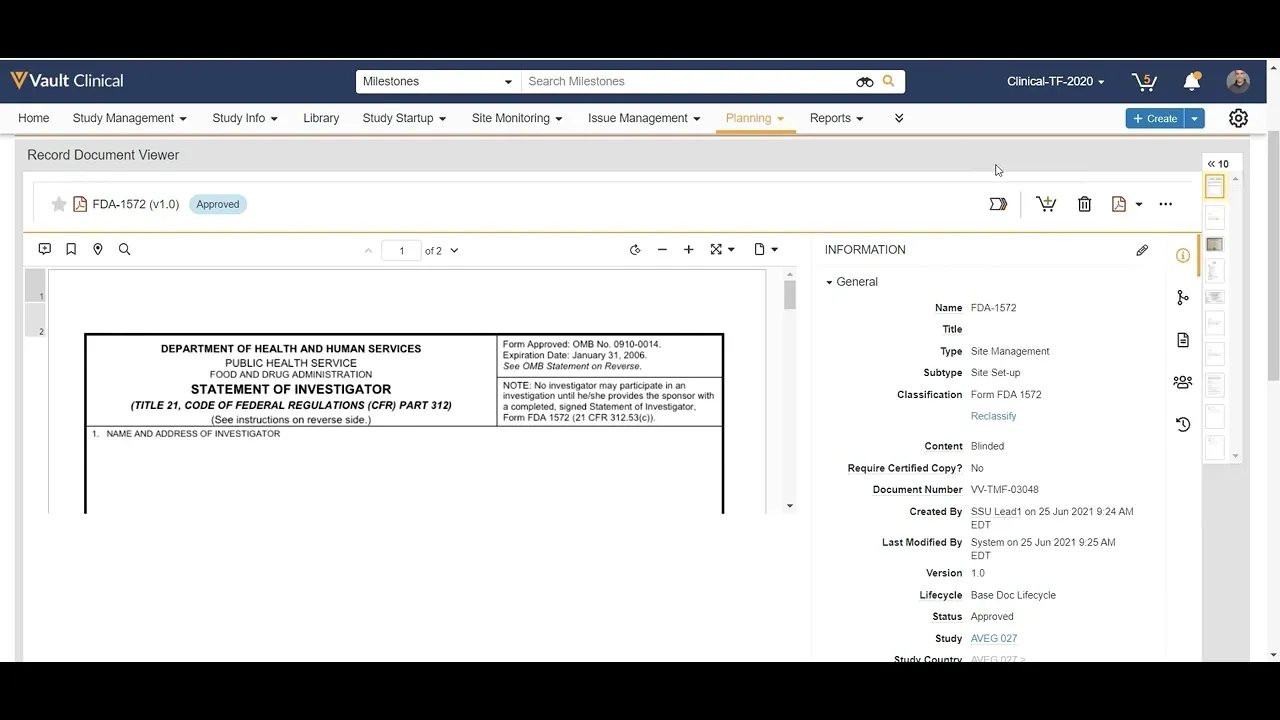
Vault Study Startup: Site Greenlight Process
Veeva Systems Inc
/@VeevaSystems
Jan 26, 2022
This video demonstrates how Veeva Vault Study Startup streamlines the complex and highly regulated process of achieving site greenlight, enabling pharmaceutical and biotech companies to move study sites from selection to regulatory approval more quickly and compliantly. The core functionality centers on the use of milestones, which serve as structured checkpoints to ensure the diligent collection, review, and approval of all necessary documentation before a site can begin clinical activities. The demonstration focuses on a specific Green Light milestone for a study site (e.g., US-105). Within the Vault system, these milestones track essential data, including planned and actual completion dates. Crucially, milestones can be configured with dependencies, meaning they cannot be completed until specific prerequisite documents are finalized and approved. The system allows for the definition of criteria that, when met, can trigger the milestone to automatically complete, enhancing efficiency and reducing manual oversight. Once the necessary criteria are satisfied, a workflow action is initiated to send the milestone for internal review, marking the transition from a "planned" status to "in internal review." Workflow automation is a key feature highlighted in the review process. When the review workflow is initiated, the system automatically assigns designated reviewers, sets a due date, and sends an email notification. This notification includes a direct link that takes the reviewer immediately into the target milestone within Vault. The reviewer’s task is to verify that all required content is complete and ready to proceed. Vault provides an intuitive interface for this verification, presenting the set of required documents as selectable thumbnails on the right side of the screen. As each thumbnail is selected, the document's content detail is displayed on the left, allowing for a focused and efficient review. If any issues are identified during this process, they can be logged directly within the system. Upon completing the content review, the reviewer navigates back to the milestone to finalize the Green Light Review task, indicating whether the review passed or failed. If the reviewer selects "failed," the system enforces compliance by requiring the user to enter a specific issue type and corresponding comments, ensuring a clear audit trail for non-compliance. The platform is highly configurable, allowing study managers to set up additional workflow steps, such as escalation and follow-up actions, to efficiently manage identified issues. Finally, study managers maintain comprehensive oversight of the entire process using integrated Vault reports and dashboards, such as the Site Green Light Status Report, which provides both tabular and graphical representations of green light progress across all sites in a study. Key Takeaways: • **Structured Milestone Management:** The Green Light process is managed through defined milestones within Vault Study Startup, which track key dates (planned vs. actual) and ensure a structured, auditable progression from site selection to regulatory approval. • **Dependency-Based Automation:** Milestones can be configured with dependencies on specific documents, ensuring that regulatory prerequisites are met before the site can advance. The system supports auto-completion based on these criteria, minimizing manual intervention. • **Automated Workflow Initiation:** Initiating the internal review process triggers automated workflow actions, including assigning reviewers, setting due dates, and sending email notifications with direct links to the required documents and milestone. • **Intuitive Content Review Interface:** Vault facilitates rapid and compliant document verification by providing an intuitive interface where required content is displayed as selectable thumbnails, allowing reviewers to efficiently view content details and log issues. • **Enforced Compliance and Audit Trails:** If a review fails, the system mandates the entry of specific issue types and detailed comments, ensuring a clear, documented audit trail necessary for GxP and regulatory compliance. • **Configurable Issue Management:** The platform supports custom workflow steps, such as escalation and follow-up actions, which can be configured to efficiently address and resolve issues identified during the green light review process. • **Real-Time Study Oversight:** Study managers gain actionable insights into the status of all sites through integrated Vault reports and dashboards (e.g., Site Green Light Status Report), allowing for graphical tracking of progress and proactive management of bottlenecks. • **Centralized Regulatory Control:** By centralizing the collection, review, and approval of highly regulated documents within a validated Veeva environment, the system significantly reduces the risk of errors and non-compliance associated with manual tracking methods. Tools/Resources Mentioned: * Veeva Vault Study Startup * Vault Reports and Dashboards Key Concepts: * **Site Greenlight Process:** The critical, highly regulated process in clinical trials where all necessary documentation (regulatory, ethical, contractual) must be collected, reviewed, and approved before a study site is authorized to begin enrolling patients. * **Milestones:** Defined checkpoints within the Vault system used to track the progress of a study site through the startup process, often linked to specific document completion requirements. * **Dependencies:** Conditions or prerequisite documents that must be completed or approved before a specific milestone can be advanced or completed.

Vault CDMS to Clinical Operations Connection
Veeva Systems Inc
/@VeevaSystems
Jan 26, 2022
This video provides an in-depth demonstration of the seamless, near-real-time data synchronization achieved through the connection between Veeva Vault CDMS (Clinical Data Management System) and Vault CTMS (Clinical Trial Management System). The primary purpose of this integration is to significantly accelerate clinical trial processes and eliminate the inefficiencies associated with manual or duplicate data entry across critical operational systems. The presentation highlights how this unified approach ensures data consistency from the initial study setup phase through ongoing monitoring and financial management. The integration begins during the study setup process, where selecting the connection option ensures that any updates made in CTMS—such as changes to metadata, lifecycle statuses, or the addition of new study sites—are immediately reflected in CDMS. This immediate synchronization allows site personnel to quickly begin working with the most current information, enabling them to create new subjects and complete visit forms promptly. Conversely, as new and updated subject data is entered into Vault CDMS, it is automatically pushed back into Vault CTMS. This bidirectional flow ensures that Clinical Research Associates (CRAs) and clinical finance teams have immediate access to the necessary data within their respective workflows. The synchronized data is leveraged extensively within CTMS for several key operational functions. CRAs benefit from up-to-the-minute enrollment dashboards and streamlined monitoring visit preparation, as all relevant subject data is apparent from a single viewpoint. Furthermore, the integration drastically simplifies the clinical finance process. Completed visits in CDMS automatically trigger the generation of payable items in CTMS based on approved fee schedules. This automation allows the clinical finance team to review and process payment requests for all sites without any manual effort required to gather transaction information, significantly improving payment cycle efficiency. A crucial feature highlighted is the ability for CRAs to perform Source Data Verification (SDV) directly from their CTMS trip report interface. CRAs have a one-click option to review subject visit forms within CDMS, where they can collect SDV activity and log subject-level protocol deviations. Once this activity is completed and recorded in the CDMS Vault, the resulting data is instantaneously reflected back in CTMS. This immediate transfer ensures that the SDV status and deviation details are available for inclusion in the CRA’s in-progress trip report, maintaining a continuous and accurate audit trail and allowing users to focus on their core roles rather than data reconciliation. Key Takeaways: • **Elimination of Duplicate Data Entry:** The core benefit of the CDMS-CTMS connection is the automatic, near-real-time transfer of critical study and subject data, which eliminates the need for users in both systems to manually input or reconcile the same information, significantly reducing human error and operational lag. • **Accelerated Study Setup and Site Activation:** Updates to study metadata, lifecycle statuses, and the addition of new sites in CTMS are instantly reflected in CDMS, allowing sites to begin subject enrollment and data entry much faster than traditional, disconnected systems allow. • **Enhanced Clinical Monitoring Efficiency:** CRAs gain a unified view of necessary data from their CTMS homepage, including subject data entered in CDMS, enabling them to move seamlessly into monitoring visits with all required information readily available. • **Streamlined Source Data Verification (SDV):** The integration provides a one-click pathway for CRAs to access and review subject visit forms directly in CDMS from their CTMS monitoring trip report, facilitating efficient SDV activity and the immediate logging of protocol deviations. • **Instantaneous Trip Report Updates:** SDV activity and protocol deviations recorded in CDMS are nearly immediately reflected in the CRA’s in-progress CTMS trip report, ensuring that monitoring documentation is current and accurate without manual data transfer delays. • **Automated Clinical Financial Management:** Completed visits documented in CDMS automatically trigger the generation of payable items in CTMS, based on pre-approved fee schedules, allowing the clinical finance team to generate payment requests for all sites with zero effort needed for transaction information gathering. • **Improved Data Consistency and Compliance:** By ensuring that study build-out and subject enrollment data are synchronized across both the data capture (CDMS) and operational management (CTMS) systems, the integration supports better data quality and a more robust, auditable compliance posture. • **Focus on Role-Specific Tasks:** The automation of data transfer and reconciliation allows clinical operations personnel, CRAs, and clinical finance teams to dedicate their time to high-value, role-specific tasks rather than managing data movement and verification. Tools/Resources Mentioned: * Vault CDMS (Clinical Data Management System) * Vault CTMS (Clinical Trial Management System) * Vault EDC (Electronic Data Capture) Key Concepts: * **Source Data Verification (SDV):** The process of ensuring that data recorded in the Case Report Form (CRF) or EDC matches the original source documents (e.g., patient charts). The video highlights how the integration streamlines the recording of SDV activity. * **Payable Items Generation:** The automated process within CTMS where completed subject visits, as recorded in CDMS, trigger financial transactions based on pre-set site fee schedules, facilitating timely site payments. * **Clinical Research Associate (CRA):** The personnel responsible for monitoring clinical trials, ensuring compliance, and verifying data quality at investigator sites. The integration provides CRAs with immediate access to subject data and SDV tools.

TMF Transfer
Veeva Systems Inc
/@VeevaSystems
Jan 26, 2022
This video provides a detailed demonstration of the Trial Master File (TMF) Transfer functionality within Veeva Vault eTMF, designed to streamline the movement of critical clinical documents between organizational structures, typically from a Contract Research Organization (CRO) to a Sponsor. The core purpose of this feature is to establish a simple, continuous connection between two separate Vault eTMF instances, thereby eliminating the need for costly, time-consuming, and often complex end-of-study migrations. This simple "push" mechanism significantly enhances collaboration and ensures that both parties remain continuously inspection-ready throughout the trial lifecycle. The process begins with the originating organization (e.g., the CRO) generating an "agreement task" within their Vault eTMF. This agreement is crucial as it formally defines the scope of the transfer, specifying which vaults are connecting and precisely which records are in scope to be sent over. Once the CRO user initiates the transfer by sending the agreement task to the sponsor, the sponsor team receives the request in their own Vault eTMF. The sponsor then reviews the agreement, approves the defined scope, and links the connection to the corresponding study within their system. The demonstration highlights that the scope can be highly granular, allowing for the transfer of finalized content, as well as updated information for study, country, and site records, ensuring data consistency across both organizations. Once the agreement is approved and the connection is established, the CRO can initiate the TMF transfer action at any point during the trial, not just at the conclusion. As the CRO generates new records and files documentation within their TMF structure, selecting the transfer action sends all records falling under the agreed scope directly to the sponsor’s Vault. The key operational benefit demonstrated is the automatic filing of the CRO’s efforts within the sponsor’s TMF structure. This eliminates the need for manual mapping between the two vaults, a common source of error and delay in traditional migration processes. The result is that the sponsor’s eTMF is populated with accurate, current study information and finalized content, ensuring continuous compliance and preparedness for regulatory inspections without the typical administrative burden associated with data handover. Key Takeaways: • **Elimination of End-of-Study Migration:** The TMF Transfer feature replaces traditional, costly, and time-consuming end-of-study migrations by establishing a continuous, simple connection between two Veeva Vault eTMF systems. • **Continuous Inspection Readiness:** By allowing documents to be transferred throughout the trial, both the CRO and the Sponsor maintain up-to-date and complete Trial Master Files, ensuring continuous inspection readiness. • **Streamlined Collaboration Mechanism:** Collaboration is formalized through an "agreement task" generated by the sending organization (e.g., CRO) and approved by the receiving organization (e.g., Sponsor), defining the parameters of the data exchange. • **Granular Scope Definition:** The agreement allows for precise definition of the transfer scope, enabling organizations to specify whether they are transferring only finalized content or also updated information for study, country, and site records. • **Vault-to-Vault Connection:** The functionality is based on a direct connection between two separate Vault eTMF instances, simplifying the technical infrastructure required for data exchange. • **Actionable Transfer at Any Point:** The transfer action is not restricted to the conclusion of the study; it can be selected and executed at any point throughout the trial lifecycle, facilitating ongoing data synchronization. • **Automatic Filing and Zero Mapping:** A critical advantage is that the transferred content is filed appropriately within the receiving organization's TMF structure automatically, eliminating the need for manual mapping or complex configuration between the two vaults. • **Focus on Finalized Content:** The demonstration emphasizes that the transfer is typically used to bring over finalized content, ensuring that the sponsor receives verified and completed documentation from the CRO’s efforts. Tools/Resources Mentioned: * Veeva Vault eTMF (Electronic Trial Master File) * Veeva Vault Products Key Concepts: * **TMF (Trial Master File):** The essential collection of documents that individually and collectively permit the reconstruction of the conduct of a clinical trial and the evaluation of the quality of the data produced. Maintaining an accurate TMF is a regulatory requirement (GxP). * **eTMF (Electronic Trial Master File):** A digital system, such as Veeva Vault, used to manage and store TMF documents. * **TMF Transfer:** A specific Veeva functionality that enables the secure and compliant transfer of TMF documents and associated metadata between two separate Veeva Vault eTMF instances (e.g., between a CRO and a sponsor). * **CRO (Contract Research Organization):** An organization that provides support to the pharmaceutical, biotechnology, and medical device industries in the form of outsourced research services. * **Sponsor:** The individual, company, institution, or organization that takes responsibility for the initiation, management, and/or financing of a clinical trial.
The Regulatory Focus on Operational Risk
Second Line Advisors
/@secondlineadvisors4588
Jan 26, 2022
This video provides an in-depth analysis of the factors driving the heightened regulatory focus on operational risk across highly regulated sectors. The speaker, a former Chief Operational Risk Officer, establishes the context by demonstrating that operational failures are the primary source of regulatory action and financial penalties, necessitating a fundamental shift in how organizations approach governance and control. The central argument is grounded in empirical evidence, noting that historically, operational risk has been the underlying factor in a substantial portion of regulatory enforcement actions. Specifically, the speaker cites that over 40% of all Matters Requiring Attention (MREs) tracked by regulatory bodies can be traced directly back to operational risk failures. This pattern, coupled with high-profile negative headlines—such as major fines, settlements, and systemic errors—has made operational risk the dominant concern for regulators. The complexity of modern enterprise operations further intensifies this focus. As companies in regulated industries scale, they become increasingly reliant on sophisticated technology (including AI and custom software) and extensive networks of third-party vendors. This reliance introduces new vectors for operational failure, requiring regulators to demand a more intense focus on risk management. The core expectation is that organizations must not only understand their operational risks but also actively embed sound controls, robust monitoring, and transparent reporting mechanisms directly into their core business processes and governance structures. The discussion culminates in the introduction of "operational resilience" as the evolution of operational risk management. Operational resilience is defined as the organization’s ability to maintain critical operations under both normal and stressful conditions. This concept moves beyond merely identifying potential risks to actively ensuring the continuity and integrity of essential functions—a critical consideration for life sciences companies dealing with GxP data, clinical trials, and patient safety. For technology providers like IntuitionLabs, this means ensuring that all AI, data engineering, and CRM solutions are designed inherently for continuity, compliance, and stress tolerance. Key Takeaways: * **Operational Risk as the Primary Regulatory Driver:** Historical data shows that operational risk is the root cause of a significant majority of regulatory failures, with over 40% of tracked MREs being tied back to operational deficiencies, demanding that life sciences firms prioritize operational integrity over other risk domains. * **The Mandate for Embedded Controls:** Regulators are shifting expectations, requiring that sound controls, continuous monitoring, and transparent reporting are not external compliance layers but are deeply embedded into the daily business processes and governance frameworks of the organization. * **Technology and Third-Party Risk Amplification:** The increasing reliance on complex technology (e.g., LLMs, custom software) and external vendors (CROs, data providers) multiplies operational risk, necessitating stringent vendor management and robust validation of all integrated systems. * **Operational Resilience is the New Standard:** The focus is moving beyond static risk identification to dynamic operational resilience, requiring organizations to prove their ability to maintain critical functions (such as clinical data management or commercial reporting) under high-stress scenarios, including system failures or cyber incidents. * **Governance Must Scale with Complexity:** As AI and data engineering solutions increase operational complexity, governance structures must evolve to ensure that new technologies are deployed with clear accountability, audit trails, and risk mitigation strategies tailored to the specific technology (e.g., managing AI model drift). * **High-Profile Failures Set the Tone:** While the examples cited relate to banking (trading errors, fines), the principle holds true in the pharmaceutical sector: major compliance breaches, data integrity failures, or adverse event reporting lapses drive immediate and intense regulatory scrutiny across the entire industry. * **Proactive Risk Understanding is Essential:** Regulators are focused on how well organizations *understand* their operational risks, requiring continuous assessment and real-time reporting rather than relying on periodic, static risk assessments. * **Designing for Stress Tolerance:** Operational resilience requires designing systems and processes that can withstand "stressful conditions," meaning technology solutions must incorporate robust failover mechanisms, data recovery plans, and validated compliance pathways to ensure continuity during disruptions. * **Applicability to Regulated Software:** For firms developing bespoke software and AI solutions for pharma, this analysis underscores the necessity of building GxP and 21 CFR Part 11 compliance directly into the architecture to mitigate the operational risk associated with data handling and system validation. Key Concepts: * **Operational Risk:** The risk of loss resulting from inadequate or failed internal processes, people, and systems, or from external events. In the life sciences context, this includes errors in clinical data management, compliance failures in commercial operations, and system outages affecting validated environments. * **Matters Requiring Attention (MREs):** Formal directives or findings issued by regulatory bodies (like the OCC, or analogous findings by the FDA/EMA) indicating deficiencies that must be addressed by the organization. * **Operational Resilience:** The ability of an organization to prevent, absorb, and recover from operational disruptions while maintaining the delivery of its essential services. This is a critical extension of traditional operational risk management.

Vault Study Startup Country Intelligence
Veeva Systems Inc
/@VeevaSystems
Jan 26, 2022
This video provides an in-depth demonstration of how Veeva Vault Study Startup (SSU) addresses the complexity of maintaining accurate regulatory intelligence and standardizing clinical trial initiation processes across diverse global regions. The core problem addressed is the inefficiency and error-proneness associated with managing country-specific regulatory requirements and essential document tracking using traditional methods like spreadsheets. Vault Study Startup offers a standardized, centralized approach by managing two key aspects of country intelligence: required content (documents) and workflow processes (milestone sequencing). The platform standardizes the required content by automatically adjusting the list of essential documents needed to complete a specific milestone based on the country where the site is located. For instance, the documents required for the "Essential Documents" milestone at a US site will differ from those required at a site in another country, reflecting local regulatory mandates. This automated differentiation eliminates the need for manual tracking and ensures that study teams are always working with the correct, country-specific documentation requirements. Beyond document tracking, the system tracks key dates, including planned and actual finish dates for each milestone, providing robust project management capabilities for clinical trial initiation. The second critical component is the management of country-specific workflow processes, which dictates the sequence of milestones required for site activation. The video illustrates this using a comparison between the United Kingdom and Poland. In the UK, the "Ethics Approval" milestone can immediately follow the "Site Selected" milestone. However, in Poland, the regulatory sequence is different: a fully executed contract must be in place *prior* to seeking ethics approval. Vault SSU manages this by utilizing milestone sequencing logic. For the Polish site, the "Ethics Approval" milestone is hidden from the immediate next steps after site selection; instead, it appears only after the "Financial Documents" milestone (which includes contract execution) has been completed. This automated sequencing ensures regulatory adherence by enforcing the correct order of operations specific to each country's legal framework. This country intelligence—encompassing both document requirements and workflow sequencing—is maintained and managed at a template level within Veeva Vault. These robust templates serve as a standardized starting point for startup and regulatory teams, which can then be reviewed, updated, and maintained by the client teams on an ongoing basis. Furthermore, Veeva actively updates the underlying country intelligence data whenever regulations change, providing SSU customers with access to the latest regulatory requirements, significantly reducing the burden of manual regulatory monitoring and ensuring continuous compliance throughout the study startup phase. Key Takeaways: • **Centralized Regulatory Intelligence:** Veeva Vault Study Startup eliminates the reliance on error-prone spreadsheets for tracking country-specific regulatory requirements by centralizing required content and workflow logic within the platform. • **Automated Document Requirements:** The system dynamically adjusts the list of required essential documents for specific milestones based on the site's country, ensuring compliance with local regulations (e.g., US site requirements differ from other countries). • **Milestone Sequencing for Compliance:** Vault SSU uses sophisticated milestone sequencing logic to enforce country-specific regulatory processes, ensuring that steps are completed in the correct legal order. • **Example of Workflow Differentiation:** The platform demonstrates its intelligence by enforcing different sequences for ethics approval; in the UK, ethics approval follows site selection, but in Poland, a fully executed contract must precede ethics approval. • **Tracking Key Dates:** The system tracks both planned and actual finish dates for all milestones, providing essential data for project management, forecasting, and identifying potential bottlenecks in the study startup process. • **Template-Based Standardization:** Country intelligence data, including document and workflow sequencing requirements, is managed at a template level, offering a robust, standardized starting point that client teams can customize and maintain. • **Veeva-Maintained Regulatory Updates:** A significant value proposition is that Veeva updates the underlying country intelligence data as regulations change globally, allowing SSU customers to access the latest regulatory mandates without extensive manual monitoring. • **Focus on Site Activation:** The entire system is geared toward streamlining the path to site activation by providing clear, compliant, and sequential steps that regulatory and startup teams must follow. Tools/Resources Mentioned: * Veeva Vault Study Startup (SSU) Key Concepts: * **Country Intelligence:** The automated management of country-specific regulatory requirements, essential document lists, and workflow sequencing necessary for clinical trial initiation. * **Milestone Sequencing:** The structural linking of milestones within a process to enforce a specific, required order of completion, ensuring regulatory adherence based on local laws (e.g., contract before ethics approval). * **Site Activation:** The final stage of study startup where a clinical site is authorized and ready to begin screening and enrolling patients.

Maximize Your Resources with Integrated Roster Management
Veeva Systems Inc
@VeevaSystems
Jan 25, 2022
The video, produced by Veeva Systems, focuses on the critical role of integrated Roster Management within Veeva Align to optimize pharmaceutical commercial operations and ensure continuous field coverage. The presentation begins by quantifying the significant operational challenge posed by field force turnover, noting that approximately 37,000 territories globally are left vacant annually due to resignations, transfers, or sick leaves. This lack of coverage directly translates into lost revenue, customer disengagement, and inefficient resource utilization. Veeva Align’s built-in Roster Management capability is presented as the solution designed to manage these changes dynamically and substantially reduce the ramp-up time required for new or transferred representatives. The core functionality revolves around a centralized dashboard tailored for commercial operations teams. This dashboard provides an immediate, comprehensive overview of the field force status, displaying both assigned and vacant territories within a region, alongside a list of unassigned field users (such as new hires). This centralization eliminates the need for commercial operations to reconcile data across multiple systems. From this single dashboard, teams can access detailed reports and representative profiles, enabling swift administrative action. The system is designed to facilitate the rapid setup of new hires or the transfer of permissions from existing representatives, thereby maintaining maximum coverage and reach. A key differentiator highlighted is the system’s ability to integrate seamlessly with existing HR systems, allowing commercial operations teams to easily import and update necessary profile information, including start and end dates. Crucially, Veeva Align leverages a robust rules engine to automate the complex process of provisioning. This engine automatically assigns territory roles, system permissions, and product access at both the individual user and team levels. By automating these assignments, the system avoids manual input errors in the CRM, ensuring consistency and compliance. The final step in the process is the ability to push all these automated updates to Veeva CRM in a single click, ensuring that field representatives are fully provisioned and ready to engage with customers from their very first day, enabling agile management of both the field force and digital channels. Key Takeaways: * **Mitigation of Vacancy Risks:** The video emphasizes that integrated roster management is essential for mitigating the risks associated with territory vacancies, which globally affect an estimated 37,000 territories annually, leading to significant revenue loss and customer disengagement. * **Accelerated Representative Readiness:** The primary operational benefit is the drastic reduction in representative ramp-up time, ensuring that new hires or transferred reps are provisioned and ready to engage customers immediately upon joining their territory. * **Centralized Operational Visibility:** Commercial operations teams gain a unified dashboard view showing the status of all territories (assigned vs. vacant) and the availability of unassigned field users, simplifying resource allocation decisions. * **Data Integration with HR Systems:** Veeva Align facilitates easy import and updating of representative data from existing HR systems, which ensures data accuracy and consistency across the enterprise and the CRM platform. * **Automation via Rules Engine:** The platform utilizes a powerful rules engine to automate the assignment of complex, multi-layered attributes, including territory roles, system permissions, and product assignments, eliminating manual configuration errors. * **Compliance and Consistency:** By automating assignments through predefined rules, the solution helps ensure that all representatives adhere to the correct operational parameters and regulatory requirements (like access controls) without manual oversight. * **Single-Click Deployment to CRM:** The system allows for the immediate deployment of all roster and alignment updates to Veeva CRM in a single action, which is crucial for maintaining operational speed and agility in a dynamic commercial environment. * **Focus on Commercial Agility:** The overall framework supports an agile approach to field force management, allowing pharmaceutical companies to respond rapidly to organizational changes, market shifts, and personnel movements. Tools/Resources Mentioned: * **Veeva Align:** The platform providing the integrated Roster Management and rules engine capabilities. * **Veeva CRM:** The core system receiving the automated field force updates, ensuring representatives are operational in the field. * **HR System:** The source system for representative profile data used for initial setup and updates. Key Concepts: * **Roster Management:** The systematic process of managing the assignment, transfer, and termination of field personnel to ensure optimal territory coverage and resource deployment. * **Ramp-Up Time:** The period required for a new employee to reach full productivity; minimizing this time is a core goal of the integrated roster management solution. * **Rules Engine:** An automated component that processes business logic (rules) to determine and apply appropriate territory assignments, permissions, and roles based on input data, ensuring consistency and reducing manual effort.

Leveraging Your Veeva Vault Investment
Daelight Solutions
/@daelightsolutions2128
Jan 24, 2022
This video provides an in-depth exploration of maximizing investment in Veeva Vault, a critical platform for life sciences companies. Presented by Daelight Solutions, an IT consulting company specializing in life sciences, the webinar focuses on the technical and business considerations required when adding new functional capabilities, applications, or integrating systems within an existing Veeva Vault environment. The speakers, Dan Wheeler (Founder and CEO) and Terry Montez (Clinical Practice Lead), share their expertise and real-world insights, emphasizing that the "go-live" of a Veeva Vault implementation is merely the beginning of an ongoing journey that requires strategic planning and disciplined management. The presentation begins by outlining the typical customer journey with Veeva Vault, from initial planning and design through configuration, build, testing, and eventual go-live. It then transitions to highlight the continuous nature of managing a Veeva Vault investment, which includes navigating three annual releases, user-specific enhancements, shifts in business direction (e.g., acquisitions, insourcing TMF), future integrations, and the expansion into additional Veeva Vault suites or applications. To manage this inherent complexity, the speakers introduce a robust framework centered on roadmaps, change management, and solution governance, stressing that proactive planning is paramount to avoid chaos and ensure long-term success. The core of the webinar delves into practical examples and case studies from Daelight Solutions' client engagements. These examples illustrate common challenges and best practices when expanding Veeva Vault usage, such as adding Study Startup (SSU) or Clinical Trial Management System (CTMS) to an existing eTMF Vault, integrating Registrations into a Submissions Vault, deploying new Vault suites (Clinical, Quality, Regulatory) simultaneously, and leveraging advanced features like SiteConnect. Each case study provides specific details on issues encountered—like data model inconsistencies, legacy data migration complexities, global directory duplications, and the need for cross-functional alignment—along with actionable recommendations for overcoming them, underscoring the critical role of data governance and early stakeholder collaboration. Key Takeaways: * **Go-Live is Just the Beginning:** A Veeva Vault implementation's go-live marks the start of a continuous journey involving annual releases, user enhancements, business shifts (e.g., acquisitions, insourcing TMF), and potential future integrations or expansions into additional Vault suites and applications. * **Robust Roadmaps are Essential:** Develop a comprehensive roadmap aligned with company strategies and objectives, securing buy-in from executive sponsors and cross-functional leads. This roadmap must include realistic timelines, budgets, and a strong focus on change management, training, and communication to ensure widespread adoption. * **Disciplined Change Management:** Implement a formal release management plan that clearly defines roles and responsibilities for IT, business, validation, and quality partners. Utilize a Change Advisory Board (CAB) to prioritize changes, assess the impact of Veeva releases, and strategically defer requests if out-of-the-box functionality is imminent, aiming to keep solutions as standard as possible. * **Strong Solution and Data Governance:** Establish robust solution governance to ensure compliance with industry regulations (FDA, EMA, GxP, 21 CFR Part 11) and best practices. Crucially, implement data governance (people, process, technology) to define naming conventions, manage master data (e.g., organizations, personnel), and maintain consistency across all Vaults, especially for shared data. * **Early Planning Prevents Rework:** When adding new applications (e.g., SSU to eTMF), engage all stakeholders and conduct thorough analysis *before* configuration. This includes re-evaluating TMF index, milestone sets, and EDLs to build a foundational structure that accommodates future functionality and avoids costly rework. * **Thorough Data Model Analysis for Integrations:** For applications with distinct data models (e.g., product-based Registrations versus submission-based Submissions), perform in-depth data model analysis upfront. Understand how new data structures will expand and impact existing models, and address legacy data integrity issues at the source prior to migration. * **Engage Experts for Complex Processes:** When business processes or data usage are unclear, particularly for complex systems like Registrations, engage experts (e.g., from Veeva) to understand downstream data utilization. This insight helps inform configuration decisions and ensures the system meets long-term business needs. * **Test with Diverse Scenarios:** Before full rollout, manually test new configurations by adding a few diverse product types or scenarios. This iterative testing helps work out kinks, validate data organization, and ensures the system functions as expected across various use cases. * **Cross-Suite Standard Alignment:** When deploying multiple Vault suites (e.g., Clinical, Quality, Regulatory), dedicate significant effort to aligning on support processes, data sharing standards, SOP updates, and standard terminology across all domains from the outset. Early and continuous participation from all affected groups is critical. * **Centralize Vault Management:** To minimize confusion and service impact, centralize the management of all Veeva Vaults, including terminology, naming conventions, object relationships, and communication standards. This provides a consistent framework for IT support and users, even if initial naming choices were suboptimal. * **Strategic SiteConnect Implementation:** For SiteConnect, define clear business decisions regarding document flow (site to sponsor, sponsor to site), internal connectivity for regulatory/safety documents, and document packages to be shared. Adapt internal processes (e.g., site connection states) and SOPs to accommodate a hybrid environment of sites using and not using SiteVault. * **Anticipate Global Directory and User Provisioning Impacts:** Integrating external systems like SiteConnect significantly impacts global directory structures (e.g., shifting from hospital names to department-specific organizations, incorporating USN numbers) and user provisioning processes, requiring data reformatting and new rules. * **Leverage Cloud Platform for Third-Party Exchange:** For exchanging data with third parties not using specific Veeva connectors, consider leveraging underlying cloud platform capabilities (e.g., AWS Lambda and S3 storage) to automate data ingestion, transform data into Vault-loader-ready formats, and streamline the transfer process. * **Consider Veeva Platform Vault for Non-GxP Documents:** For managing documents that don't fit neatly into existing development cloud vaults (e.g., legal contracts, budgets), explore Veeva's platform vault offering. This can provide a single platform and consistent user experience for both GxP and non-GxP content, but should be discussed with Veeva account managers. **Tools/Resources Mentioned:** * Veeva Vault (general platform) * Veeva CRM * Veeva Clinical (eTMF, CTMS, SSU, SiteConnect, MyVeeva Patient application) * Veeva Regulatory (Submissions, Registrations) * Veeva Quality (QualityDocs, QMS) * Veeva PromoMats * Amazon Web Services (AWS) functionality: Lambda, S3 storage * Vault Loader **Key Concepts:** * **Veeva Vault:** A cloud-based content and data management platform specifically designed for the life sciences industry, offering various suites and applications. * **eTMF (electronic Trial Master File):** A digital system for managing essential clinical trial documents, ensuring compliance and audit readiness. * **SSU (Study Startup):** The phase of clinical trials involving all activities required to initiate a study, including site selection, contract negotiation, and regulatory approvals. * **CTMS (Clinical Trial Management System):** Software used to manage and track various aspects of clinical trials, including participant enrollment, site performance, and study progress. * **Registrations:** The process of tracking and managing product registrations with regulatory authorities worldwide. * **Submissions:** The process of preparing and submitting regulatory documents (e.g., eCTD) to health authorities. * **SiteConnect:** A Veeva solution that facilitates the secure exchange of documents and data between sponsor Veeva Vaults and investigator SiteVaults. * **Global Directory:** A centralized repository within Veeva Vault for managing information about organizations, sites, and personnel, crucial for consistent data across applications. * **Country Intelligence:** A feature within Veeva Vault that provides guidance and control for managing country-specific regulatory requirements and document collections. * **Master Data Management (MDM):** A comprehensive method for defining and managing an organization's critical non-transactional data to provide a single point of reference. * **Change Advisory Board (CAB):** A formal group responsible for reviewing, evaluating, authorizing, and prioritizing changes to IT services and infrastructure, including Veeva Vault configurations and releases. * **GxP, 21 CFR Part 11, FDA, EMA:** Regulatory standards and authorities relevant to pharmaceutical and life sciences industries, emphasizing good practices (GxP), electronic records and signatures (21 CFR Part 11), and oversight by the Food and Drug Administration (FDA) and European Medicines Agency (EMA).

Cost of Medication Non-Adherence: 33- 69% of Hospitalizations
AHealthcareZ - Healthcare Finance Explained
@ahealthcarez
Jan 22, 2022
This video provides an in-depth exploration of the critical and often underestimated problem of medication non-adherence in healthcare, highlighting its profound impact on patient outcomes and healthcare costs. Dr. Eric Bricker, the speaker, challenges the common assumption that patients consistently take their prescribed medications, revealing a significant breakdown in the adherence process. He systematically presents compelling statistics from the CDC to underscore the magnitude of this issue, demonstrating how non-adherence leads to a substantial portion of hospitalizations and imposes a massive financial burden on health plans and employers. The presentation details the lifecycle of a prescription, illustrating how adherence rates drastically decline at each stage. Out of every 100 prescriptions written, only 50-70% are filled, 48-66% are picked up, a mere 25-30% are taken correctly, and only 15-20% are correctly refilled. This cumulative failure results in approximately 50% of patients being non-adherent at any given time. Dr. Bricker emphasizes that this hidden problem is not just a medical issue but a significant financial drain, directly impacting the efficacy of treatments and the overall health of a population. A core focus of the video is quantifying the financial ramifications of non-adherence, particularly for employer-sponsored health plans. Dr. Bricker calculates that 33-69% of all hospitalizations are attributable to medication non-adherence, which translates to roughly 16% of a health plan's total annual costs. Using a hypothetical 1,000-employee plan with $10 million in annual healthcare costs, he demonstrates that $1.6 million is wasted due to non-adherence, equating to $133 per employee per month across the entire plan, or a staggering $323 per non-adherent employee per month. This detailed financial breakdown serves to highlight the urgent need for effective interventions. Finally, the video delves into the primary reasons for non-adherence, revealing surprising insights. Contrary to popular belief, cost is not the leading factor. The top reasons cited by patients are forgetting (42%), running out of medication (37%), and being away from home/medication (27%), with cost ranking fourth at 22%. This crucial distinction reframes the problem, shifting the focus from financial barriers to behavioral and logistical challenges. Dr. Bricker concludes by asserting that medication non-adherence is a solvable problem, advocating for reminder interventions such as phone calls, text messages, and in-person or virtual appointments, which have been proven to significantly increase adherence rates. Key Takeaways: * **Pervasive Non-Adherence:** A staggering 50% of patients are non-adherent to their prescribed medications at any given point in time, indicating a widespread and critical healthcare challenge. * **Major Cause of Hospitalizations:** Medication non-adherence is a primary driver of hospital admissions, accounting for 33% to 69% of all hospitalizations, underscoring its severe impact on patient health and healthcare system strain. * **Breakdown in Prescription Process:** The journey from prescription to correct usage is fraught with failure points; only 50-70% of prescriptions are filled, 48-66% are picked up, 25-30% are taken correctly, and a mere 15-20% are refilled correctly. * **Significant Financial Burden:** Medication non-adherence contributes to approximately 16% of an employer's total health plan costs, representing a substantial financial drain that often goes unrecognized. * **Quantifiable Employer Costs:** For a hypothetical 1,000-employee health plan spending $10 million annually, non-adherence accounts for $1.6 million in wasted costs, or $133 per employee per month across the plan. * **High Cost Per Non-Adherent Individual:** The financial impact is even more concentrated on individuals, with each non-adherent employee costing their plan nearly $4,000 per year, or $323 per month. * **Primary Reasons Are Not Cost-Related:** The leading causes of non-adherence are behavioral and logistical: forgetting (42%), running out of medication (37%), and being away from home (27%), with cost being a less frequent reason (22%). * **Medication Efficacy Depends on Adherence:** Medications are scientifically proven effective only when taken correctly, as demonstrated in clinical trials; non-adherence negates their intended therapeutic benefits. * **Hidden Problem:** Non-adherence is an "unseen problem" in healthcare, as there are no immediate indicators for employers or providers, yet its consequences are profound and costly. * **Solvable Through Interventions:** Medication non-adherence is a solvable problem, with reminder interventions (e.g., phone calls, text messages, in-person/virtual appointments) proven to significantly increase adherence rates. * **Challenge Assumptions:** Healthcare stakeholders, especially employers, should not assume patients are taking their medications correctly but rather assume the opposite, given the high rates of non-adherence. * **Focus on Behavioral Solutions:** Interventions should prioritize addressing the top reasons for non-adherence—forgetting, running out, and being away from home—rather than solely focusing on cost. Tools/Resources Mentioned: * **CDC (Centers for Disease Control and Prevention):** The primary source for the statistics and data presented in the video, specifically referencing a CDC Grand Rounds video. Key Concepts: * **Medication Non-Adherence:** The failure of patients to take their medications as prescribed by their healthcare providers, encompassing not filling prescriptions, not taking them correctly, or not refilling them. * **Adherence Rates:** The percentage of patients who consistently follow their prescribed medication regimen. * **PEPPM (Per Employee Per Month):** A common metric used in healthcare finance to express costs on a per-employee, per-month basis. Examples/Case Studies: * **Hypothetical 1,000-Employee Health Plan:** Dr. Bricker uses a scenario of a 1,000-employee health plan with $10 million in annual healthcare costs to illustrate the financial impact, calculating that $1.6 million (16%) is attributable to hospitalizations caused by medication non-adherence. This breaks down to $1,600 per employee per year or $133 per employee per month across the entire plan, and $3,874 per year or $323 per month for each of the 413 non-adherent employees within that plan.
Veeva Systems: Case Study in Converting to a Public Benefit Corporation
UC Berkeley School of Law
/@UCBerkeleySchoolofLaw
Jan 20, 2022
This video provides an in-depth exploration of Veeva Systems' groundbreaking conversion to a Public Benefit Corporation (PBC) in January 2021, making it the first public company to do so with 99% shareholder support. The content serves as an accompaniment to a Berkeley Law Executive Education case study, delving behind the scenes of this significant corporate governance shift. The discussion features insights from Veeva's founder, who shares personal anecdotes and the philosophical underpinnings of the decision, alongside expert commentary on the legal and economic implications of the PBC structure. The core of the video centers on the evolution of corporate responsibility from traditional shareholder primacy to a more expansive stakeholder-centric model. Veeva's founder recounts his early experiences in a small family business, where taking care of customers and the community was paramount due to the lack of an external safety net, contrasting this with the overly simplistic "make money for shareholders and don't do anything illegal" mandate of traditional corporate charters. The concept of a PBC is introduced as an innovative legal framework that allows a company's board to explicitly balance the interests of various stakeholders—including employees, customers, the community, and the environment—with those of shareholders, even when trade-offs are involved. The video emphasizes that formalizing a company's social purpose and values in its articles of incorporation, as a PBC does, serves multiple critical functions. It provides a clearer communication mechanism for a growing workforce and customer base, sets a legal obligation for future leadership, and ensures the company's ethos remains consistent over decades. The conversion process at Veeva involved extensive internal discussions, including a pivotal hike with the chairman of the board, and careful communication with investors. Surprisingly, investors were not skeptical once the rationale was thoroughly explained, recognizing the long-term benefits of a company that is clear about its social purpose and committed to ethical governance. The benefits of this shift, as articulated in the video, extend beyond mere ethical considerations to tangible business advantages. Companies with a clear social purpose are better equipped to manage stakeholder expectations, align business strategy with corporate purpose, secure a durable social license to operate, communicate more authentically, and proactively flag risks. For Veeva, the PBC status has already yielded positives such as attracting employees aligned with its values, deepening customer relationships, and significantly increasing the source of innovative ideas by prompting consideration of value-aligned initiatives alongside business growth. The video concludes by highlighting that while a PBC is a powerful mechanism, the fundamental principle is clear social purpose, accountability, and reporting, which can also be pursued within traditional corporate forms, especially as shareholders increasingly advocate for stakeholder focus. Key Takeaways: * **Pioneering Corporate Governance:** Veeva Systems became the first public company to convert to a Public Benefit Corporation (PBC) in January 2021, with overwhelming support (99%) from its voting shareholders, setting a precedent for publicly traded entities. * **Redefining Corporate Purpose:** A PBC legally mandates that a company's board of directors can balance the interests of all stakeholders (employees, customers, community, environment) with those of shareholders, moving beyond the sole focus on shareholder primacy inherent in traditional corporate structures. * **Formalizing Values for Longevity:** Converting to a PBC allows a company to formalize its values and social purpose within its articles of incorporation, ensuring that these principles are legally binding and communicated clearly to employees, customers, and future leadership, fostering long-term consistency. * **Strategic Communication and Risk Management:** Companies with a clear social purpose, like PBCs, are better positioned to manage stakeholder expectations, align business strategies, build a strong social license to operate, communicate authentically, and effectively identify and mitigate risks. * **Shareholder Alignment with Stakeholder Focus:** Counter-intuitively, many investors are not skeptical of the PBC model; when properly explained, they recognize that a strong commitment to social purpose and stakeholder well-being can lead to long-term economic sustainability and reduced risk. * **Enhanced Attractiveness for Talent and Customers:** Veeva experienced tangible benefits, including attracting employees who are aligned with the company's values and deepening relationships with customers, which are crucial for sustained growth and market leadership. * **Innovation Through Values:** The PBC framework has broadened Veeva's source of ideas, encouraging the pursuit of initiatives aligned with its values, which are then cross-referenced with business objectives, fostering a more holistic approach to innovation. * **Complexity of Balancing Interests:** While beneficial, balancing the diverse interests of multiple stakeholders presents new and unprecedented challenges for management and boards compared to the simpler focus on shareholder primacy, requiring more information gathering and trust-building. * **Internal Ethos is Crucial:** For a PBC to be effective, its charter must genuinely align with the company's internal ethos and way of working; imposing a charter externally without internal buy-in can lead to operational issues. * **Formalized Stakeholder Communication:** The PBC structure formalizes communication channels with stakeholders, breaking down corporate silos and providing boards with a wider array of viewpoints and information essential for making informed decisions. * **Accountable Reporting:** PBCs are required to report on their pursuit of their public benefit purpose, emphasizing accountability over mere positive optics, with the understanding that this will be an iterative process requiring shareholder feedback. * **Broader Definition of Social Purpose:** The video expands the definition of "social purpose" beyond merely avoiding negative externalities (like pollution or discrimination) to include a company's broader obligations to society, such as protecting democracy. * **Economic Sense for Diversified Shareholders:** From the perspective of a diversified shareholder, investing in companies that manage stakeholders well and do not externalize costs makes economic sense, as such externalizations can negatively impact other companies within their portfolio. Key Concepts: * **Public Benefit Corporation (PBC):** A legal corporate structure that requires a company to balance the financial interests of its shareholders with the best interests of its stakeholders (employees, customers, community, environment) and a specific public benefit purpose. * **Shareholder Primacy:** The traditional corporate governance theory that a company's primary responsibility is to maximize profits for its shareholders. * **Stakeholder Capitalism:** An economic system in which companies are oriented to serve the interests of all their stakeholders, not just shareholders. * **Social Purpose:** The idea that companies should serve a purpose beyond profit generation, contributing positively to society and the environment. * **Corporate Governance:** The system of rules, practices, and processes by which a firm is directed and controlled, encompassing the relationship between management, its board of directors, shareholders, and other stakeholders. * **Externalities:** Costs or benefits incurred by a third party who is not directly involved in a transaction or activity (e.g., pollution affecting local communities). Examples/Case Studies: * **Veeva Systems' PBC Conversion:** The entire video serves as a case study of Veeva Systems' journey to becoming the first public company to convert to a Public Benefit Corporation, detailing the motivations, process, and initial outcomes.

MMIT's Integration in Veeva CRM: Pre-Call Planning
MMIT Managed Market Insights & Technology
/@mmitpatientaccess
Jan 20, 2022
This video provides a focused demonstration of the MMIT FormTrak integration within Veeva CRM, illustrating how pharmaceutical sales representatives can leverage real-time managed markets data to significantly enhance their pre-call planning and commercial execution. The primary purpose of the integration is to seamlessly deliver relevant pull-through and promotional materials directly within the native Veeva application interface, ensuring reps have immediate access to critical payer and coverage information based on the specific account and product they plan to discuss. The demonstration highlights the dynamic functionality of the MMIT integration. By leveraging the existing profile information stored in Veeva CRM—specifically the account's location (zip code) and the chosen product—MMIT's system dynamically pulls in all relevant formulary and coverage data into FormTrak templates in real time. For instance, the video illustrates a scenario where a rep preparing to visit a doctor in Connecticut instantly sees a 96% coverage rate in that area, accompanied by a grid detailing the top relevant payer plans based on the highest number of covered lives within that zip code. This immediate access to actionable data ensures that the rep's message is tailored to the patient access landscape specific to that physician. A crucial aspect emphasized is the integration's ability to maintain content accuracy and efficiency across multiple engagements. The system eliminates the need for reps to manually create or search for different materials when planning subsequent calls for the same product in different territories. By simply clicking a thumbnail within the Veeva interface, the system dynamically pings the MMIT database, instantly refreshing the coverage information for the new account's zip code. The example switches to a Wisconsin-based account, immediately displaying a 90% coverage rate and the corresponding top plans for that region. This real-time synchronization is positioned as critical in the pharmaceutical industry, where payer policies and coverage details are constantly changing, ensuring that the promotional material used is always compliant and relevant. The integration effectively transforms Veeva CRM into a single source of truth for both customer interaction history and managed markets intelligence, streamlining commercial operations and maximizing the impact of sales calls. Key Takeaways: • **Optimized Pre-Call Planning:** The integration automates the preparation phase for sales reps by instantly matching specific account profiles (location, product) with relevant managed markets intelligence, drastically reducing the time spent gathering information before a call. • **Real-Time Data Synchronization:** The system ensures that coverage and policy information is always current by dynamically querying the MMIT database upon access, which is essential given the rapid changes in payer landscapes and regulatory requirements. • **Enhanced Promotional Material Relevance:** By providing real-time data on formulary coverage and payer plans, the integration allows reps to select or generate promotional and pull-through materials that are highly relevant to the specific physician's patient base, improving the effectiveness of the sales conversation. • **Single Source of Truth for Commercial Data:** Integrating managed markets data directly into Veeva CRM centralizes critical commercial intelligence, eliminating the need for reps to navigate external applications or rely on static, potentially outdated, resources. • **Data-Driven Targeting based on Lives:** The coverage grid prioritizes relevant plans based on the "highest number of lives" covered within the account's zip code, providing a practical, quantitative metric for reps to focus their messaging and understand patient access potential. • **Efficiency in Multi-Territory Planning:** The dynamic content generation capability allows a rep to prepare for multiple calls across different geographic areas for the same product without having to manually create or customize distinct material sets, leveraging the system's ability to instantly localize the data. • **Maximizing Veeva CRM Investment:** The integration showcases how third-party data services can be deeply embedded into the Veeva platform, extending the CRM's utility beyond contact management into critical commercial intelligence and sales enablement. • **Compliance and Accuracy:** By relying on a dedicated managed markets data provider (MMIT), the solution helps ensure that the coverage information presented to physicians is accurate and supports compliant discussions around patient access and product availability. Tools/Resources Mentioned: * Veeva CRM * MMIT FormTrak (Managed Market Insights & Technology) Key Concepts: * **Pre-Call Planning:** The process pharmaceutical sales representatives undertake to prepare for a meeting with a healthcare professional, including researching the doctor, understanding their patient population, and reviewing relevant product information and market access data. * **Managed Markets Data:** Information pertaining to payer organizations, health plans, formularies, and drug coverage policies, which dictates patient access to pharmaceutical products. * **Pull-Through Material:** Promotional or educational content designed to help physicians understand how to prescribe a drug effectively within the context of managed care restrictions and patient access programs. * **Dynamic Functionality:** The ability of the software to retrieve and display information that is specific to the user's context (e.g., account, location, product) in real time by querying an external database.

MMIT's Integration in Veeva CRM: Triggered Email
MMIT Managed Market Insights & Technology
/@mmitpatientaccess
Jan 20, 2022
This video provides a focused overview of how MMIT’s FormTrak solution integrates seamlessly with Veeva CRM to revolutionize the delivery of promotional and pull-through materials by pharmaceutical sales representatives. The core objective is to transition commercial operations away from static, outdated methods, such as distributing physical printouts or static PDFs, toward a dynamic, compliant digital communication strategy utilizing Veeva’s native "rep triggered email" functionality. This integration is positioned as a critical upgrade for commercial teams seeking to ensure content accuracy, maintain regulatory compliance, and gain measurable insights into content utilization. The mechanism for content delivery is highly sophisticated and designed for regulatory adherence. Following an account visit, the sales representative uses the Veeva CRM interface to select a pre-approved template specific to the product being discussed. The MMIT integration then automatically populates the approved message, personalizes it with the physician's name, and embeds a crucial dynamic hyperlink. This hyperlink is the cornerstone of the solution: rather than linking to a static file, it pings the MMIT database in real-time when clicked. This ensures that the healthcare professional (HCP) is always viewing relevant data and information current "as of that moment," regardless of whether the email was initially sent two weeks or six months prior. This dynamic retrieval capability is essential for pharmaceutical companies dealing with rapidly changing market access and formulary information, guaranteeing that content is "never outdated or stale." Beyond compliant content delivery, the integration significantly enhances the business intelligence capabilities available to commercial operations and marketing teams. By leveraging the native email tracking functionality within Veeva CRM, the solution provides robust metrics that go beyond simple delivery confirmation. It allows companies to track not only the frequency of communication sent to an account but, more importantly, to quantify the return on investment (ROI) and utilization rate. This is achieved by monitoring the number of times the HCP actually opens the email and clicks the dynamic hyperlink. These granular utilization insights provide actionable data for leadership, enabling them to definitively identify whether the current marketing strategy is working effectively or if a strategic pivot in messaging, targeting, or content is necessary. Key Takeaways: * **Modernizing Commercial Content Delivery:** The solution facilitates a necessary shift from outdated static content (printouts, PDFs) to dynamic, digital delivery via Veeva's rep-triggered email, enhancing the professionalism and efficiency of sales interactions. * **Real-Time Data for Compliance:** The use of a dynamic hyperlink that connects directly to the MMIT database ensures that the content viewed by the HCP is updated in real-time, effectively solving the critical compliance challenge of preventing the distribution of stale or non-compliant market access data. * **Optimizing Veeva CRM Investment:** The integration maximizes the value of the existing Veeva CRM platform by utilizing core functionalities like rep-triggered email and email tracking, demonstrating how specialized third-party data can be integrated into regulated workflows. * **Automated Regulatory Adherence:** Sales representatives are guided to use pre-approved templates, and the system automatically populates compliant messaging, minimizing the risk of human error and ensuring that all communications adhere to regulatory standards. * **Quantifiable ROI Measurement:** The integration provides a clear mechanism for quantifying the utilization and ROI of promotional materials by tracking the specific number of times the dynamic hyperlink is opened and clicked, moving beyond simple email open rates. * **Data-Driven Strategic Pivots:** The utilization data gathered through Veeva tracking serves as crucial business intelligence, allowing marketing and commercial operations teams to make informed decisions about content efficacy and determine if a change in strategy or messaging is warranted. * **Addressing Content Obsolescence:** The dynamic data retrieval directly addresses the high rate of content obsolescence common in the pharmaceutical industry, particularly concerning complex formulary and patient access information. * **Seamless Data Integration:** The solution establishes a robust data pipeline that connects external, specialized market access data (MMIT) directly into the regulated, auditable environment of Veeva CRM for both delivery and subsequent performance analysis. Tools/Resources Mentioned: * **Veeva CRM:** The foundational Customer Relationship Management platform utilized for sales force automation and compliant communication. * **MMIT FormTrak:** A specific solution from MMIT (Managed Market Insights & Technology) focused on patient access data and insights, which serves as the real-time data source. * **Rep Triggered Email:** A specific feature within Veeva CRM used to initiate compliant email communications from the sales representative. * **Email Tracking Functionality:** The native Veeva CRM feature used to monitor and quantify the engagement (opens and clicks) with the sent communications. Key Concepts: * **Dynamic Hyperlink:** A link embedded in the email that retrieves the most current data from the source database upon clicking, ensuring the content is always up-to-date and compliant. * **Rep Triggered Email:** A regulated communication method allowing sales representatives to send pre-approved, personalized emails to HCPs directly from the CRM, maintaining an audit trail. * **Pull-Through Material:** Promotional or educational content designed to facilitate the patient journey by providing information on formulary status, coverage, or access requirements. * **Content Staleness:** The state where promotional or educational content, particularly that referencing market access or formulary status, becomes outdated or inaccurate due to changes in payer policy, posing a regulatory risk.