Videos
Browse videos by topic
All Videos
Showing 385-408 of 1435 videos

Addiction: Impact on Health and Healthcare Costs
AHealthcareZ - Healthcare Finance Explained
@ahealthcarez
Aug 11, 2024
This video provides an in-depth exploration of addiction, defining it as a treatable, chronic disease and detailing its profound impact on both individual health and the broader healthcare economy. Dr. Eric Bricker, the presenter, begins by establishing a non-judgmental stance, emphasizing that addiction is a disease that affects a significant portion of the American population, directly or indirectly through family and friends. He systematically breaks down the prevalence of various substance use disorders (SUDs) and behavioral addictions, offering specific statistics to underscore the widespread nature of the problem. The presentation progresses by outlining the specific types of addictions, starting with substance use disorders, including alcohol, prescription drugs like opioids and benzodiazepines, and illicit drugs such as cocaine, methamphetamines, and heroin. Dr. Bricker then expands to include behavioral addictions like food addiction, particularly highlighting its prevalence in older age groups. A critical aspect discussed is the strong correlation between addiction and underlying mental health problems, termed "dual diagnosis," where conditions like depression and anxiety often act as triggers or co-morbidities. The video explains the neurobiological mechanism behind addiction, focusing on the role of dopamine stimulation in the brain, which leads to tolerance, withdrawal, and cravings, trapping individuals in a destructive cycle. A significant portion of the discussion is dedicated to the financial implications of addiction on healthcare costs, particularly for employer-sponsored health plans. Dr. Bricker presents compelling data comparing the annual healthcare expenditures of individuals with SUDs versus those without, revealing a substantial difference. He quantifies the billions of dollars spent annually on alcohol and opioid use disorders, underscoring the massive economic burden. Despite the grim statistics, the video concludes on a hopeful note, highlighting the existence of Addiction Medicine as a specialized medical field and the efficacy of multimodal treatment approaches involving therapy, medication, and group programs, demonstrating that recovery is not only possible but leads to fulfilling lives. Key Takeaways: * **Addiction as a Chronic, Treatable Disease:** The American Society of Addiction Medicine defines addiction as a treatable, chronic disease characterized by compulsive and harmful substance use or behaviors, emphasizing that it is not a moral failing but a medical condition. * **High Prevalence of Substance Use Disorder (SUD):** Approximately 47 million Americans over the age of 12 (17% of the population) have a substance use disorder, indicating its widespread impact across society. * **Dominant Addiction Types:** Alcohol use disorder affects 10% of Americans, making it the most prevalent, followed by prescription drug use disorder (6%), primarily involving opioids like Oxycontin and benzodiazepines such as Xanax or Valium. * **Significant Behavioral Addictions:** Beyond substances, behavioral addictions are also prevalent, with 17% of Americans aged 50-64 and 8% of seniors over 64 reportedly addicted to food, according to a University of Michigan survey. * **Dual Diagnosis is Common:** A substantial 22 million Americans with SUD also have an underlying mental health problem, such as depression, anxiety, or post-traumatic stress disorder, highlighting the critical need for integrated treatment approaches. * **Neurological Basis of Addiction:** Addiction is driven by the stimulation of dopamine in the brain, leading to a cycle of tolerance (requiring more of the substance), withdrawal (physical and psychological discomfort without the substance), and intense cravings. * **Substantial Healthcare Cost Burden:** Individuals with substance use disorder cost employer-sponsored health plans an average of $26,000 per year, significantly higher than the $10,000 per year for those without SUD, representing a 260% increase. * **Major Financial Impact of Specific Addictions:** Alcohol use disorder accounts for $8 billion in costs to employer-sponsored health plans, while prescription opioid addiction costs $7.6 billion, underscoring the immense economic strain these conditions place on the healthcare system. * **Existence of Specialized Treatment:** Addiction Medicine is a recognized medical specialty, with physicians, nurses, counselors, psychologists, and psychiatrists specifically trained to treat addiction, offering hope and structured pathways to recovery. * **Multimodal Treatment Effectiveness:** Successful recovery from addiction often involves a combination of therapies, medications, and group programs, demonstrating that comprehensive and individualized treatment plans are crucial for positive outcomes. * **Recovery is Achievable:** The video provides examples of individuals who have successfully overcome addiction and gone on to live fulfilling lives, emphasizing that recovery is a realistic and attainable goal. * **Importance for Employers and Benefits Professionals:** Understanding the prevalence, health impacts, and financial costs of addiction is crucial for employers and benefits professionals to design effective employee wellness programs and support systems. Key Concepts: * **Substance Use Disorder (SUD):** The official diagnostic term for addiction to substances, characterized by compulsive use and harmful consequences. * **Dual Diagnosis:** The co-occurrence of a mental health disorder and a substance use disorder in the same individual, often with one condition exacerbating the other. * **Addiction Medicine:** A specialized medical field focused on the prevention, evaluation, diagnosis, treatment, and recovery of individuals with addiction. * **Dopamine Stimulation:** The release of dopamine in the brain's reward pathways, a key neurochemical process involved in the pleasurable effects of addictive substances and behaviors, leading to the addiction cycle. * **Tolerance:** The body's adaptation to a substance, requiring increasingly larger doses to achieve the same effect. * **Withdrawal:** The physical and psychological symptoms that occur when a person stops or reduces the use of an addictive substance. * **Cravings:** Intense desires for a substance or behavior, often triggered by environmental cues or emotional states, driving continued use. Examples/Case Studies: * **Specific Prescription Drugs:** Opioids (e.g., Oxycontin), benzodiazepines (e.g., Xanax, Valium) were mentioned as common prescription drugs involved in addiction. * **Illicit Drugs:** Cocaine, methamphetamines, and heroin were cited with their respective prevalence rates. * **Food Addiction:** Highlighted as a significant behavioral addiction, particularly affecting individuals aged 50-64 and seniors, with associated health risks like diabetes and heart disease. * **Attorney's Recovery Story:** A personal anecdote of an attorney who overcame a severe addiction 20 years prior, transforming his life from a "horrible mess" to a "beautiful" one, illustrating the potential for successful long-term recovery. Tools/Resources Mentioned: * **American Society of Addiction Medicine (ASAM):** Referenced as the authoritative body defining addiction and its characteristics. * **University of Michigan Survey:** Cited as the source for statistics on food addiction prevalence.

Season 1 Episode 3: Preparing for a Launch Pharma's High Stakes Gamble
Veeva Systems Inc
@VeevaSystems
Aug 6, 2024
This video provides an in-depth exploration of the high-stakes challenge of preparing for and ensuring launch success in the pharmaceutical industry, with a particular focus on rare diseases. Featuring Florian Schnappauf from Veeva Systems and Andy Eeckhout, Commercial Excellence Lead at ADVANZ PHARMA, the discussion delves into ADVANZ PHARMA's unique journey from a generics company to an innovator in specialized medicines, biosimilars, and rare diseases. Eeckhout shares his extensive experience, emphasizing the critical role of commercial excellence, cross-functional collaboration, data utilization, and technology in navigating complex market landscapes and optimizing patient and customer experiences. The conversation progresses from Eeckhout's personal journey into pharma to defining commercial excellence as the comprehensive effort required to prepare for and sustain product promotion, particularly highlighting the importance of a strong launch pipeline. A significant portion of the discussion is dedicated to the unique complexities of launching products in the rare disease space, where market knowledge, stakeholder identification, and patient journeys are often less defined. Eeckhout elaborates on how ADVANZ PHARMA leverages data, including insights from platforms like Veeva Link, for targeting and segmentation, and adapts its multi-channel strategies based on direct feedback from healthcare professionals (HCPs). The dialogue further explores the crucial interplay between commercial and medical teams, noting ADVANZ PHARMA's lean structure and open communication channels as key enablers for effective pre-launch activities and strategy definition. Eeckhout candidly discusses challenges such as balancing new launch preparations with ongoing business demands and resource limitations. He underscores the importance of data in measuring KPIs and maintaining flexibility to adapt strategies post-launch. The discussion culminates in a forward-looking perspective on enhancing customer experience through continuous feedback and a shift from traditional, volume-based engagement models to more personalized, customer-centric approaches, especially vital in the nuanced rare disease landscape. Key Takeaways: * **Commercial Excellence is Foundational for Launch Success:** Commercial excellence encompasses all preparatory and ongoing support activities required to effectively promote a product, involving cross-functional strategy definition from market access to marketing and medical affairs. * **Technology is Pivotal, Especially Post-COVID:** CRM systems are crucial for tracking information and managing customer interactions. The COVID-19 pandemic accelerated the adoption of technology to enable alternative engagement channels when face-to-face interactions were limited, highlighting the need for robust digital solutions. * **Rare Disease Launches Present Unique Complexities:** Preparing for a rare disease launch is significantly more challenging due to unknown markets, difficulty identifying key stakeholders, and less established patient journeys, necessitating extensive exploratory work and cross-functional collaboration. * **Cross-Functional Collaboration is Essential:** A lean organizational structure and open communication between departments, particularly medical and commercial, are vital for sharing pre-launch insights, defining strategies, and ensuring alignment, overcoming traditional "silo" challenges. * **Data Drives Targeting, Segmentation, and Strategy Adaptation:** Data is crucial for defining physician targets, segmentation, and call planning. Platforms like Veeva Link provide valuable intelligence for identifying key stakeholders, while internal CRM data allows for continuous measurement of KPIs and flexible adaptation of strategies based on field insights. * **Balancing New Launches with Ongoing Business is a Key Challenge:** Managing a robust launch pipeline while sustaining focus and investment in existing products and channels requires careful prioritization and resource allocation, often leading to demanding workloads for specialized teams like CRM and digital. * **Customer Experience is a Critical Differentiator:** In competitive markets, especially rare diseases, an optimal customer experience is paramount. This involves actively seeking feedback from stakeholders on preferred channels and discussion topics, continuous training for field teams, and tailoring engagement strategies to meet specific needs. * **Comprehensive Patient Journey Analysis is Indispensable:** Understanding the patient journey from diagnosis through treatment, including experiences across multiple specialties often involved in rare diseases, is crucial for developing effective tactics and key messages for stakeholders. * **High-Quality Field Data Enhances Strategic Decision-Making:** Capturing crucial information from the field in a compliant and easily analyzable manner (e.g., through CRM pre-launch modules for MSLs and KAMs) ensures that insights on leading physicians, prescribers, influencers, and barriers are leveraged effectively. * **Diverse Stakeholder Engagement Requires Tailored CRM:** Field teams interact with various stakeholders beyond physicians, including nurses, payers, and pharmacists. CRM systems must be configured to capture interactions with these diverse groups and enable multi-channel engagement for all relevant customer types. * **Shift from Classical to Customer-Centric Engagement:** The industry must move away from classical, prescriptive engagement models (e.g., fixed interaction counts or key messages) towards a more customer-centric approach that prioritizes stakeholder feedback on preferred channels and communication content. * **Artificial Intelligence Holds Promise for Data Integration:** AI could significantly enhance the analysis of both external (vendor, market research) and internal (CRM) data sources, helping to match and synthesize information to provide deeper insights and support better decision-making. * **Global Guidance with Local Flexibility is Key for Multi-Country Operations:** In companies with a commercial presence across multiple countries, global strategies and guidance must allow for local adaptation, recognizing that each country may have different market dynamics, commercial models, and stakeholder approaches. **Tools/Resources Mentioned:** * **Veeva CRM:** A customer relationship management system specifically designed for the pharmaceutical industry, used for tracking interactions, managing customer data, and supporting commercial operations. * **Veeva Link:** A platform mentioned for gathering intelligence on key opinion leaders (KOLs) and stakeholders, particularly useful for identifying experts in new or rare disease areas. **Key Concepts:** * **Commercial Excellence:** A strategic approach focused on optimizing all commercial activities, from strategy definition to execution and support, to achieve superior market performance and launch success. * **Rare Disease Launch:** The complex process of introducing a new pharmaceutical product for a rare disease, characterized by unique challenges such as limited patient populations, specialized medical communities, and often undefined market landscapes. * **Customer Journey:** The entire experience a customer (e.g., a healthcare professional or patient) has with a company or product, from initial awareness through engagement, treatment, and ongoing support. * **Multi-channel/Omni-channel Strategy:** An approach to customer engagement that utilizes multiple communication channels (e.g., face-to-face, email, digital platforms, events) to provide a seamless and integrated experience, tailored to customer preferences. * **Targeting & Segmentation:** The process of identifying and categorizing specific groups of customers (e.g., physicians) based on their characteristics, needs, and potential influence, to focus commercial efforts more effectively. * **Adoption Ladders:** A framework used to track the progression of a customer's engagement and acceptance of a product or message, often used by field teams to guide interactions. **Examples/Case Studies:** * **ADVANZ PHARMA's Transformation:** The company's strategic shift from a generics focus to innovative medicines, specialized generics, biosimilars, and rare diseases, highlighting the complexities and opportunities of such a transition. * **Veeva Link for KOL Identification:** ADVANZ PHARMA's use of Veeva Link to identify key stakeholders and gather information on rare diseases, aiding in targeting and segmentation efforts. * **CRM Pre-Launch Module:** The implementation of a specific module within Veeva CRM to capture crucial pre-launch information from MSLs in the field, such as leading physicians, prescribers, and influencers in key accounts, ensuring compliant and useful data collection.

The Social Determinants Of Health (with Justen Nestico)
Self-Funded
@SelfFunded
Aug 6, 2024
This video provides an in-depth exploration of how advanced AI and machine learning are being utilized to revolutionize risk assessment in the self-funded health insurance market, particularly through the lens of Social Determinants of Health (SDOH). Justen Nestico, Director of Actuarial Solutions at Verikai, discusses their platform which aggregates traditional medical and pharmaceutical claims data (ICD-10, J codes) with thousands of behavioral, socioeconomic, and financial data points to create a holistic risk profile for individuals and groups over the next 12 to 24 months. This methodology is crucial for stop-loss carriers and MGUs seeking to underwrite groups, especially those transitioning from fully insured plans with limited claims history, providing the necessary insight to price risk accurately and confidently. Verikai’s unique value proposition lies in its ability to leverage purchasing information (derived from credit card transactions via data aggregators) and neighborhood characteristics (e.g., pollution levels, proximity to quality hospitals/ERs) to predict future claims activity. The data is tokenized and de-identified to maintain HIPAA compliance, ensuring individual privacy while still allowing the machine learning models to tie specific behaviors and characteristics to claims risk. The platform scores risk on a continuum, with 1.0 representing the national average, allowing underwriters to quickly identify groups in the highest risk percentiles that may require additional premium loading or specific stop-loss measures (such as A-specs or lasers, though Verikai cannot directly identify individuals for lasering due to HIPAA constraints). A significant portion of the discussion focuses on the systemic implications of SDOH, confirming strong correlations between health outcomes and race, income, and education. The data reveals expected inequalities, such as higher rates of premature births and maternal mortality among minority women. This confirmation of systemic issues shifts the focus from mere risk assessment to potential intervention. Nestico outlines a future vision for Verikai centered on AI-enabled intervention and Care Management, moving beyond quoting to proactively controlling risk. Examples include using predictive models to identify individuals at high risk for opioid addiction or premature birth, allowing health plans or captives with high clinical integration to intervene early (e.g., providing nutritional support or home environment modifications, as seen in the anecdote about addressing asthma triggers in a member’s home). The conversation also touches on the disruptive potential of GLP-1 drugs (like Ozempic) and the need for the industry to figure out how to ensure the resulting weight loss is sustainable to realize a positive ROI on the high cost of the medication. Key Takeaways: • **Holistic Risk Assessment via SDOH:** Effective risk prediction in self-funding requires integrating traditional medical/pharmaceutical claims data with external behavioral and socioeconomic data, which provides a more complete picture of an individual's health trajectory than claims data alone. • **Behavioral Data Sources:** Key behavioral insights are sourced from purchasing information (credit card transactions) and neighborhood characteristics (e.g., pollution, distance to quality healthcare), which act as strong proxies for lifestyle and financial status. • **AI Explainability is Crucial:** To move beyond "black box" models, AI platforms must provide explainability by extrapolating feature importance, allowing actuaries and underwriters to understand which variables (medical vs. behavioral) are driving the risk score for a specific group. • **The Five Correlates of Good Health Outcomes:** Five factors strongly correlate with better health outcomes and lower claims risk: 1) Low-intensity exercise (walking, yoga, gardening); 2) High degree of religious activity (suggesting social connection and stress reduction); 3) Mentally engaging hobbies (puzzles, reading, collecting); 4) Driving a luxury car (proxy for wealth and socioeconomic status); and 5) Comfort with technology (independent of age, correlated with education and wealth). • **Addressing Systemic Inequalities:** AI models confirm strong correlations between socioeconomic factors (race, income, education) and poor health outcomes (e.g., premature births, maternal mortality), highlighting areas where targeted interventions can improve health equity and reduce high-cost claims. • **Future of AI is Intervention:** The highest value for AI in healthcare is shifting from static risk scoring (underwriting) to dynamic, AI-enabled intervention and Care Management, allowing for proactive cost control by keeping high-risk individuals out of the hospital. • **Opioid Addiction Risk Prediction:** AI can combine prescription data with behavioral and socioeconomic risk factors to identify individuals at high risk of opioid addiction, enabling early intervention before a crisis occurs. • **GLP-1 Drug Strategy:** While GLP-1s show promise in reducing comorbidities related to obesity (heart disease, diabetes), their high cost necessitates a strategy focused on ensuring the weight loss is sustainable through behavioral and lifestyle modification tools to achieve a positive long-term ROI. • **Financial Incentives Drive Behavior:** The push from CMS to align financial incentives in Medicare (e.g., through Accountable Care Organizations and rewarding SDOH focus) is expected to migrate to the commercial space, potentially leading to more efficient spending and better outcomes in self-funded plans. • **Challenges in Data Compliance:** Maintaining HIPAA compliance requires strict data de-identification (using tokens) and limits the ability of the AI platform to directly disclose individual names to carriers for specific actions like lasering. Key Concepts: * **Social Determinants of Health (SDOH):** All non-genetic factors that influence health, including personal behaviors, socioeconomic status, neighborhood characteristics (e.g., pollution, proximity to hospitals), and social connections. * **AI Risk Prediction/Scoring:** Using machine learning to aggregate diverse data sets to forecast an individual or group's expected claims cost over a defined period (e.g., 12 or 24 months). * **AI-Enabled Intervention:** The proactive use of predictive AI models to identify high-risk individuals and trigger specific care management or social support actions before severe, high-cost health events occur. Examples/Case Studies: * **Asthma Intervention:** An employer’s primary care model investigated a member’s frequent ER visits for asthma, identifying poor air quality at home. The intervention involved replacing the carpet and improving filtration systems, addressing the root cause and stopping the high-cost ER utilization. * **Premature Birth Risk:** The data highlights premature births as a high-cost condition with a huge socioeconomic component, presenting a prime opportunity for AI-driven intervention (e.g., targeted maternity management and nutritional support) to improve outcomes and reduce prolonged NICU stays.

Advanced Practice Providers Explained... Nurse Practitioners, Physicians Associates, Plus More!
AHealthcareZ - Healthcare Finance Explained
@ahealthcarez
Aug 4, 2024
This video provides an in-depth explanation of Advanced Practice Providers (APPs), a crucial and growing segment of the healthcare workforce in the United States. Dr. Eric Bricker, from AHealthcareZ, systematically breaks down the various types of APPs, their training, scope of practice, and their increasing role in addressing the physician shortage. The discussion highlights the organizational structure of APPs, distinguishing between Advanced Practice Nurses (APRNs) and Physician Associates (PAs), and further categorizing APRNs into Nurse Practitioners (NPs), Certified Nurse Anesthetists (CRNAs), Certified Nurse Midwives (CNMs), and Clinical Nurse Specialists (CNSs). The presentation details the educational pathways and numerical presence of each APP type. Nurse Practitioners, for instance, typically pursue a Master of Science in Nursing (MSN) or a Doctor of Nursing Practice (DNP) after their initial nursing degree, with approximately 385,000 NPs in America, growing at 8% annually. A significant 70% of NPs work in primary care, often serving as the primary clinician for patients due to physician scarcity. Physician Associates, on the other hand, complete a 3-year PA school program after an undergraduate degree, with about 148,000 PAs nationally, growing at 6.5% per year. PAs are more commonly found in surgical specialties, assisting in operating rooms and managing pre- and post-operative patient care, though 17% also work in primary care and 11% in emergency rooms. A key theme explored is the evolving independence of APPs. Historically, APPs often practiced under the direct supervision of a physician. However, due to the persistent shortage of doctors and the need to expand the clinical workforce, many states are granting greater autonomy to APPs. The video notes that Nurse Practitioners can practice independently in 28 states, with varying initial supervision requirements. Physician Associates have a more limited independent scope, with only three states currently allowing them to practice without physician supervision. This regulatory patchwork across states means that the extent of APP independence is highly variable, impacting how they can bill for services and manage patient care. The speaker acknowledges the ongoing controversy surrounding the substitution of APPs for physicians, particularly concerning differences in clinical training hours and the quality of patient experience, while emphasizing the necessity of understanding these roles for anyone working in healthcare. Key Takeaways: * **Understanding the APP Landscape:** Advanced Practice Providers (APPs) are non-physician clinicians who play a vital role in patient care, including taking histories, performing physical exams, ordering tests, and prescribing medications. They are categorized into Advanced Practice Nurses (APRNs) and Physician Associates (PAs). * **Dominance of Nurse Practitioners:** Nurse Practitioners (NPs) are the largest group of APPs, with approximately 385,000 in the U.S., growing at 8% annually. A substantial 70% of NPs work in primary care, making them crucial for addressing physician shortages in this sector. * **Physician Associates in Specialties:** Physician Associates (PAs), numbering around 148,000 and growing at 6.5% annually, frequently specialize in surgical fields (e.g., general, cardiothoracic, orthopedic surgery), assisting in the operating room and managing outpatient care. They also contribute significantly to primary care (17%) and emergency medicine (11%). * **Diverse APRN Subcategories:** Beyond NPs, APRNs include Certified Nurse Anesthetists (CRNAs, ~53,000), who administer anesthesia; Certified Nurse Midwives (CNMs, ~14,000), who assist with labor and delivery; and Clinical Nurse Specialists (CNSs, ~90,000), who often work in administrative or patient care roles. * **Educational Pathways:** NPs typically complete an MSN (2 years) or DNP (4 years) after their initial nursing degree. PAs undergo a 3-year Physician Associate school program after an undergraduate degree. These programs provide extensive clinical training, though generally less than a physician's residency. * **Growing Independence and Scope of Practice:** Due to physician shortages, many states are granting increased autonomy to APPs. Nurse Practitioners can practice independently in 28 states (some with initial supervision), while Physician Associates have independent practice rights in only three states (Utah, Wyoming, North Dakota). * **Regulatory Complexity:** The licensing and scope of practice for APPs are determined at the state level, leading to a "patchwork of regulation" across the country. This variability impacts how pharmaceutical companies engage with these providers and how their products are prescribed. * **Economic and Access Implications:** APPs are often utilized as a "less expensive labor" alternative to MDs/DOs, particularly in settings like emergency rooms. Their expanded roles aim to improve patient access to care, especially in areas with physician scarcity, despite ongoing controversies regarding training differences. * **Billing Capabilities:** APPs are able to bill Medicare and private insurance for their services, either under physician supervision or independently, depending on state regulations. This financial aspect underscores their integral role in the healthcare delivery system. * **Identification of Providers:** Clinicians can be identified by the letters after their names (e.g., MD/DO for doctors, FNPC for Family Nurse Practitioner Certified, PA-C for Physician Associate Certified), which indicates their training and certification level. Key Concepts: * **Advanced Practice Providers (APPs):** A broad category of healthcare clinicians who are not physicians but are trained to see patients, take histories, perform physical exams, order tests, and prescribe medications. * **Advanced Practice Nurses (APRNs):** A category of APPs that includes Nurse Practitioners (NPs), Certified Nurse Anesthetists (CRNAs), Certified Nurse Midwives (CNMs), and Clinical Nurse Specialists (CNSs). * **Physician Associates (PAs):** Formerly Physician Assistants, these APPs work in collaboration with or under the supervision of physicians, providing diagnostic and therapeutic care. * **Scope of Practice:** The services that a qualified health professional is deemed competent to perform and permitted to undertake, which varies significantly for APPs by state. * **Independent Practice:** The ability of an APP to practice without the supervision or collaboration of a physician, including the ability to diagnose, treat, and prescribe. Examples/Case Studies: * **Primary Care:** 70% of Nurse Practitioners work in primary care, often serving as the primary point of contact for patients due to physician shortages. * **Surgical Specialties:** Physician Associates frequently serve as "first assists" in operating rooms for general, cardiothoracic, vascular, and orthopedic surgeries, and manage pre- and post-operative patient visits. * **Emergency Rooms:** 11% of PAs work in ERs, and there's a growing trend of ERs replacing MDs/DOs with PAs to manage patient flow and costs. * **Anesthesia:** CRNAs are responsible for administering anesthesia, including epidurals for labor and general anesthesia for surgical procedures.

Veeva AI Partner || Maximizing Efficiency with Veeva AI Partner
Anitech Talk
/@AnitechTalk
Aug 3, 2024
This video provides an in-depth exploration of the Veeva AI Partner Program, detailing how it enables the development and delivery of innovative Generative AI (GenAI) solutions specifically tailored for the life sciences industry. The speaker outlines Veeva’s strategic approach to fostering AI innovation by providing select partners with essential resources, including software, direct data API access, enablement training, and comprehensive support. The core objective of the program is to allow partners to build GenAI solutions powered by Veeva data that are seamlessly integrated with existing Veeva applications, thereby maximizing efficiency and driving customer success. A critical component highlighted is the technical infrastructure supporting these solutions: the Veeva platform and the Vault Direct Data API. The speaker emphasizes that GenAI applications require accurate, secure, and timely data to deliver value, which the Direct Data API facilitates by enabling data access up to 100 times faster than traditional request/response APIs. Furthermore, Veeva Vault is unique in its ability to manage both content and data on a single platform. This capability allows AI partners to quickly extract necessary data, build innovative solutions, and, crucially, deliver the results and processed data directly back into Vault. This ensures that the AI-generated insights or content can be incorporated immediately into the customer’s existing workflows and business processes, maximizing adoption and impact. The presentation identifies three key reasons why customers choose Veeva AI partners: they are proven partners focused on customer success, they utilize the powerful Vault Direct Data API access, and they employ Veeva-trained personnel. The video then transitions to showcasing specific use cases and the challenges solved by several established AI partners, illustrating the practical application of the program’s resources. These examples demonstrate the breadth of AI application across commercial and medical operations within the pharmaceutical sector. Specific partner case studies reveal how AI is transforming core operations. Partners like Anel and TransPerfect focus on optimizing the content supply chain through content automation and GenAI solutions. Their use cases include content generation, modular content identification, and content chatbots, which accelerate content to market by streamlining discovery, rapid assembly, review, and reuse. Coply addresses the regulatory and compliance side by automating the Medical, Legal, and Regulatory (MLR) review process. Their AI reviewer integrates with Vault PromoMats to provide fast, consistent reviews, scanning content for compliance and brand alignment while offering automatic encoring, effectively serving as an MLR PreCheck tool. Finally, Ora focuses on commercial effectiveness, delivering an integrated GenAI solution that provides real-time predictive insights directly within Veeva CRM, enhancing sales call planning, pre-call insights, and HCP segmentation. These examples underscore the program's focus on solving high-value, industry-specific challenges using integrated AI. Key Takeaways: • **Strategic Importance of the Veeva AI Partner Program:** The program is essential for firms seeking to develop and deploy proprietary AI solutions within the highly regulated life sciences ecosystem, offering necessary access to Veeva’s platform, data, and support structure. • **Vault Direct Data API as a Competitive Differentiator:** The Direct Data API enables data access up to 100 times faster than traditional methods, which is critical for real-time GenAI applications that require secure, timely, and accurate data to deliver immediate value to end-users. • **Single Platform for Content and Data Management:** Veeva Vault’s ability to manage both content and data centrally simplifies the AI development lifecycle, allowing partners to build solutions that seamlessly integrate AI output back into customer workflows. • **Validated AI Use Cases in Commercial Operations:** The program validates high-impact AI applications, including enhancing sales effectiveness through real-time predictive insights in Veeva CRM for call planning, pre-call analysis, and HCP segmentation (e.g., Ora). • **AI for Content Supply Chain Optimization:** GenAI is actively being used by partners (Anel, TransPerfect) to automate the content lifecycle, focusing on modular content identification, content generation, and streamlining the MLR review process to accelerate time-to-market for promotional materials. • **Automating Regulatory Compliance (MLR):** AI solutions are effectively automating the MLR review process (e.g., Coply’s MLR PreCheck), ensuring content consistency, alignment with brand guidelines, and automatic encoring, which is vital for maintaining regulatory adherence. • **Focus on Seamless Workflow Integration:** A core requirement for successful AI deployment is the ability to deliver results and data directly back into Veeva Vault, ensuring that AI insights are immediately actionable within the customer's existing business processes. • **Partner Selection Criteria:** Customers prioritize partners who demonstrate a proven focus on customer success, possess expertise in leveraging the Vault Direct Data API, and employ Veeva-trained personnel, indicating the need for specialized domain knowledge alongside technical AI skills. Tools/Resources Mentioned: * Veeva AI Partner Program * Veeva Vault * Vault Direct Data API * Veeva CRM * Vault PromoMats (implied by MLR review use case) Key Concepts: * **GenAI Solution:** Generative Artificial Intelligence applications designed to create new content, data, or insights. * **Vault Direct Data API:** A high-speed interface enabling partners to access data from Veeva Vault significantly faster than standard APIs, crucial for real-time AI processing. * **MLR PreCheck:** An AI-driven process that automates the initial review of promotional content for compliance with Medical, Legal, and Regulatory standards before formal submission. * **Content Automation:** Using AI and GenAI to streamline the creation, assembly, review, and reuse of content within the pharmaceutical content supply chain. Examples/Case Studies: * **Anel & TransPerfect:** Solved challenges in content supply chain optimization through content automation, modular content identification, and content generation, accelerating content time-to-market. * **Coply:** Developed an AI reviewer that integrates with Vault PromoMats to automate the MLR review process, providing fast and consistent reviews (MLR PreCheck). * **Ora:** Delivered an integrated GenAI solution providing real-time predictive insights within Veeva CRM to enhance sales effectiveness, focusing on call planning, pre-call insights, and HCP segmentation.

Why Tribal Healthcare Is So Unique (with Kevin Chambers)
Self-Funded
@SelfFunded
Jul 30, 2024
This video provides an in-depth exploration of the unique mechanisms and entitlements governing tribal healthcare plans in the United States, featuring Kevin Chambers, SVP and Tribal Practice Leader at Lucent Health. The discussion centers on how self-funded tribal plans can leverage specific federal mandates to achieve substantial cost savings and superior member benefits, often resulting in claim savings and avoidance that outperform traditional commercial plans. Chambers emphasizes that tribal healthcare is a highly specialized niche, often misunderstood or avoided by carriers due to the concept of sovereign immunity, yet it presents significant opportunities for financial efficiency when managed correctly. The core of the strategy revolves around four distinct federal entitlements, or "pillars," designed to subsidize tribal healthcare. The first pillar is the ability for Native American members to receive reimbursement at Medicare-like rates for facility services, effectively eliminating balance billing risks for the member and providing the "ultimate Reference-Based Pricing" for the plan. The second pillar utilizes a caveat in the Affordable Care Act (ACA) allowing tribes to sponsor high-cost members onto the ACA Exchange every 30 days. By actively monitoring diagnostic coding for upcoming high-cost events (like complex surgeries or high-risk pregnancies), the plan can divert catastrophic risk to a primary ACA plan, significantly improving the self-funded plan's health and loss ratio. Pillar three addresses pharmacy and clinical services through self-governed tribal clinics (known by the IRS code 638). These clinics, funded and controlled by the tribe rather than the federal government, can acquire and dispense medicines at 340B pricing—the lowest wholesale cost. This allows the tribe to not only provide affordable care to native members but also generate a margin by dispensing to non-native employees at a slightly higher rate, creating a revenue stream. Finally, the fourth pillar is the Catastrophic Health Emergency Fund (CHEF), a federally funded emergency program that reimburses self-funded tribes for specific claims exceeding $25,000 within a fiscal year. Although the fund is finite and operates on a fiscal year basis, leveraging it effectively acts as reinsurance on reinsurance, allowing tribes to potentially raise their specific deductibles while mitigating catastrophic risk. Chambers stresses that successful management of tribal plans requires a TPA with the specialized systems and legal knowledge to properly adjudicate claims according to these unique rules, manage the constant migration of members on and off the ACA Exchange, and ensure timely submission to the CHEF program. The combination of these entitlements makes a population that might otherwise be deemed high-risk highly attractive to specialized stop-loss carriers, provided the carrier accepts the jurisdiction of tribal court due to sovereign immunity. The ultimate goal is to increase transparency and efficiency in healthcare, which Chambers believes could eliminate 30% to 40% of waste in the system if exploitative practices were exposed and regulated. **Key Takeaways** * **Tribal Healthcare is Governed by Four Cost-Saving Pillars:** Consultants and TPAs must understand the four distinct federal entitlements (Medicare-like rates, ACA sponsorship, 340B clinics, and CHEF) to effectively serve tribal clients and maximize plan savings. * **Medicare-Like Reimbursement is the Ultimate RBP:** Native American members are entitled under the Medicare Modernization Act to have facility claims reimbursed at Medicare rates with no balance billing risk, offering significant cost control for the self-funded plan. This requires the TPA system to accurately identify native status during claim adjudication. * **Strategic Risk Diversion via ACA Sponsorship:** Tribes can actively monitor diagnostic coding (e.g., for complex medical events) and sponsor members onto the ACA Exchange for 30-day periods, effectively diverting high-cost claims away from the self-funded plan. This process requires sophisticated, proactive claims monitoring and execution capabilities by the TPA. * **340B Drug Pricing as a Revenue Stream:** Self-governed 638 tribal clinics can acquire drugs at 340B wholesale pricing. When dispensing to non-native employees covered under the tribal plan, the tribe can apply a margin, turning the clinic into a cost-center reducer and potential revenue generator. * **Catastrophic Health Emergency Fund (CHEF) Optimization:** The CHEF program reimburses claims over $25,000, acting as a secondary layer of reinsurance. Tribes should consider raising their specific stop-loss deductibles to take advantage of this fund, but must ensure timely claim submission as the fund is finite and operates on a fiscal year basis, potentially running out before the end of September. * **Sovereign Immunity is a Carrier Hurdle:** A major reason why many stop-loss carriers avoid tribal business is the requirement to litigate disputes in tribal court. Brokers must partner with carriers (such as Swiss Re or those using London market paper like Hudson/Tribal First) who are willing to accept this condition. * **Data Systems are Critical for Compliance and Savings:** The ability to execute these entitlements (especially monitoring diagnostic codes for ACA migration and tracking CHEF submissions) hinges on the TPA having robust data engineering and administrative systems tailored to the tribal space. * **Higher Native Population Improves Risk Profile:** A higher percentage of native members in a commingled plan makes the risk more favorable because more members qualify for the deep discounts provided by Medicare-like rates and the CHEF program, offsetting typical risk assumptions. * **Tribal Clinics Offer Quality of Care Control:** Tribes often choose to self-govern their clinics (638 model) due to the poor reputation and long wait times associated with federally run Indian Health Services (IHS) clinics, allowing them to provide higher quality, localized care. * **Healthcare Waste Exposure is Key to Future Savings:** The speaker believes that 30% to 40% of healthcare costs could be eliminated if greater transparency and honesty were enforced, exposing wasteful and potentially fraudulent practices within the hospital system. **Tools/Resources Mentioned** * **Face Rock:** An outfit in Oregon and Oklahoma mentioned for executing ACA Exchange enrollment for tribal members. * **Tribal First:** A company mentioned that provides its own stop-loss paper (through Hudson/London Li slip) and embraces tribal risk, including property and casualty. * **Lucent Health:** The TPA represented by the speaker, specializing in tribal practice. **Key Concepts** * **Sovereign Immunity:** The legal principle that tribes possess inherent authority to govern themselves, meaning any legal disputes related to the health plan are tried in tribal court, not state or federal court. * **638 Clinics (Self-Governed Clinics):** Tribal healthcare clinics that are funded by the federal government but are governed and controlled by the tribe itself, allowing them to manage care delivery and utilize programs like 340B. * **340B Pricing:** A federal program requiring drug manufacturers to provide outpatient drugs to eligible healthcare organizations and pharmacies (including tribal clinics) at significantly reduced prices. * **Catastrophic Health Emergency Fund (CHEF):** A finite, federally funded program that reimburses self-funded tribes for specific claims exceeding $25,000 within a given fiscal year. * **Medicare Modernization Act (MMA):** The federal law that created the caveat allowing Native Americans to be reimbursed at a Medicare-like rate for healthcare services.

Regulatory Zone | 2024 Veeva R&D and Quality Summit, U.S. | Register Now
Veeva Systems Inc
/@VeevaSystems
Jul 30, 2024
This video serves as a promotional overview for the Regulatory Zone track at the 2024 Veeva R&D and Quality Summit, U.S., scheduled to take place in Boston. The event is positioned as a critical gathering for the life sciences ecosystem, expecting over 2,200 industry leaders, with a dedicated focus on regulatory affairs drawing over 450 specialized attendees. The core purpose of the regulatory track is to facilitate networking, explore emerging industry trends, and share best practices aimed at significantly improving the efficiency and effectiveness of regulatory processes across the globe. A major strategic focus of the summit is providing an update on the Veeva Vault RIM (Regulatory Information Management) product strategy. This update centers on critical initiatives to better unify regulatory data and documents, which is essential for maintaining data integrity and streamlining complex compliance requirements. Furthermore, the strategy aims to improve support for advanced submission processes, addressing the increasing complexity of global regulatory filings. The agenda is heavily weighted toward practical application, featuring numerous customer presentations from large biopharma giants like Roche, Sanofi, and Lilly, alongside emerging biotechs such as Vir, Mersana, and Sarepta, offering diverse perspectives on real-world RIM deployment challenges and successes. Innovation, particularly in the realm of intelligent automation, is a central theme, with several dedicated sessions and live demos highlighting new AI features and strategic partnerships within the Veeva ecosystem. This emphasis underscores the industry shift toward leveraging advanced technology, such as Large Language Models (LLMs) and specialized AI, to automate routine regulatory tasks, enhance content planning, and accelerate submission preparation. The summit also features high-level discussions on regulatory transformation, including a keynote speaker sharing insights on the benefits and challenges of modernizing regulatory functions. Beyond technology, the summit delves deeply into operational excellence and organizational structure. A key session features Steve Gens, discussing the findings of the newly released Gens and Associates World Class RIM survey, which provides data-backed insights into what constitutes a high-performing regulatory organization. The agenda covers practical operational topics, including report-level content plan best practices, process optimization strategies, the development of global end-to-end operating models, effective data stewardship protocols, and the implementation of agile release management processes for regulatory systems. These sessions are designed to provide attendees with actionable frameworks for enhancing their regulatory infrastructure and maximizing their investment in Veeva technology. Key Takeaways: • **Strategic Focus on Data Unification:** The core Vault RIM product strategy is moving toward unifying regulatory data and documents, addressing a critical industry need for single sources of truth to support advanced and complex global submission processes. • **Regulatory AI Adoption is Accelerating:** The inclusion of multiple sessions and demos dedicated to new AI features and partnerships signals that generative AI and intelligent automation are becoming standard tools for streamlining regulatory content creation, submission management, and compliance tracking. • **Operational Benchmarking is Crucial:** The presentation of the Gens and Associates World Class RIM survey data provides a vital benchmark for regulatory leaders to assess their organizational performance against industry peers and identify specific gaps in their regulatory operating models. • **Shift to Agile RIM Implementation:** Discussions on agile release management processes indicate a growing trend away from monolithic system deployments toward iterative, flexible approaches for managing and updating regulatory information systems (RIM). • **Importance of Data Stewardship:** The inclusion of dedicated customer discussions on data stewardship emphasizes that successful regulatory transformation relies not just on technology, but on establishing robust governance and ownership protocols for critical regulatory data assets. • **Global Operating Model Optimization:** The agenda highlights the need for life sciences companies to establish global end-to-end operating models, ensuring consistency and efficiency across regional regulatory functions, which is essential for multinational compliance. • **Content Planning Best Practices:** Specific customer discussions focus on report-level content plan best practices, providing granular, actionable advice on how to structure and manage the content lifecycle required for regulatory filings. • **Direct Peer-to-Peer Learning:** The format heavily relies on customer presentations (from companies like Roche, Sanofi, and smaller biotechs), offering practical, unfiltered insights into the challenges and successful deployment strategies for Veeva R&D and Quality applications. • **Focus on Publishing Advances:** The summit includes updates on the latest publishing advances, which remain a critical, high-stakes component of the regulatory submission process, ensuring compliance with evolving electronic submission standards. Tools/Resources Mentioned: * Veeva Vault RIM (Regulatory Information Management) * Gens and Associates World Class RIM survey Key Concepts: * **Vault RIM Product Strategy:** The roadmap and development priorities for Veeva’s Regulatory Information Management suite, focusing on data unification and advanced submission support. * **Regulatory Transformation:** The comprehensive process of modernizing regulatory affairs departments, encompassing technology adoption (AI), process optimization, and organizational restructuring to achieve higher efficiency and compliance levels. * **Data Stewardship:** The responsible planning, management, and governance of data assets within an organization, ensuring data quality, security, and accessibility for regulatory purposes. * **Agile Release Management:** An iterative and flexible approach to deploying and updating enterprise software (like RIM systems), allowing for faster feedback loops and continuous improvement compared to traditional waterfall methods. Examples/Case Studies (Companies mentioned): * Roche (Large Biopharma) * Sanofi (Large Biopharma) * Lilly (Large Biopharma) * Vir (Biotech) * Mersana (Biotech) * Arcus (Biotech) * Biocryst (Biotech) * Beigene (Biotech) * Sarepta (Biotech)

Doctor Appointment Availability by Specialty and City in America
AHealthcareZ - Healthcare Finance Explained
@ahealthcarez
Jul 28, 2024
This video, presented by Dr. Eric Bricker of AHealthcareZ, provides a comprehensive analysis of doctor appointment wait times across America, highlighting a significant and worsening crisis in healthcare access. The core premise is that since the COVID-19 pandemic, approximately 71,000 doctors, representing 7% of all physicians, have left the practice of medicine. This exodus has made it considerably more challenging for patients to secure timely appointments, a problem Dr. Bricker terms "accessing healthcare." He stresses that the cost and quality of healthcare become moot if patients cannot even "get in the door" to receive services. The analysis is primarily based on a "fantastic study" conducted by ECG Management Consultants, a subsidiary of Siemens. This research involved surveying 3,712 doctor's offices across America by attempting to schedule appointments via phone in various states and specialties. A key methodological detail was requesting the "third available appointment" rather than the first or second, to avoid artificially low wait times caused by immediate cancellations and instead capture the true booking lead time for open slots. The study revealed a stark reality: the average wait time across all specialties in the U.S. is 38 days, which is more than double the standard hospital goal of scheduling patients within 14 days. Furthermore, the study uncovered a systemic communication breakdown, with 20% of calls failing to yield any information about appointment availability due to unnavigable phone trees or unreturned messages. The video meticulously breaks down appointment wait times by both medical specialty and geographic location. Among specialties, orthopedic surgeons and general surgeons had the shortest average waits at 20 and 22 days, respectively. In contrast, neurologists and rheumatologists faced the longest waits, often exceeding 60 days. Interestingly, family practice physicians, often recommended as the first point of contact, had an average wait time of 29 days, which is longer than some specialists, creating a practical dilemma for patients. Geographically, Houston and New York City surprisingly reported shorter average wait times (27 and 28 days), while Boston stood out with an exceptionally long average of 70 days. Dr. Bricker also emphasized the wide distribution of wait times around these averages, citing an example where a neurologist in Phoenix could have an appointment available in 7 days at one practice but 290 days (10 months) at another, illustrating the variability and the effort required to find timely care. Dr. Bricker concludes by offering practical advice for patients and those managing employee benefit plans. He underscores that making a doctor's appointment is "easier said than done" and requires significant persistence. Patients should expect to make "five to ten calls" and engage in "smile and dial" efforts to find a doctor who can see them in a relatively expedient fashion. This highlights the substantial burden placed on individuals to navigate a challenging healthcare access landscape, ultimately impacting patient care, adherence to treatment, and the overall efficiency of the healthcare system. Key Takeaways: * **Significant Physician Exodus:** The U.S. healthcare system faces a critical access challenge due to 71,000 doctors (7% of all physicians) having left practice since the COVID-19 pandemic, directly contributing to longer patient wait times. * **Extended Average Wait Times:** The average wait time to schedule a new patient appointment across all specialties in America is 38 days, substantially exceeding the typical hospital goal of 14 days, impacting timely care. * **Systemic Communication Barriers:** A notable obstacle to access is the inability to even obtain appointment information; 20% of calls to doctor's offices failed to provide an available appointment time due to inefficient phone trees or unreturned messages. * **Specialty-Specific Access Disparities:** Appointment wait times vary significantly by specialty, with orthopedic surgery (20 days) and general surgery (22 days) having the shortest waits, while neurology and rheumatology exceed 60 days, indicating uneven access to specialized care. * **Primary Care Access Paradox:** Despite the emphasis on primary care, family practice physicians have an average wait time of 29 days, which is longer than some specialists, potentially deterring patients from seeking initial care through primary channels. * **Geographic Variation in Availability:** Access to appointments differs considerably by city; Houston (27 days) and New York City (28 days) show relatively shorter waits, whereas Boston experiences an average wait of 70 days, highlighting regional disparities. * **Wide Distribution of Wait Times:** Even within specific specialties and cities, there's a broad range of wait times (e.g., a neurologist in Phoenix could range from 7 to 290 days), necessitating extensive patient effort to find timely care. * **Patient Persistence is Crucial:** Patients are advised to anticipate making "five to ten calls" to secure an appointment, emphasizing the significant personal effort required to navigate the current healthcare access landscape. * **Implications for Life Sciences Commercial Operations:** The difficulty in accessing healthcare professionals (HCPs) directly impacts pharmaceutical and life sciences companies' commercial operations, sales force effectiveness, and ability to disseminate medical information. * **Value of Data-Driven Market Insights:** The detailed data from studies like the one by ECG Management Consultants is invaluable for life sciences firms to understand market access challenges, optimize resource allocation, and refine engagement strategies with HCPs and patients. * **Increased Need for Digital Engagement:** Given the challenges in traditional physician access, there is a growing imperative for digital solutions, such as AI-powered chatbots for medical information or intelligent sales operations assistants, to facilitate efficient communication and support for HCPs. Tools/Resources Mentioned: * **ECG Management Consultants (subsidiary of Siemens):** The firm that conducted the comprehensive study on patient wait times across the U.S. * **Beckers Healthcare newsletter:** A publication that initially brought the ECG study to the speaker's attention. Key Concepts: * **Healthcare Access:** Defined as the ability of patients to obtain necessary healthcare services. The video underscores that without effective access, the quality and cost of care become secondary concerns. * **Third Available Appointment:** A specific methodological approach used in the ECG study to measure true appointment wait times by requesting an appointment beyond any immediate cancellations, thereby reflecting the standard booking lead time for open slots.
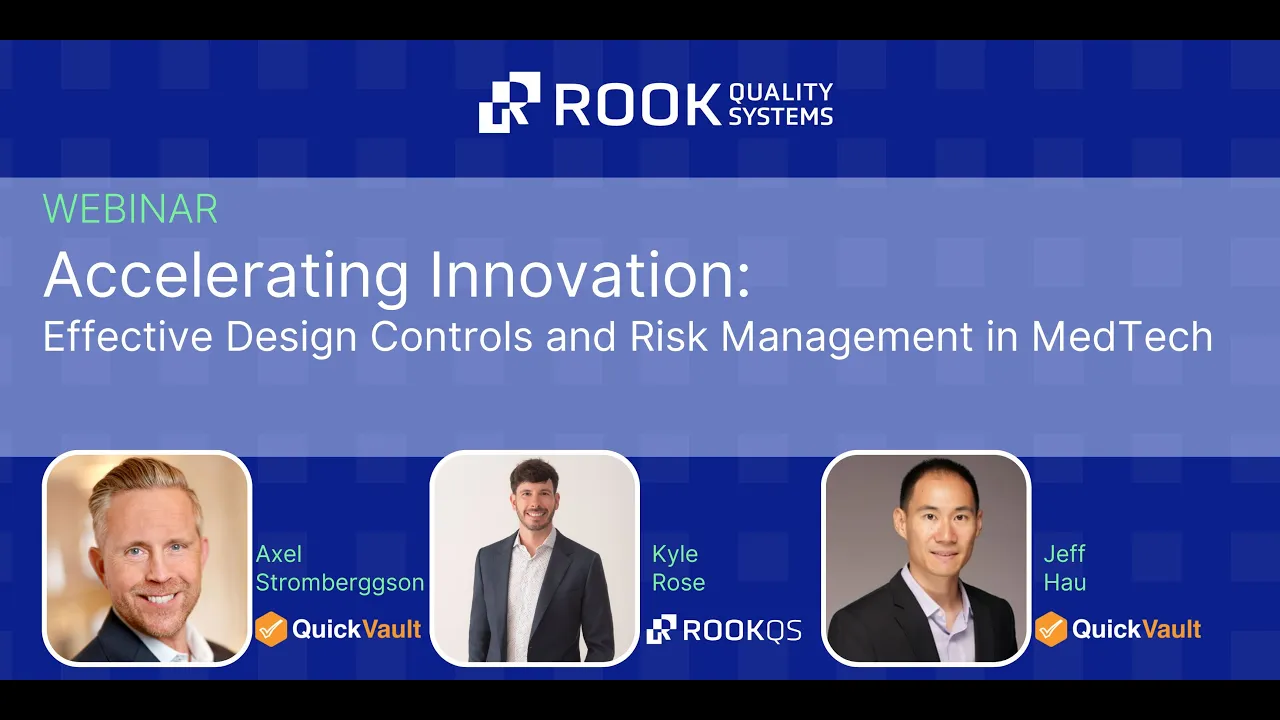
Accelerating Innovation: Effective Design Controls and Risk Management in MedTech
Rook Quality Systems
/@RookQualitySystems
Jul 25, 2024
This video provides an in-depth exploration of effective design controls and risk management within the MedTech industry, emphasizing how these practices accelerate innovation while ensuring regulatory compliance. The webinar, presented by Rook Quality Systems and QuickVault by Veeva Systems, features industry experts Kyle Rose (RookQS), Axel Strombergsson (Veeva), and Jeff Hau (Veeva). The session begins by outlining FDA and ISO guidelines for design controls, stressing the critical importance of early planning and robust documentation, particularly for software-driven medical devices. The discussion progresses from the foundational principles of design control, such as defining user needs and translating them into measurable design inputs, to the practical aspects of implementation. Axel Strombergsson frames design controls as a specialized form of project management, highlighting the need for upfront planning, meticulous execution, and continuous review to minimize setbacks and achieve faster market entry. He underscores the regulatory imperative that "if it's not documented, it never happened," emphasizing the role of comprehensive documentation throughout the design and development lifecycle. The speakers delve into the interconnectedness of design inputs, outputs, verification, validation, and risk assessment, illustrating how these elements form a traceable matrix crucial for regulatory submissions and post-market compliance. A significant portion of the webinar is dedicated to showcasing QuickVault, Veeva's cloud-based EQMS solution tailored for smaller MedTech companies. Jeff Hau provides a live demonstration of QuickVault's capabilities, illustrating how the platform automates and streamlines the management of design controls and risk. This includes creating and linking user needs, design inputs, and risks, conducting integrated design and risk reviews with electronic signatures, and automatically generating regulatory-ready documents like the Design Development File (DDF) and Medical Device File (MDF). The demo highlights QuickVault's user-friendly interface and its ability to simplify complex regulatory processes, thereby reducing the need for extensive prior experience in quality management and accelerating product development. The speakers also touch upon the nuances of software device development, including agile methodologies, cybersecurity considerations, and the management of design changes. Key Takeaways: * **Early Implementation of Design Controls is Crucial:** Starting the design control process early, even at the conceptual "back of a napkin" stage, helps identify testing requirements and market pathways sooner, preventing costly delays and rework later in development. * **Design Controls as Regulated Project Management:** Design controls can be viewed as project management with a regulatory twist, requiring robust upfront planning, diligent execution, and formal documentation to achieve project success, faster market entry, and high submission success rates. * **The "If It's Not Documented, It Never Happened" Principle:** Regulatory bodies like the FDA emphasize that undocumented activities or poorly recorded data are considered non-existent. Meticulous documentation throughout the design and development process is paramount for compliance and successful submissions. * **Foundational Planning Elements:** Successful design control hinges on three foundational elements: a comprehensive Design and Development Plan (project plan), clearly defined Design Inputs (measurable specifications based on user needs), and an early, thorough Risk Assessment. * **Traceability is Key for Compliance:** ISO 13485 and FDA regulations mandate traceability between user needs, design inputs, design outputs, verification, validation, and risk assessments. Modern software solutions like QuickVault automate this traceability, simplifying management and ensuring compliance. * **Automation Enhances Efficiency and Reduces Expertise Dependency:** Leveraging modern EQMS software like QuickVault automates many regulatory processes, increasing efficiency, reducing the need for extensive prior experience in quality management, and organizing documents for regulatory submissions and audits. * **Formal Design and Risk Reviews are Mandatory:** Design reviews must be conducted at specific project milestones, documented with meeting minutes, and include an independent reviewer (as per ISO 13485) to ensure objectivity. QuickVault integrates these reviews directly into the workflow. * **Distinction Between Verification and Validation:** Design verification confirms that design outputs meet design inputs (e.g., bench testing, electrical testing), while design validation ensures the product meets user needs and intended use (e.g., usability studies, clinical trials). Both require formal, approved protocols and defined acceptance criteria. * **Risk-Based Approach to Sample Size Justification:** When determining sample sizes for verification and validation testing, a risk-based approach should be employed. Higher-risk components or failure modes that could cause harm to end-users necessitate larger sample sizes. * **Specific Considerations for Software Devices:** Software development, while potentially faster and more iterative (e.g., agile sprints), still requires defined processes for requirements, architecture, testing (unit, functional, regression), and maintenance. Cybersecurity is a critical concern for medical device software, requiring dedicated planning and testing. * **Rigorous Design Change Management:** Any design change, whether during development or post-market, must undergo a thorough review and risk analysis to determine its impact on regulatory status, performance, safety, effectiveness, and the need for re-verification, re-validation, or new regulatory submissions. * **Understanding Regulatory Classification:** Products are classified (e.g., FDA Class I, II, III) based on risk, which dictates the level of design control, testing, and regulatory submission required. Early identification of the regulatory path is crucial for design planning. * **QuickVault's Value Proposition:** QuickVault offers a "day one ready" EQMS, continuous software improvement with frequent releases, compliance with industry standards, free industry best practice documentation, and flexible month-to-month subscription models, making it accessible for smaller MedTech startups. * **Integrated Regulatory Document Generation:** QuickVault automatically generates regulatory-ready files such as the Design Development File (DDF) and Medical Device File (MDF) by indexing and categorizing all related documents, significantly reducing the manual effort involved in preparing submissions. **Tools/Resources Mentioned:** * **QuickVault by Veeva Systems:** An EQMS (Electronic Quality Management System) specifically built for smaller MedTech companies, offering automated design controls, risk management, quality events, training, and supplier management. * **Rook Quality Systems:** A consulting firm specializing in quality and regulatory support for MedTech companies, offering services in design control, risk management, product development, validation, and audit support. * **Project Management Institute (PMI):** Mentioned as a leading organization for establishing best practices in project management. * **FDA Website:** Recommended for understanding design control regulations. **Key Concepts:** * **Design Controls:** A set of quality practices and procedures to ensure that medical devices meet user needs, intended use, and specified requirements throughout their development. * **Risk Management:** The systematic application of management policies, procedures, and practices to the tasks of analyzing, evaluating, controlling, and monitoring risk. * **User Needs:** High-level requirements describing what the user wants the device to do. * **Design Inputs:** Detailed, measurable specifications derived from user needs, against which the device will be designed and tested. * **Design Outputs:** The results of the design process, including drawings, material specifications, software code, instructions for use, and labeling. * **Design Verification:** Testing to confirm that design outputs meet design inputs ("Did we build the product right?"). * **Design Validation:** Testing to confirm that the finished device meets user needs and intended use ("Did we build the right product?"). * **Design Review:** Formal, documented meetings at various stages of development to evaluate the design and ensure it meets requirements. * **Design History File (DHF) / Design Development File (DDF):** A compilation of records that describes the design history of a finished medical device. The term DDF is evolving with the QMR. * **Medical Device File (MDF):** A compilation of records that contains the device master record (DMR) and other essential information for a medical device. * **EQMS (Electronic Quality Management System):** Software solutions that manage and automate quality processes, documentation, and compliance for regulated industries. * **QSR (Quality System Regulation):** FDA regulations (21 CFR Part 820) governing quality systems for medical devices. * **ISO 13485:** An international standard for quality management systems specific to medical devices. * **QMR (Quality Management Regulation):** The upcoming merged regulation combining FDA QSR and ISO 13485. * **Preliminary Hazard Analysis:** An early-stage risk assessment technique used to identify potential hazards and hazardous situations. * **Risk Acceptability Matrix:** A tool used to evaluate and classify risks based on their severity and probability. * **Agile Software Development:** An iterative approach to software development that emphasizes continuous delivery, collaboration, and adaptability to change. * **LDT (Laboratory Developed Tests):** Diagnostic tests that are designed, manufactured, and used within a single laboratory. * **Combination Products:** Products that combine a drug, device, and/or biological product. **Examples/Case Studies:** * A fictional example of designing "medical gloves" was used to demonstrate the design control and risk management features within QuickVault, including defining user needs (protection, comfort, durability), design inputs (resistance to liquids, low permeability, comfort for 8 hours), and associated risks (contamination, discomfort).

Embracing Change: Adopting a Data-Driven Mindset at Kraft Heinz
Veeva QualityOne
/@veevaqualityone
Jul 22, 2024
This video provides an in-depth exploration of the digital transformation journey within the Food Safety & Quality function at Kraft Heinz, emphasizing the critical role of adopting a data-driven mindset. Radosław Baran, who leads this transformation, frames data as the single most important topic for modern quality and compliance functions. The traditional role of Quality Assurance (QA) has been focused narrowly on ensuring compliance with internal criteria and external regulations. However, Baran argues that the true measure of success for QA today is the amount of value it can generate for the company at a holistic level, moving beyond its functional silo. This requires a fundamental shift in perspective, embracing technology and efficiency to modernize processes that have often remained static for decades. The central challenge discussed is overcoming organizational inertia and the fear of change inherent in highly regulated environments. Baran notes that while QA functions are necessarily limited by a "sandbox of regulations," they must learn to "play with that" by taking calculated risks and making assumptions to drive innovation. The speaker stresses that the processes that ensured success 15 years ago are no longer adequate, as rapid change is now visible and impacting the food sector—a change that necessitates the immediate adoption of technology and greater efficiency in food safety and quality management. This transition requires opening minds to new possibilities and viewing regulatory limits not as barriers, but as boundaries within which strategic digital experimentation can occur. A key methodological insight shared is the necessity of thinking about data from the very beginning of any digital initiative. When translating "analog ways of doing the papers" into digital solutions and a data-enabled ecosystem, the foundational structure must be data-centric. The transformation is not a one-time project with a fixed endpoint (e.g., 3, 5, or 7 years), but rather an "ongoing process." Success hinges on maintaining a clear, big-picture vision—a "big dream"—while executing small, iterative steps. This approach encourages continuous improvement and adaptation, acknowledging that failure is a possibility, but emphasizing the high probability of success when guided by a persistent, data-focused vision. Key Takeaways: • **Data is the Core of Modern QA:** The most important focus for quality and compliance functions must be data orientation; teams must "think data" first, shifting the focus from merely documenting compliance to leveraging data for strategic value generation. • **Shift from Compliance to Value Generation:** The QA function must measure its success not just by adherence to regulations, but by the tangible value it generates for the entire company, moving beyond its traditional role as a functional silo. • **Embrace Calculated Risk within Regulation:** Regulated functions operate within a "sandbox of regulations," and innovation requires taking calculated risks and making assumptions to test new, more efficient processes without compromising compliance integrity. • **Challenge Legacy Processes:** Organizations must acknowledge that processes successful 15 years ago are insufficient for today's rapidly changing environment; digital transformation requires opening minds and adapting quickly to new technological realities. • **Digital Transformation is an Ongoing Process:** The journey from analog, paper-based processes to a digital, data-enabled ecosystem is continuous and iterative, not a project with a fixed end date. Leadership must support this long-term commitment. • **Maintain a Big Vision:** Even when executing small, incremental steps, teams must keep a clear, ambitious vision ("the big dream") in front of them to ensure all efforts align toward the highest grades of achievement and systemic improvement. • **Prioritize Data Ecosystem Design:** When initiating the transition from analog paper methods to digital solutions, the foundational design must prioritize the data structure and ecosystem from the outset to ensure seamless integration and utility. • **Technology Drives Efficiency:** The current environment demands bringing "more technology and more efficiency" into quality and safety processes to manage complexity and maintain competitiveness in regulated sectors. Key Concepts: * **Data-Driven Mindset:** A cultural and operational approach where data is prioritized as the most critical asset and is used to inform all decisions, process improvements, and strategic planning within the quality and compliance functions. * **Regulatory Sandbox:** The concept that regulated industries have strict boundaries (regulations) but possess freedom within those boundaries to innovate, take risks, and experiment with new technologies and processes. * **Analog to Digital Translation:** The process of converting traditional, often paper-based, manual compliance and quality assurance workflows into integrated, automated, and data-enabled digital solutions. Tools/Resources Mentioned: * **Veeva QualityOne:** The channel hosting the video, indicating the use of Veeva’s industry-specific quality management platform, which facilitates the digital transformation discussed.

Hyntelo is a Veeva AI Partner | What's your POV?
Hyntelo
/@hyntelo
Jul 17, 2024
This video focuses on the strategic significance of Hyntelo achieving AI Partner status within the Veeva ecosystem, as validated by a key industry leader, Michael Halyk from Novo Nordisk. The core message revolves around market validation and strategic alignment, where a major pharmaceutical client views this partnership as confirmation that they "chose the right partner." This endorsement highlights the growing necessity for specialized AI platforms to integrate seamlessly with regulated enterprise software like Veeva CRM, which is the backbone of commercial operations in the life sciences sector. The speaker explicitly links the partnership to Veeva's recognition of the "power and strength of the Lyriko platform," suggesting that Veeva is actively curating a network of validated AI solutions to enhance its core offerings, particularly in areas requiring advanced intelligence and automation. The progression of the idea centers on competitive advantage and future strategy. For Hyntelo, the Veeva AI Partner designation is not merely a marketing achievement but a critical validation that de-risks their platform adoption for large pharmaceutical clients like Novo Nordisk. This status implies technical integration, adherence to Veeva’s standards, and likely a focus on commercial operations use cases, such as intelligent sales enablement, next-best-action recommendations, or automated medical information retrieval—all areas where AI can drive significant ROI. The speaker’s comment that this partnership is "great for us in the future" underscores the long-term strategic value of utilizing validated, integrated AI platforms to scale commercial capabilities and maintain a competitive edge in drug promotion and customer engagement. From a broader industry perspective, this short commentary signals a maturation of the pharmaceutical AI market. It confirms that the industry is moving past bespoke, siloed AI projects toward integrated, enterprise-ready solutions that operate within established regulatory and operational frameworks (like Veeva). The validation from a major player like Novo Nordisk serves as a powerful case study for other life sciences companies considering AI adoption. It suggests that the path of least resistance and highest trust involves selecting AI vendors that have achieved formal partnership status with core technology providers, ensuring compliance, scalability, and deep system integration necessary for regulated environments. This trend directly impacts firms specializing in both Veeva consulting and AI development, forcing them to prioritize formal partnerships and deep platform expertise to compete effectively. Key Takeaways: * **Veeva Partner Status is a Critical Differentiator:** Achieving formal AI Partner status with Veeva acts as a significant validation and de-risking mechanism for AI vendors targeting the pharmaceutical commercial sector, making them immediately more attractive to large enterprises like Novo Nordisk. * **Industry Validation Drives Adoption:** The endorsement from a major pharmaceutical company (Novo Nordisk) confirms that the market is actively seeking and trusting AI solutions that are officially recognized and integrated within the Veeva ecosystem. * **Focus on Integrated AI Platforms:** The success of the Lyriko platform suggests that the market preference is shifting towards comprehensive, specialized AI platforms (rather than generic tools) that are built specifically to solve life sciences commercial challenges and integrate natively with Veeva CRM. * **Strategic Alignment for Future Growth:** The client's view that the partnership is "great for us in the future" emphasizes that pharmaceutical companies are making long-term strategic decisions based on the stability and validated capabilities of their technology partners. * **Competitive Intelligence for Veeva Consultants:** Companies specializing in Veeva CRM consulting must monitor the Veeva AI Partner network closely, as these partners represent both potential competitors and potential integration partners for custom solutions. * **Prioritize Deep System Integration:** For AI solutions to gain traction in the life sciences, they must demonstrate seamless, validated integration with core enterprise systems like Veeva, ensuring data flow, compliance, and user adoption. * **AI Validation for Regulatory Environments:** The formal partnership status likely implies a level of technical and operational vetting by Veeva, which helps address regulatory concerns (e.g., GxP, 21 CFR Part 11) that are paramount for pharmaceutical clients. * **Market Trend Towards Commercial Intelligence:** The focus on AI within the Veeva ecosystem confirms that commercial operations (sales enablement, customer engagement, medical affairs) remain a primary target area for high-impact AI investment in the life sciences. Tools/Resources Mentioned: * **Veeva (CRM Platform):** The essential enterprise software platform for pharmaceutical commercial operations and compliance. * **Lyriko Platform (Hyntelo):** The specific AI platform that achieved Veeva AI Partner status, demonstrating capabilities recognized by both Veeva and major pharmaceutical clients. Key Concepts: * **Veeva AI Partner:** A formal designation granted by Veeva to third-party technology providers whose AI solutions meet specific integration, performance, and strategic criteria, validating their use within the Veeva ecosystem. * **Market Validation:** The process by which a product or service is confirmed as valuable and trustworthy by key industry players (in this case, Veeva and Novo Nordisk), significantly reducing perceived risk for other potential customers.
Self-Funding Drug Trials (with Public Good Pharma)
Self-Funded
@SelfFunded
Jul 16, 2024
This video provides an in-depth exploration of the misaligned incentive structures within the pharmaceutical industry and introduces a revolutionary funding model for clinical trials called "Interventional Pharmacoeconomics" (IVP), or "self-funding trials." The speakers, Savva Kerdemelidis (Founder/CEO) and Zan Lowe of Public Good Pharma, argue that the current system, heavily reliant on patent protection, filters out potentially superior, lower-cost, generic, or off-patent therapies. They highlight the "massive disconnect" where profitable, patentable drugs (often requiring a $3 billion revenue threshold for development) are pursued, while effective public good treatments (like repurposed generics, diets, or supplements) are ignored due to a lack of commercial incentive. The core of the discussion centers on the mechanism of IVP, which aims to generate high-quality clinical data for affordable treatments by leveraging existing high-cost specialty drug spend. In a self-funding trial, an employer or payer (like a self-insured group) partners with Public Good Pharma to compare a high-cost standard-of-care drug with a drastically lower-cost alternative (e.g., a generic or repurposed drug). The cost difference (the "Delta") between the two treatments during the trial period generates immediate cost savings for the payer, which are then used to fund the clinical trial itself. This effectively creates a trial that pays for itself, mitigating the financial risk traditionally associated with R&D, especially for unpatentable therapies. A compelling case study discussed is the comparison between generic ketamine ($2 per dose) and its patented, slightly tweaked, intranasal version, Esketamine (Spravato, costing $30,000–$50,000 per year, or $800 per dose). The speakers note that generic IV ketamine may offer superior bioavailability and clinical outcomes but lacks commercial incentive for large-scale trials. By enrolling patients currently prescribed Esketamine into an IVP trial comparing the two, the employer could realize guaranteed cost savings (e.g., 20% upfront) while generating the necessary data to prove the efficacy of the lower-cost option. If successful, the employer gains access to the generic drug at a 90%+ cost reduction perpetually, secured via an Advanced Market Commitment (AMC). Furthermore, the speakers extend the IVP model beyond generic drugs to include behavioral and nutritional interventions, such as those competing with GLP-1 medications or dietary protocols (like the ketogenic diet for cancer). They argue that the primary barrier preventing these highly effective, non-pharmaceutical interventions from entering mainstream clinical practice is the lack of rigorous, funded data to compete with pharmaceutical-level studies. By using the cost savings from expensive drug spend (e.g., GLP-1s) to fund head-to-head trials against behavioral protocols, the IVP model can bridge the "Valley of Death" between academic research and patient care, ultimately leading to truly personalized medicine where treatment protocols are based on individual biomarkers and data-driven algorithms (AI), rather than commercial profitability. Key Takeaways: * **The Patent System's Flaw:** The current pharmaceutical patent system incentivizes the development of the "most patentable" molecules, often resulting in slightly tweaked, high-cost drugs (like Esketamine) rather than the most clinically effective or affordable treatments. This creates a massive opportunity gap for generic repurposing. * **Interventional Pharmacoeconomics (IVP):** This methodology provides a path to fund clinical trials for lower-cost therapies by using the cost difference (Delta) between the high-cost standard of care and the lower-cost alternative to cover the trial's expenses. This makes the trial self-funding or even net-negative cost. * **Targeting Specialty Drug Spend:** Employers and payers should analyze their high-cost specialty drug spend (e.g., immunotherapies, GLP-1s, specific mental health drugs like Esketamine) to identify opportunities for IVP trials where a lower-cost, medically derisked alternative exists. * **Advanced Market Commitments (AMCs):** To incentivize the first mover (the payer funding the trial), the model includes an AMC, guaranteeing the employer access to the proven, lower-cost drug or protocol at the lowest possible price (e.g., 90%+ savings) after the trial's successful conclusion. * **Data as the Public Good:** The primary value generated by IVP trials is high-quality clinical data. This data, regardless of whether the low-cost alternative is superior or inferior, is a "public good" that can be used to update formularies, inform clinical guidelines, and advance personalized medicine globally. * **Bridging the Health/Wellness Divide:** IVP can fund rigorous head-to-head studies comparing expensive pharmaceutical interventions with non-patentable alternatives, such as dietary protocols (e.g., ketogenic diet for cancer) or behavioral interventions (e.g., for weight loss/GLP-1 alternatives), thereby validating effective, non-drug treatments. * **AI and Personalized Medicine:** The ultimate goal is to generate enough data to enable personalized medicine, where AI algorithms analyze patient-specific data (DNA, biomarkers) to match them to the most effective treatment protocol, potentially including enrollment in ongoing clinical trials for continuous optimization. * **Regulatory Navigation:** The model relies on navigating FDA-approved clinical trial frameworks to legally test and compare off-label or repurposed generic drugs against the expensive standard of care, ensuring the generated data is credible and actionable for regulatory and formulary changes. * **Risk Reduction:** Unlike traditional drug development, IVP focuses on therapies that are "medically derisked" (already known to be effective or highly likely to be effective), reducing the informational and financial risk associated with R&D. Key Concepts: * **Interventional Pharmacoeconomics (IVP):** A clinical trial funding mechanism where the cost savings generated by substituting a high-cost drug with a low-cost alternative during the trial period are used to pay for the trial itself. * **Evergreening/Product Hopping:** The practice by pharmaceutical companies of slightly tweaking a drug's formulation or delivery system near the end of its patent life to obtain a new patent, thereby extending market exclusivity and maintaining high prices. * **Advanced Market Commitment (AMC):** A contractual agreement guaranteeing the trial sponsor (payer/employer) long-term access to the proven, lower-cost therapy at a deeply discounted rate, providing a financial incentive for initial investment. * **Valley of Death:** The funding gap between promising academic scientific research (often involving off-patent or non-patentable discoveries) and the massive investment required for large-scale clinical trials and commercialization. Examples/Case Studies: * **Ketamine vs. Esketamine (Spravato):** Esketamine (J&J) is a patented, intranasal version of generic ketamine, costing $30k–$50k annually. Generic IV ketamine is $2 per dose and may be clinically superior. An IVP trial comparing the two would be funded by the massive cost difference, potentially leading to widespread adoption of the cheaper, more effective generic. * **GLP-1 Alternatives:** IVP can be used to fund trials comparing expensive GLP-1 medications (like Ozempic or Wegovy) against rigorous behavioral or nutritional protocols, aiming to prove equivalent or superior long-term outcomes for weight management and diabetes reversal. * **Rare Disease Price Gouging:** The model can be applied to high-cost rare disease drugs (e.g., those costing $700k–$800k annually) where the underlying molecule is off-patent, allowing for the development and testing of a much lower-cost version (e.g., a pro-drug) funded by the cost delta.

ER Imaging Overutilization: CT Scans in 36% of Visits!!
AHealthcareZ - Healthcare Finance Explained
@ahealthcarez
Jul 14, 2024
This video provides an in-depth exploration of the significant issue of emergency room (ER) imaging overutilization in the United States, highlighting its financial implications and contributing factors. Dr. Eric Bricker begins by sharing a personal anecdote about a $5,000 CT scan that constituted 83% of his total ER bill, immediately establishing the immense cost burden associated with advanced imaging in emergency settings. He then presents compelling statistics, revealing that out of 150 million annual ER visits, 50% involve some form of imaging, with 36% including a CT scan and 2.5% an MRI – figures that have surged over 300% in the last decade. The presentation delves into the various factors driving this overutilization, categorizing them into patient demographics (middle-aged or older, drug use, non-English speaking), patient psychology (anxiety, specific expectations), physician behavior (malpractice avoidance), and systemic issues. A particularly insightful point is the practice of non-ER physicians sending patients to the ER for imaging to circumvent prior authorization hurdles or administrative delays, effectively turning the ER into a "24/7 Advanced Imaging Center." The video also contrasts the fee-for-service model, prevalent in most of the US, with capitated models like Kaiser in California, demonstrating how financial incentives directly influence imaging rates. Dr. Bricker critically analyzes the failure of the Centers for Medicare & Medicaid Services (CMS) to implement the Appropriate Use Criteria (AUC) program, a decade-long effort mandated by Congress to reduce imaging overutilization. Despite a law passed in 2014, CMS was unable to fully implement the program, eventually pausing it in 2024, partly due to a significant exemption for emergency departments. This highlights the challenges of health policy implementation. Finally, the video offers a proven solution: employers and Medicare Advantage plans have successfully reduced ER utilization and associated imaging by up to 30% within a year by providing patients with 24/7 access to primary care through on-site, near-site, direct primary care clinics, or virtual visits, offering a viable alternative to the ER for non-emergent issues. Key Takeaways: * **Significant Cost Burden of ER Imaging:** Advanced imaging, particularly CT scans, can account for a disproportionately large percentage of an ER visit's total cost, as illustrated by an example where a CT scan was 83% of a $3,000 allowed amount. * **High Prevalence of Imaging in ERs:** Approximately 50% of the 150 million annual ER visits in America involve some form of imaging, with 36% including a CT scan and 2.5% an MRI. * **Dramatic Increase in Advanced Imaging:** The utilization of CT scans and MRIs in ERs has increased by over 300% in the last 10-15 years, transforming ERs into de facto "24/7 Advanced Imaging Centers." * **Multiple Factors Drive Overutilization:** Key drivers include patient demographics (older age, drug use, non-English speaking), patient anxiety/expectations, physician's fear of malpractice lawsuits, and requests from non-ER physicians seeking to bypass prior authorization or administrative delays. * **Financial Models Impact Imaging Rates:** Fee-for-service models are associated with higher rates of advanced imaging in the ER compared to capitated models (e.g., Kaiser, group HMOs) where providers bear financial risk. * **Failure of Regulatory Intervention:** The CMS's Appropriate Use Criteria (AUC) program, mandated by Congress in 2014 to curb imaging overutilization, failed to be effectively implemented over a decade and was ultimately paused in 2024, demonstrating the difficulty of policy change in healthcare. * **ER Exemption from AUC:** A major loophole in the AUC program was the exemption of emergency departments, allowing ER doctors complete discretion in ordering imaging without decision support tools or financial penalties. * **ER as a High-Volume Outpatient Imaging Center:** With 86% of ER visitors going home, the ER often functions as an expensive, high-volume outpatient imaging center rather than solely for true emergencies. * **Effective Solution: 24/7 Primary Care Access:** Employers and Medicare Advantage plans have achieved up to a 30% reduction in ER utilization (and associated imaging) within one year by providing patients with 24/7 access to primary care through on-site, near-site, direct primary care clinics, or virtual visits. * **Importance of Alternative Care Pathways:** Offering accessible primary care alternatives helps divert non-emergent cases from the ER, reducing unnecessary advanced imaging and overall healthcare costs. Tools/Resources Mentioned: * **Electronic Medical Record (EMR):** Mentioned in the context of decision support tools for Appropriate Use Criteria. * **Decision Support Tool:** A hypothetical tool within EMRs for guiding appropriate imaging orders. Key Concepts: * **ER Imaging Overutilization:** The excessive and often unnecessary use of diagnostic imaging (like CT scans and MRIs) in emergency departments. * **Appropriate Use Criteria (AUC):** Specific guidelines developed by healthcare policy makers and researchers to determine when it is medically appropriate to order certain diagnostic tests, particularly advanced imaging. * **Protecting Access to Medicare Act of 2014:** The federal law that mandated the implementation of Appropriate Use Criteria for advanced diagnostic imaging services under Medicare. * **Fee-for-Service:** A payment model where providers are paid for each service they perform, which can incentivize higher utilization of services. * **Capitated/Group HMO:** A payment model where providers receive a fixed amount per patient per period, regardless of the services provided, which can incentivize cost control and appropriate utilization. * **On-Site, Near-Site, Direct Primary Care Clinics:** Models of primary care delivery that offer convenient and often 24/7 access to primary care physicians, serving as alternatives to ER visits for non-urgent conditions.

Can We Use AI To Fix Healthcare? (with Guy Benjamin)
Self-Funded
@SelfFunded
Jul 12, 2024
This video provides an in-depth exploration of how artificial intelligence (AI) can revolutionize and "fix" the complex, costly, and often opaque US healthcare system, as discussed with Guy Benjamin, founder of Healthee. The conversation begins by establishing the universal frustration with healthcare's lack of simplicity, navigability, and affordability. Healthee positions itself as a "One-stop AI platform" designed to address these challenges by offering comprehensive health and wellness benefits management, including decision support, care navigation, price transparency, and telehealth services, all integrated into a single, user-friendly application. A core technological innovation highlighted is Healthee's ability to leverage AI, specifically Large Language Models (LLMs), to transform unstructured data from health plan documents (e.g., PDFs) into structured, mappable databases. This process enables the platform's AI assistant, Zoe, to provide hyper-personalized information to individual members about their specific plan, eligibility, coverage, and costs across medical, dental, vision, and employer point solutions. The discussion traces Healthee's rapid evolution, from initially focusing on care navigation to expanding its offerings to include decision support for plan selection, virtual care, and price transparency, demonstrating a commitment to continuous innovation driven by user feedback. The conversation further delves into the strategic impact and future roadmap of AI in healthcare. Benjamin emphasizes the scalability of AI solutions, contrasting them with human-labor-intensive models, and highlights how Healthee's AI-driven approach has led to explosive growth and significant cost savings for self-funded employers. Future applications discussed include AI-powered medication management, where Zoe could facilitate prescription fulfillment directly to a user's home, and automated medical bill auditing to identify and rectify errors, which are estimated to be present in up to 70% of bills. The overarching vision is to empower consumers with accurate information and self-service tools, fostering greater transparency and consumerism to ultimately drive down healthcare costs and improve accessibility for all, including previously underserved populations like the uninsured. Key Takeaways: * **AI as a Healthcare Navigator:** Healthee's platform, powered by AI assistant Zoe, acts as a personal health assistant, providing hyper-personalized information on health benefits, coverage, costs, and provider networks by converting unstructured plan documents into structured data. * **The "One-Stop Shop" Value Proposition:** Integrating decision support, care navigation, price transparency, and telehealth into a single platform significantly enhances user experience and engagement, making it a compelling differentiator in a fragmented market. * **Scalability Through AI:** AI-driven solutions offer immense scalability compared to human-centric call centers, allowing platforms like Healthee to serve millions of users without a proportional increase in human resources. * **Data-Driven Engagement Strategies:** Effective engagement is crucial for utilization and outcomes. Healthee employs a dedicated marketing team that uses A/B testing and data analysis to understand user preferences and optimize communication channels (e.g., text, WhatsApp, email) to drive app usage. * **AI for Informed Decision-Making:** The AI decision support tool helps users select the best health plan for their family by considering dozens of factors, including current healthcare needs, future medical events, and in-network doctors, often leading to high user acceptance rates for recommended plans. * **Cost Reduction for Employers:** By steering employees towards lower-cost options like telehealth (which often has zero associated claims) and in-network providers, Healthee helps self-insured employers save hundreds of thousands of dollars annually. * **Future of AI in Medication and Billing:** The roadmap includes AI-driven medication management (from prescription to home delivery) and automated medical bill auditing, which could identify and rectify errors in a significant percentage of healthcare bills. * **Empowering Consumerism and Transparency:** Arming employees with transparent pricing and quality information for services like MRIs can drive market competition among providers, potentially leading to lower costs across the entire healthcare system. * **Addressing the Uninsured:** Healthee extends its services to uninsured populations, offering affordable access to virtual primary care physicians and therapists, which can serve as a significant retention benefit for employers with hourly workers. * **Strategic Partnerships for Distribution:** Collaborating with PEOs (Professional Employer Organizations), TPAs (Third-Party Administrators), and benefit administrators provides broad distribution channels and allows these partners to offer cutting-edge AI solutions without building them in-house. * **Continuous Innovation and User Feedback:** Healthee's rapid development cycle (6-12 new features per quarter) is fueled by constant feedback from users, HR leaders, brokers, and partners, ensuring the platform evolves to meet real-world needs. * **AI as a Fundamental Shift:** The speaker emphasizes that AI is not a fleeting trend but a transformative technology that will profoundly impact healthcare, urging employers and individuals to embrace AI tools for better health outcomes. * **Seamless User Experience:** A focus on intuitive design and zero-touch onboarding (e.g., for PEO partners) is critical for driving adoption and ensuring that the platform is easy to use, preventing user frustration and disengagement. **Tools/Resources Mentioned:** * **Healthee:** An AI platform for health and wellness benefits. * **Zoe:** Healthee's AI-powered personal health assistant. * **Paro Health:** A sponsor mentioned in the podcast. * **Claim Doc:** A sponsor mentioned in the podcast. * **Plan Site:** A sponsor mentioned in the podcast. * **Tret:** A PEO (Professional Employer Organization) that is a partner of Healthee. * **Script Code:** (Mentioned by host as an example of a company providing wholesale pass-through pricing on generics with robotic fulfillment). **Key Concepts:** * **Consumerism in Healthcare:** The idea that individuals, armed with information, can make informed choices about their healthcare, similar to how they shop for other goods and services, thereby influencing market dynamics. * **Price Transparency:** Making the cost of healthcare services and medications readily available to consumers before they receive care. * **Self-funded Employers:** Companies that directly assume the financial risk for providing healthcare benefits to their employees, rather than paying premiums to an insurance carrier. * **AI Decision Support:** Using artificial intelligence to analyze data and provide recommendations to help users make choices, such as selecting a health plan. * **Care Navigation:** Guiding individuals through the complex healthcare system to find appropriate providers, understand coverage, and manage their care. * **Unstructured Data:** Information that does not have a predefined data model or is not organized in a pre-defined manner (e.g., text documents, PDFs). * **Structured Data:** Information organized in a formatted repository, typically a database, that is easily searchable and analyzable. * **Pharmacogenomics:** (Briefly mentioned by host) The study of how genes affect a person's response to drugs. **Examples/Case Studies:** * **Healthee's Partnership with Tret:** A large PEO with hundreds of thousands of employees chose Healthee after a year-long due diligence, primarily due to its "One-stop shop" AI platform, despite Healthee being the youngest company considered. This partnership demonstrates the power of comprehensive AI solutions in large-scale benefits management. * **Cost Savings for Self-Insured Customers:** Healthee has saved self-insured customers hundreds of thousands of dollars annually by effectively steering employees to lower-cost options like telehealth and in-network providers, proving a strong ROI. * **Addressing Uninsured Restaurant Employees:** Healthee provides free telehealth services to uninsured hourly employees of restaurant chains, offering a crucial healthcare benefit that helps employers with retention in a competitive labor market. * **The "Amazon Experience" for Healthcare:** The analogy is used to describe Healthee's goal of making healthcare navigation as simple, transparent, and quality-assured as shopping on Amazon, where users know the cost, quality, and delivery time upfront.
How Kenvue Leverages Technology to Enhance Quality Culture
Veeva QualityOne
/@veevaqualityone
Jul 12, 2024
This video provides an insightful look into how Kenvue, a major consumer health company recently separated from Johnson & Johnson, is strategically leveraging technology and cultural initiatives to modernize its Quality Management System (QMS) and enhance its overall quality culture. Natasha Zuyev, Kenvue's Chief Quality Officer, frames the separation as a unique opportunity—like "moving out of your parents' house"—to simplify, standardize, and digitize inherited, complex systems. The core objective is to make the QMS work *for* the people, rather than the other way around, thereby making employees' jobs easier and allowing them to focus on value creation for the consumer. The presentation emphasizes a dual approach combining technological transformation with grassroots cultural change. Technologically, the focus is on implementing digital solutions that support automation. This automation is directly linked to key operational improvements, specifically the reduction of human errors, which subsequently leads to fewer incidents, non-conformances, and safety issues. Culturally, Kenvue established "Quality Change Agent Teams" (QCATs), composed of employees from all organizational levels. These agents are tasked with actively listening to staff on the floor and in the office to identify pain points, understand what is working well, and pinpoint areas where digital solutions or process improvements can enhance the employee experience and operational efficiency. A critical theme highlighted is the power of data in driving quality improvements. Zuyev notes that by leveraging data from various channels, Kenvue can gain a much deeper understanding of the consumer experience. This enhanced data analysis capability is then utilized directly to inform product improvements and elevate overall quality standards. Looking forward, the Chief Quality Officer envisions a future state within the next five to ten years where manufacturing environments are completely paperless, systems are fully interconnected, and the focus shifts from reactive problem-solving to proactive, predictive issue prevention. This digital transformation allows personnel to dedicate their time to high-value tasks that truly benefit consumers and customers. The transformation journey at Kenvue serves as a powerful case study for regulated companies undergoing significant structural change. It demonstrates that separating from a legacy organization provides a rare chance to shed complexity and legacy IT debt, enabling rapid adoption of modern, integrated, cloud-based quality platforms (like those offered by Veeva). The strategy prioritizes user experience and operational efficiency, recognizing that a simplified, digitized QMS is the foundation for a robust quality culture, ultimately leading to better compliance and superior consumer products. Key Takeaways: * **Strategic Opportunity in Separation:** Organizational separation (like Kenvue's spin-off from J&J) presents a massive opportunity to rationalize and modernize inherited, complex Quality Management Systems (QMS) and associated IT applications, moving toward simplification, standardization, and digitization. * **QMS Must Serve the People:** The goal of digital transformation in quality should be to make the system work *for* the employees, making their jobs easier and allowing them to focus on high-value activities rather than administrative burdens. * **Automation as Error Reduction:** Digital solutions support automation, which is a direct mechanism for reducing human errors; this leads to a tangible decrease in operational metrics like incidents, non-conformances, and safety incidents, improving both compliance and safety. * **Grassroots Change Agents (QCATs):** Implementing Quality Change Agent Teams (QCATs) composed of employees across all organizational levels is crucial for successful change management, as they act as internal listeners and advocates who identify real-world pain points and opportunities for digital improvement. * **Data-Driven Consumer Experience:** Leveraging data from diverse channels is essential for gaining a superior understanding of the consumer experience, allowing the company to analyze feedback and insights directly to improve product quality. * **Future Vision: Predictive and Paperless:** The industry trajectory points toward interconnected, digital systems in manufacturing environments where paper is eliminated, and the focus shifts from solving issues *after the fact* to predicting and actively preventing them from occurring. * **Prioritizing Digital Interconnectivity:** The long-term vision involves fully interconnected systems, which is a key requirement for achieving true predictive quality and maximizing the efficiency of AI-driven insights across the quality ecosystem. * **Regulatory Compliance through Simplification:** By simplifying and standardizing the QMS, companies inherently improve their ability to maintain compliance, as fewer complex, disparate systems mean fewer opportunities for oversight or non-adherence to regulatory standards (e.g., GxP, 21 CFR Part 11). Tools/Resources Mentioned: * **Veeva QualityOne:** Mentioned in the channel name, indicating the use of a cloud-based quality management platform common in the life sciences sector. * **IT Applications (QMS):** Reference to multiple, complex legacy IT applications inherited from the parent company, which are now being consolidated and digitized. Key Concepts: * **Quality Culture:** Defined as critically important, involving empowering employees and utilizing technology to ensure quality is embedded at every level of the organization. * **QMS Digitization:** The process of converting paper-based or disparate electronic Quality Management Systems into unified, standardized, and automated digital platforms. * **Change Agents (QCATs):** Internal teams tasked with facilitating organizational change by gathering feedback, communicating transformation goals, and ensuring new digital solutions meet the needs of end-users.
BASF + Veeva: Digital Change Control at BASF Personal Care
Veeva QualityOne
/@veevaqualityone
Jul 12, 2024
The video details the successful digital transformation of the Change Control process at BASF Personal Care Europe through the implementation of Veeva QualityOne. Iris Scheepers, Senior Manager for Quality Management Systems (QMS) and Audits, shares the company's journey, emphasizing the critical importance of managing changes efficiently and compliantly within a business adhering to GMP standards. The transformation was initiated specifically with change control due to its central role in the business, requiring meticulous documentation, risk management assessment, and tracking of change criticality. Prior to the implementation, BASF struggled with manual change control processes, relying heavily on disparate systems like files and emails, which made follow-up difficult and obscured the overall status of changes. The core motivation for the shift was to centralize these processes. By moving to Veeva QualityOne, the team gained a "perfect overview" of all changes, including their current status (in work, closed), significantly enhancing transparency and control. This centralization not only improved efficiency but also boosted team morale and motivation, as employees could easily visualize the collective impact of their work over time. The implementation methodology involved comparing BASF's existing, clear workflow against the standard change control workflow provided by Veeva. This comparison allowed the team to adapt the standard solution to their specific needs, resulting in a reduction of procedural steps. This streamlining made the entire process simpler to overview and ultimately led to greater overall efficiency. A key outcome of the digital system was the ability to easily retrieve historical data and demonstrate compliance by simply pressing a button, a significant advantage for audit readiness. Scheepers concludes by offering valuable advice for organizations embarking on similar digital transformations. She stresses the importance of clarity regarding initial objectives but cautions against striving for immediate perfection, advocating instead for adaptability and continuous learning from the organization's experience. Crucially, the digital platform facilitated organic integration of related QMS functions; employees quickly recognized the potential to connect risk management and audit reports directly to the change control process, making the system more comprehensive and driven by user needs. Key Takeaways: • **Change Control as a Foundational Transformation Pillar:** BASF strategically chose change control as the starting point for their digital transformation due to its absolute importance in a regulated business, its linkage to risk management, and the need to document compliance with GMP standards. • **Overcoming Manual Process Deficiencies:** The shift addressed the inherent difficulties of manual change control, which involved tracking changes across decentralized files and emails, leading to poor follow-up and lack of visibility into the current status of changes. • **Achieving Centralized Visibility and Control:** Implementing a unified system like Veeva QualityOne provides a "perfect overview" of all changes, allowing users to instantly see the status (closed, in work) and track the history of changes executed over time, significantly aiding management and audit preparedness. • **Boosting Employee Motivation and Adoption:** The improved user-friendliness and clear visibility offered by the digital system led to high enthusiasm and adoption among the team, demonstrating that efficiency gains can directly contribute to increased employee motivation. • **Workflow Optimization through Comparison:** The implementation strategy involved comparing the company's existing workflow against the standard workflow offered by the solution provider (Veeva). This comparative analysis allowed BASF to adapt the system and successfully reduce the number of procedural steps, saving time and simplifying the overall process. • **Prioritize Clarity over Perfection:** A key recommendation for starting a digital transformation is to be very clear about the initial goals, but not to expect immediate perfection. Organizations should embrace adaptability and plan to learn and evolve the system based on organizational feedback and practical application. • **User-Driven System Integration:** The digital platform fostered organic connections between critical QMS functions. Employees who worked directly with the tool recognized and implemented connections between change control, risk management, and audit reporting, making the system more robust and integrated based on real-world needs. • **Focus on Efficiency and Simplicity:** The ultimate goal of the transformation was to increase efficiency and simplify the overview of the entire change control process, ensuring that the system saves time while maintaining regulatory rigor. Tools/Resources Mentioned: * **Veeva QualityOne:** The specific software platform used by BASF Personal Care for implementing digital change control. Key Concepts: * **Change Control:** A formal process used to manage all changes to systems, processes, or products in a regulated environment (like pharmaceuticals or personal care) to ensure that changes are necessary, documented, risk-assessed, and approved before implementation. * **GMP Standard (Good Manufacturing Practice):** A system for ensuring that products are consistently produced and controlled according to quality standards. Adherence to GMP requires rigorous documentation and management of quality systems, including change control. * **Quality Management System (QMS):** A formalized system that documents processes, procedures, and responsibilities for achieving quality policies and objectives, often encompassing audits, risk management, and change control.
Join the Future of Pharma with SFDC Veeva CRM | People Prime Worldwide
People Prime Worldwide Salesforce
/@PeoplePrime_SalesforceJobs
Jul 10, 2024
This video serves as a recruitment announcement, positioned by People Prime Worldwide, focusing on the critical need for skilled SFDC Veeva CRM Developers to support the evolving technological landscape within the pharmaceutical industry. The core message emphasizes the opportunity to elevate a career in Salesforce development by specializing in Veeva CRM, a platform essential for commercial operations and regulatory compliance in life sciences. The announcement targets professionals ready to engage with cutting-edge solutions and collaborate with industry experts on impactful projects, framing the role as a gateway to career advancement in the dynamic Pharma CRM sector. The primary focus of the role, as detailed in the transcript, centers on the full lifecycle management of Salesforce applications tailored for pharmaceutical clients. Key responsibilities include not only the foundational development of these applications but also the crucial tasks of enhancing existing systems and managing complex projects. A significant component of the role involves stakeholder engagement, specifically gathering and communicating detailed requirements to ensure that the developed solutions accurately address business needs and strategic objectives. This highlights the blend of technical expertise and business acumen required for success in the specialized field of Pharma CRM consulting. Furthermore, the announcement outlines specific technical and operational duties that define the day-to-day work of an SFDC Veeva CRM Developer. These responsibilities are highly relevant to IntuitionLabs' consulting practice, including configuration and customization of the Veeva platform, performing impact analysis to assess changes, and delivering solutions utilizing the Veeva Vault platform. A strong emphasis is placed on maintaining code quality through rigorous code review and optimization processes. Operationally, the role demands strong collaboration skills, requiring the developer to build effective working relationships with diverse teams—including onsite, offshore, business teams, and external vendors—to ensure seamless project execution and delivery across complex, often globally distributed, pharmaceutical organizations. Key Takeaways: • The demand for specialized SFDC Veeva CRM developers is high, indicating a continued industry reliance on this platform for managing commercial operations and ensuring regulatory adherence in the pharmaceutical sector. • The role requires a dual skill set encompassing core Salesforce development proficiency (SFDC) combined with deep functional knowledge of the Veeva CRM ecosystem, which is crucial for delivering industry-specific solutions. • A core responsibility involves configuration and customization, suggesting that consultants must be adept at tailoring the standard Veeva product to meet unique client workflows while maintaining the integrity and compliance of the system. • Impact analysis is a critical component of the development lifecycle, ensuring that any changes or enhancements made to the CRM system do not disrupt existing business processes or violate regulatory requirements. • Expertise in delivering solutions using the Veeva Vault platform is explicitly required, highlighting the importance of understanding Veeva’s content management and regulatory compliance tools alongside its CRM capabilities. • Code quality assurance is paramount, requiring developers to perform thorough code reviews and optimization to maintain system performance, scalability, and long-term maintainability within a regulated environment. • Effective communication and requirement gathering from stakeholders are essential, reinforcing the consulting nature of the role where technical solutions must align perfectly with business needs and user requirements. • The necessity of building strong working relationships across onsite, offshore, and external vendor teams underscores the complexity of modern pharmaceutical IT projects, which often involve global collaboration and multiple service providers. • The focus on enhancing and managing projects suggests that the role moves beyond simple development tasks into strategic project ownership and continuous improvement of the CRM system. • Career advancement in Pharma CRM is directly tied to mastering the integration of Salesforce technology with the specialized compliance and workflow requirements of the life sciences industry. Key Concepts: * **SFDC (Salesforce.com):** The foundational cloud computing platform upon which Veeva CRM is built. Proficiency in SFDC development, including Apex, Visualforce, and Lightning components, is assumed. * **Veeva CRM:** A specialized, cloud-based customer relationship management solution built on the Salesforce platform, tailored specifically for the pharmaceutical and life sciences industries to manage sales, marketing, and medical affairs interactions while maintaining regulatory compliance. * **Veeva Vault Platform:** Veeva’s suite of cloud applications designed for content management and regulatory processes (e.g., Quality, Regulatory, Clinical, Commercial), which often integrates closely with Veeva CRM for comprehensive operational oversight. * **Configuration and Customization:** Refers to the two primary methods of tailoring the Veeva CRM system—configuration involves using built-in tools (e.g., fields, layouts, workflows), while customization involves writing custom code (Apex) to meet specific, complex business requirements.

Tips to become a good product analyst #analytics #interviewtips #podcast #productanalytics
Tech Podcast
/@techpodcastbyAnuj
Jul 9, 2024
This video, titled "Tips to become a good product analyst," offers succinct yet crucial guidance for individuals embarking on a career in product analytics. The speaker from "Tech Podcast" identifies two foundational skill sets that are absolutely essential for aspiring analysts to master. The primary objective of the discussion is to equip new entrants with a clear roadmap for developing the core competencies required to effectively analyze product data and contribute meaningfully to product strategy. The first and foremost skill highlighted is a strong command of statistics. The speaker underscores the necessity of understanding fundamental statistical concepts, providing a list of specific examples that include Bayes theorem, the bell curve (normal distribution), standard deviation, probability, conditional probability, probabilistic models, and the interpretation of P-values. This statistical literacy is presented as indispensable for accurately interpreting data, identifying trends, and making data-driven decisions. To facilitate learning, the video points to various accessible resources such as LinkedIn Learning, YouTube, and an IT Metros course, specifically noting a structured "three-step course statistics 1, 2, and 3" available on LinkedIn Learning. Following the emphasis on statistics, the second critical skill discussed is basic proficiency in SQL (Structured Query Language). The rationale for SQL's importance is explicitly stated: it enables analysts to independently extract and manipulate data. The speaker explains that in the vast majority of contemporary organizations, data is stored within Relational Database Management Systems (RDBMS), making SQL the primary tool for querying and retrieving the necessary information for any analytical task. This logical progression of skills—first understanding the meaning behind data (statistics), then knowing how to access that data (SQL)—forms a practical and effective framework for building a robust analytical foundation. Key Takeaways: * **Foundational Skills for Product Analysts:** The video identifies a strong grasp of statistics and basic SQL proficiency as the two non-negotiable, bare minimum skills for anyone starting a career as a product analyst. These form the essential bedrock for effective data analysis and informed decision-making. * **Mastery of Statistics is Paramount:** Aspiring analysts must cultivate a deep understanding of core statistical concepts. This includes critical principles such as Bayes theorem, the bell curve (normal distribution), standard deviation, probability, conditional probability, probabilistic models, and the correct interpretation of P-values, all of which are vital for accurate data interpretation. * **Recommended Resources for Statistical Learning:** The speaker suggests leveraging widely available educational platforms for acquiring statistical knowledge. Specific recommendations include LinkedIn Learning, YouTube, and an "IT Metros course on statistics," with a particular mention of a structured "three-step course statistics 1, 2, and 3" available on LinkedIn Learning. * **SQL Proficiency for Data Extraction:** Basic SQL knowledge is highlighted as the second indispensable skill. Its primary value lies in empowering analysts to independently pull and query data from databases, a fundamental and recurring task in any data-centric role. * **Understanding Data Storage Architectures:** The video points out that most modern organizations store their data in Relational Database Management Systems (RDBMS). Consequently, SQL becomes the essential language for interacting with these systems to retrieve, filter, and prepare datasets for analysis. * **Practical, Hands-On Approach:** The emphasis on both statistical theory and practical SQL application underscores a balanced approach to product analytics, where understanding the 'what' (statistics) and the 'how' (SQL) of data are equally crucial for deriving actionable insights. * **Empowerment Through Data Autonomy:** By mastering SQL, analysts gain the autonomy to access and manipulate their own data, which streamlines the analytical process, reduces dependencies on other teams, and accelerates the time-to-insight. * **Relevance to IntuitionLabs.ai's Service Offerings:** The skills advocated in the video—statistics, SQL, and data extraction from RDBMS—are directly pertinent to the core competencies required for IntuitionLabs.ai's services. These foundational skills are crucial for professionals involved in Data Engineering & Business Intelligence, custom software development, and the development of AI & LLM solutions, as these services inherently rely on robust data handling, analysis, and interpretation. **Tools/Resources Mentioned:** * LinkedIn Learning * YouTube * IT Metros course * RDBMS (Relational Database Management Systems) **Key Concepts:** * **Product Analyst:** A professional who uses data to understand user behavior, product performance, and market trends to inform product development and strategy. * **Statistics:** The scientific discipline concerned with collecting, analyzing, interpreting, presenting, and organizing data. * **Bayes Theorem:** A mathematical formula used to calculate conditional probabilities, showing how to update beliefs based on new evidence. * **Bell Curve (Normal Distribution):** A common probability distribution that is symmetrical around its mean, representing data where values near the mean are more frequent than values far from the mean. * **Standard Deviation:** A measure that quantifies the amount of variation or dispersion of a set of data values. * **Probability:** The likelihood or chance of an event occurring. * **Conditional Probability:** The probability of an event occurring given that another event has already occurred. * **Probabilistic Models:** Mathematical models that incorporate randomness and uncertainty, used to describe the probability of various outcomes. * **P-value:** In hypothesis testing, the probability of obtaining an observed result (or a more extreme result) if the null hypothesis were true. A smaller P-value typically indicates stronger evidence against the null hypothesis. * **SQL (Structured Query Language):** A standard language for storing, manipulating, and retrieving data in relational databases. * **RDBMS (Relational Database Management System):** A type of database management system that stores data in a structured format, typically in tables, and allows users to access or recombine data in many different ways without reorganizing the database tables.

Veeva Vault 24R2 Release Dates and Events || 2024
Anitech Talk
/@AnitechTalk
Jul 6, 2024
This video provides a focused update on the critical timeline and resources associated with the Veeva Vault 24R2 release, a major platform update essential for pharmaceutical and life sciences companies relying on Veeva's regulated content management and quality systems. The presentation is designed to inform users, particularly those new to the platform or those responsible for system validation and compliance, about the key milestones for the 2024 second-half release cycle. The speaker emphasizes the importance of staying current with these updates, as they directly impact operational continuity, system validation efforts, and adherence to GxP and 21 CFR Part 11 requirements. The core of the analysis centers on the structured release schedule, which is vital for regulated environments. The speaker outlines specific dates for different phases of the rollout, including the initial availability for selected partners, the general availability for all customers, and, most critically, the dates when necessary compliance and validation documentation become available. This structured approach allows clients to plan their internal testing, validation cycles, and change management processes effectively. The video serves as a navigational guide, directing users to official Veeva resources, such as the release notes and the Customer Connect portal, where detailed feature descriptions and technical documentation for the new release can be accessed. A significant point highlighted is the distinction between general release dates and application-specific release dates. While the video provides a general timeline, the speaker cautions that specific Veeva Vault applications (e.g., QualityDocs, Clinical Operations, Regulatory Submissions) may have slightly varied deployment schedules. This necessitates that users consult the respective application help documentation or contact Veeva support for precise details. The emphasis on the availability of compliance documents and validation packages underscores the regulatory burden faced by life sciences companies; these materials are foundational for executing the required system validation necessary before the new release can be deployed into production environments. The overall message is one of proactive preparation and leveraging official resources to manage the transition smoothly and maintain regulatory adherence. Key Takeaways: • **Critical Release Timeline Notification:** The video alerts users to the specific dates for the Veeva Vault 24R2 release, which is essential for regulated life sciences firms to schedule downtime, validation activities, and change control procedures. • **Phased Availability:** The release follows a phased approach, with Vault becoming available for selected partners on July 1st and general availability for all customers scheduled for July 15th, providing an early access window for critical preparatory work. • **Regulatory Documentation Availability:** Crucially, validation packages and compliance documents are slated for release on July 15th, enabling clients to immediately begin the formal validation process required under GxP and 21 CFR Part 11 regulations. • **Sandbox Launch and Testing:** The execution against the release for all limited release sandboxes is scheduled for July 1st, allowing consultants and client teams to test integrations, custom configurations, and new features in a non-production environment well ahead of the general release. • **Accessing Detailed Feature Information:** Users are strongly advised to utilize the Veeva Customer Connect portal to obtain detailed information regarding the new features and enhancements included in the 24R2 release, which is vital for updating standard operating procedures (SOPs) and training materials. • **Application-Specific Release Variation:** A key warning is issued that not all specific Veeva Vault applications (e.g., Vault Quality, Vault RIM) adhere to the exact same general release timeline, necessitating verification of specific dates via application help documentation or direct support contact. • **Resource Utilization for Compliance:** The video directs users to the official Veeva Vault release notes link (rn.veevavault.help/en/gr/about-the-24r2-release/) as the authoritative source for all release details, ensuring that teams are working with verified, up-to-date information. • **Importance for Consulting Firms:** For firms like IntuitionLabs.ai, tracking these dates is mandatory for resource allocation, ensuring that consultants are prepared to assist clients with validation, system integration, and the implementation of new AI-powered solutions that interface with the updated Vault platform. Tools/Resources Mentioned: * **Veeva Vault:** The core enterprise content and data management platform for the life sciences industry. * **Veeva Customer Connect:** A dedicated portal for Veeva customers to access detailed feature lists, documentation, and community support. * **Veeva Vault Release Notes Link:** The specific URL provided for official 24R2 release information and documentation (rn.veevavault.help/en/gr/about-the-24r2-release/). Key Concepts: * **24R2 Release:** Refers to the second major platform update of the year 2024 for the Veeva Vault suite of products. * **Validation Packages:** Documentation provided by Veeva that clients use as a foundation for their own system validation efforts, demonstrating that the software meets regulatory requirements (e.g., GxP). * **Compliance Documents:** Materials confirming that the updated software adheres to relevant industry regulations, such as 21 CFR Part 11 (electronic records and signatures). * **Sandbox Launch:** The deployment of the new release into non-production, testing environments, allowing users to evaluate and validate the update without impacting live operations.

Veeva Must Know Interview Questions with Answers - 2024|| Set - 2
Anitech Talk
/@AnitechTalk
Jul 3, 2024
This video provides a comprehensive overview of essential Veeva Vault functionalities, presented in an interview question-and-answer format. It delves into various aspects of Veeva Vault administration, configuration, and advanced features, crucial for professionals working with the platform in the life sciences industry. Key topics covered include managing job instances, configuring system messages, implementing validation rules for data integrity, and understanding document and object lifecycle management. The discussion also extends to API usage for bulk operations, security roles, and best practices for deployment and document migration. Key Takeaways: * **Veeva Vault Administration & Data Integrity:** Effective management of job instances, login messages, and validation rules is critical for maintaining system health and ensuring accurate data entry within Veeva Vault. * **Comprehensive Document & Object Lifecycle Management:** The video details the importance of structured workflows and lifecycles for documents and objects, including processes for copying approved documents, handling obsolescence, and defining various states to support regulatory and operational needs. * **API-Driven Automation & Integration:** Veeva Vault's API enables powerful bulk actions and integrations, offering flexibility for custom development and automating complex business processes. * **Robust Security and Access Control:** Understanding how to define default and override roles, along with the visibility implications for obsoleted documents, is fundamental for securing sensitive data and ensuring compliance. * **Streamlined Deployment and Data Migration:** The concepts of Outbound/Inbound Packages for change deployment and Document Migration Mode for efficient large-scale data onboarding are vital for managing system evolution and data integrity. * **Controlled Configuration Management:** Utilizing Configuration Mode to lock out non-admin users during deployments is a critical practice for minimizing disruption and ensuring stability during production updates.

For full fundamental analysis of Veeva Systems, visit: https://www.theglobetrottinginvestor.com/
Ben Tan, MBA | Value Investing
/@theglobetrottinginvestor
Jul 1, 2024
This video provides a concise analysis of Veeva Systems' highly effective market strategy within the life sciences industry, focusing on how the company achieves unparalleled client retention and market dominance. The core thesis presented is that Veeva utilizes a strategic "lock-in" mechanism, transforming what begins as a standard customer relationship management (CRM) solution into an indispensable, self-sustaining operational ecosystem for pharmaceutical and biotech companies. The strategy starts with Veeva's foundational product: a CRM specifically designed and tailored for the unique needs of the life sciences sector. This specialization immediately establishes Veeva as a primary industry player. However, the genius of their approach lies in the subsequent introduction of complementary features, described metaphorically as "bonus rooms" added to the client's software warehouse. These add-ons are not peripheral; they integrate critical functions, such as essential drug data storage and other regulated processes, directly into the core CRM infrastructure. The progression of ideas highlights that as clients adopt these additional features, Veeva becomes increasingly central to their daily operations. This deep integration dramatically raises the cost and risk associated with switching vendors. The transcript explicitly notes that transitioning away from Veeva becomes potentially risky, specifically citing the danger of delaying critical processes like product launches. This operational risk, combined with the difficulty of migrating deeply embedded data and workflows, creates a powerful, self-sustaining ecosystem where the more features a client uses, the more valuable and entrenched Veeva becomes, solidifying its position as the number one industry spending choice, a status achieved rapidly from a previous top 10 ranking. Key Takeaways: * **Veeva's Foundational Specialization:** Veeva's success is rooted in providing a CRM explicitly designed for the life sciences industry, confirming that specialized, compliant solutions are the entry point for market dominance in this sector. * **Ecosystem Lock-in Strategy:** The primary mechanism for client retention is the strategic expansion beyond the core CRM into critical, regulated functions, such as drug data storage, which makes the platform indispensable to commercial and clinical operations. * **High Operational Switching Costs:** The cost of switching vendors is not purely financial; it is defined by the high operational risk, particularly the potential for delaying crucial business activities like product launches, which is a significant deterrent for pharmaceutical companies. * **Focus on Complementary Add-ons:** Consulting efforts must recognize and address the entire Veeva ecosystem, including the "bonus rooms" (e.g., Veeva Vault modules like PromoMats, MedComms, QualityDocs), as these are the components that drive deep integration and client stickiness. * **Market Dominance Confirmed:** Veeva's rapid ascent from a top 10 player to the number one position in industry spending validates its strategy and underscores its status as the de facto enterprise standard for commercial operations in life sciences. * **Strategic Positioning for AI Integration:** IntuitionLabs.ai should position its AI and LLM solutions as enhancements that seamlessly integrate *within* the existing, highly valued Veeva ecosystem, rather than as disruptive or replacement technologies, thereby mitigating the client's perceived risk of operational disruption. * **Targeting Data Storage Integration:** Since the transcript highlights critical drug data storage as a key lock-in feature, developing AI solutions that enhance data governance, compliance, and retrieval within Veeva's data architecture (Vault) is a high-value proposition. * **Leveraging Regulatory Compliance:** The deep integration of Veeva in critical, regulated workflows means that any custom software or AI agent developed by IntuitionLabs.ai must prioritize and guarantee compliance (FDA, GxP, 21 CFR Part 11) to maintain the client's confidence in the integrated ecosystem. * **Understanding the Sales Cycle:** The difficulty of switching Veeva systems provides a strong consultative sales lever; IntuitionLabs.ai should emphasize maximizing the client's existing, substantial Veeva investment through optimization, customization, and intelligent automation. --- Key Concepts: * **Veeva CRM:** A specialized Customer Relationship Management platform tailored specifically for the pharmaceutical and life sciences industries, serving as the foundational product for the Veeva ecosystem. * **Client Lock-in Strategy:** A business model where a vendor makes it difficult or costly for customers to switch to a competitor, achieved in this case through deep operational integration and high switching risks (e.g., product launch delays). * **Self-Sustaining Ecosystem:** A system where the adoption of additional features (add-ons) reinforces the value and necessity of the core product, driving continuous usage and deeper reliance on the platform. * **Industry Spending Leader:** A metric indicating that Veeva captures the largest share of technology expenditure within the life sciences sector, confirming its market authority and widespread adoption.

Episode 150 - Talking RBP with ClaimDOC, Live From Des Moines!
Self-Funded
@SelfFunded
Jun 25, 2024
This video provides an in-depth exploration of Reference-Based Pricing (RBP) and the concept of "network replacement" in self-funded healthcare plans, featuring a panel discussion with the leadership team of ClaimDOC: Bruce Hansen (Executive Vice President), Amy Pellegrin (Senior Vice President and Chief Legal Officer), and Brad Hansen (Vice President of Provider Relations). The discussion, hosted by Spencer on the "Self-Funded" podcast, delves into ClaimDOC's unique approach to health plan administration, emphasizing a member-centric philosophy, fiduciary responsibilities, and proactive management of provider relationships and balance billing. The conversation highlights the evolution of RBP from a simple repricing mechanism to a comprehensive network replacement strategy, driven by a commitment to transparency, cost savings, and superior member experience. The panel begins by defining RBP as fundamentally removing a traditional network from the health plan equation, a concept they now prefer to call "network replacement." They critique the traditional network model, arguing that it often fails to provide true access, leads to market consolidation, and creates misaligned incentives between payers and plan sponsors. ClaimDOC positions itself as a co-fiduciary, explicitly taking on liability and responsibility to prudently act on behalf of both the plan sponsor and its members. This fiduciary role underpins their entire operational design, ensuring that all services, from claims payment decisions to member advocacy and balance bill support, are aligned with the best interests of the plan and its participants. A significant portion of the discussion focuses on ClaimDOC's member-centric approach, which they identify as their "Northstar." They emphasize the importance of human interaction and advocacy, contrasting it with impersonal app-based solutions. This philosophy, instilled by their CEO, prioritizes taking care of the member, even extending to gestures like ordering pizza for families in the hospital. The conversation also addresses common objections to RBP, particularly concerning balance bills and adversarial provider relationships. ClaimDOC asserts that balance bills are a reality across all health plans, not just RBP, and their program is designed to proactively manage and resolve them through dedicated member advocates and strategic provider outreach, aiming for partnerships rather than scorched-earth tactics. Looking to the future, ClaimDOC plans to integrate AI into their call centers to enhance efficiency for member advocates, rather than replace human interaction, and continuously develop proprietary tools to improve their service delivery. Key Takeaways: * **Evolution of Reference-Based Pricing (RBP):** RBP has evolved beyond mere "repricing" to a comprehensive "network replacement" strategy, fundamentally removing traditional networks from health plans to address issues of access and cost. * **Critique of Traditional Networks:** Traditional health plan networks are often criticized for not guaranteeing true access, fostering market consolidation that reduces competition, and creating misaligned incentives where providers or large insurers may not prioritize the plan sponsor's best interests. * **ClaimDOC's Co-Fiduciary Role:** ClaimDOC explicitly acts as a co-fiduciary, taking on liability and responsibility to ensure prudent action on behalf of both the plan sponsor and its members, which drives their comprehensive service design and negotiation strategies. * **Member-Centric Philosophy:** A core tenet is to "take care of the member," emphasizing human touch and dedicated member advocates who guide individuals through the complex healthcare system, offering reassurance and support beyond just processing claims. * **Proactive Balance Bill Management:** Balance bills are an inherent reality in healthcare, regardless of the plan type. ClaimDOC's program is built on proactively addressing these, providing advocates to dispute and defend allowable charges, and protecting members from financial burden. * **Strategic Provider Relations:** ClaimDOC aims for partnerships with providers through proactive outreach and negotiation, rather than purely adversarial relationships. They seek fair and reasonable pricing while ensuring members maintain access to quality care. * **Technology as an Enabler, Not a Replacement:** While committed to human interaction, ClaimDOC is actively investing in technology, including infusing AI into call centers to enhance the efficiency of member advocates and developing proprietary tools to improve service delivery. * **Importance of "Why" for Plan Sponsors:** Network replacement is not suitable for every employer. Successful adoption requires a clear "why" from the plan sponsor, such as a strong desire for cost savings, competitive wages, or an ideological shift towards a more progressive health plan model. * **Impact on Participant Finances:** Beyond employer savings, RBP programs like ClaimDOC's also aim to improve the financial experiences of individual participants, reducing their out-of-pocket costs and providing advocacy during billing disputes. * **"Access is Not a Contract":** A key analogy suggests that access to healthcare is not solely dependent on a traditional network contract; alternative models can provide effective access and support. * **Leadership Mindset for Success:** Implementing network replacement requires a specific leadership mindset within the client company – one that is ready to navigate challenges and trust experts to solve problems, rather than expecting a completely smooth ride. * **Risk Management:** The concept that "risk doesn't leave, it just changes hands" applies to health plan management, meaning that while traditional risks may be mitigated, new challenges (like balance bills) require a robust plan to address them. * **Motivated Partnerships:** It's crucial to partner with vendors and companies that possess proper motivations, a high level of engagement, and pride in their work, ensuring a collaborative and client-focused relationship. **Tools/Resources Mentioned:** * **ClaimDOC's Internal CRM:** A proprietary Customer Relationship Management system used by member advocates to manage member relationships. * **Proprietary Tools:** Internally developed software and tools designed to enhance the efficiency and effectiveness of ClaimDOC's operations and member advocacy. * **Internal Programmers:** ClaimDOC maintains a team of in-house programmers to develop and continuously improve their proprietary systems. * **AI Integration:** Plans to infuse AI into call centers to make member advocates more efficient by providing real-time feedback and guidance based on member conversations. **Key Concepts:** * **Reference-Based Pricing (RBP):** A healthcare payment model where the amount paid for medical services is based on a reference point, such as Medicare rates, rather than negotiated network discounts off inflated charges. * **Network Replacement:** ClaimDOC's preferred term for RBP, emphasizing the comprehensive nature of replacing a traditional health insurance network with an alternative model that includes pricing, member advocacy, and provider relations. * **Co-Fiduciary:** A vendor (like ClaimDOC) that shares fiduciary responsibility and liability with the plan sponsor, ensuring actions are taken in the best interest of the plan and its participants under ERISA. * **Balance Billing:** When a healthcare provider bills a patient for the difference between the provider's charge and the amount allowed by the health plan. This is a key concern in RBP and is actively managed by ClaimDOC. * **Member Advocacy:** The service of supporting and guiding plan members through their healthcare journey, including understanding benefits, finding providers, and resolving billing issues. * **ERISA (Employee Retirement Income Security Act):** A federal law that sets minimum standards for most voluntarily established retirement and health plans in private industry to provide protection for individuals in these plans. **Examples/Case Studies:** * **Pizza for Hospitalized Members:** An anecdote about ClaimDOC's CEO encouraging staff to order pizza for members or their families in the hospital, illustrating their deep commitment to member care beyond just claims processing. * **HR Manager's Experience:** A former HR manager, now a ClaimDOC employee, shared how he could do nothing for employees under a traditional Blue Cross plan when they received large bills, but with ClaimDOC, he could confidently tell them, "Don't worry, we've got your back." * **Cynthia Swanson's Recruitment:** The story of Cynthia Swanson, ClaimDOC's Senior Audit Manager, who was initially contacted for referrals but became so fascinated by ClaimDOC's mission that she eventually joined the company, highlighting the compelling nature of their approach.

Independent Physicians Will Win - Introduction to Meroka
AHealthcareZ - Healthcare Finance Explained
@ahealthcarez
Jun 25, 2024
This video provides an in-depth analysis of the current employment trends among U.S. physicians, arguing that the pendulum is swinging back toward independent practice due to systemic dissatisfaction and technological advancements. The speaker, Dr. Eric Bricker, establishes the core premise that independent physicians offer superior patient care, greater physician autonomy, and lower overall costs compared to their employed counterparts. Despite these advantages, the vast majority of doctors—74%—are currently employed by large entities such as hospital systems, private equity firms, or insurance companies. The video explores the financial and structural reasons for this consolidation before detailing the powerful catalysts driving the shift back to independence. The initial driver for physician employment is largely financial, stemming from the average educational debt of $240,000 carried by graduating doctors. Faced with this substantial debt, new physicians struggle to acquire patients independently and navigate the complex process of getting paid by insurance companies (revenue cycle management). Employment offers a reliable salary, patient volume, and administrative support necessary to service this debt. However, the video highlights four major forces now reversing this trend: increasing government opposition to the consolidation of physician practices, high rates of physician burnout and job dissatisfaction within employed settings, the "financial confiscation" of physician-generated revenue by their employers, and the emergence of new technology designed to streamline administrative tasks. A significant portion of the discussion focuses on the role of technology and innovative organizational structures in enabling independence. Dr. Bricker notes that new technology allows for much more effective revenue cycle management (billing and collections) and drastically reduces administrative overhead. Crucially, large, established employers often fail to adopt this new, efficient technology, sticking instead with older, cumbersome systems. This technological lag creates a competitive advantage for smaller, independent practices willing to innovate. Furthermore, the video introduces the Employee Share Ownership Program (ESOP) structure as a framework for independence, promoting financial alignment among physicians, nurses, and staff. The company Meroka is specifically cited as helping practices form these ESOPs to ensure all employees are working toward the collective good of the patients and the practice. Key Takeaways: • **The Shift to Independence is Catalyzed by Technology:** A major driver for the return to independent practice is the availability of new technology that significantly improves Revenue Cycle Management (RCM) and reduces administrative costs, addressing a primary pain point that previously pushed doctors into employment. • **Large Employers Lag in Tech Adoption:** Hospital systems and large private equity firms often fail to adopt cutting-edge RCM and administrative automation technologies, creating an opportunity for nimble independent practices to gain efficiency and reduce overhead. • **Financial Debt Drives Consolidation:** The primary reason 74% of physicians are employed is the average $240,000 in educational debt they carry, making the guaranteed salary and administrative support of employment necessary for debt repayment and reliable patient acquisition. • **Physician Burnout is a Major Factor:** High job dissatisfaction and burnout among employed physicians are contributing to the desire for greater autonomy and control found in independent practice settings, moving the focus away from pure financial necessity. • **Revenue Confiscation Fuels Dissatisfaction:** Employed physicians often experience "financial confiscation," where a substantial portion of the revenue they generate is retained by the employer (hospital or PE firm), leading to resentment and a desire to capture more of their own value. • **Government Opposition Supports Independence:** Active opposition by federal and state governments to the acquisition and consolidation of physician practices is creating a regulatory environment that favors and protects smaller, independent groups. • **ESOPs as a Model for Alignment:** The Employee Share Ownership Program (ESOP) is presented as a crucial structural framework for independent practices, providing "skin in the game" for physicians, nurses, and all staff, ensuring financial and operational alignment toward patient welfare and practice success. • **Independent Practices Offer Triple Value:** The core argument for independence rests on three benefits: higher quality patient care, increased physician freedom and autonomy, and the ability to deliver care at a lower overall cost compared to consolidated systems. • **The Need for Administrative Efficiency Solutions:** The market is ripe for technology solutions that specifically address the administrative bloat and RCM inefficiencies faced by independent practices, enabling them to compete effectively against large, established employers. Tools/Resources Mentioned: * **Meroka:** A company that assists physician practices in forming Employee Share Ownership Programs (ESOPs). Key Concepts: * **Revenue Cycle Management (RCM):** The process of managing claims processing, payment, and revenue generation. The video emphasizes that new technology is making RCM more effective and less burdensome for independent practices. * **Employee Share Ownership Program (ESOP):** A type of employee benefit plan that gives workers ownership interest in the company. This structure is proposed as a way to achieve financial and operational alignment within independent medical practices. * **Financial Confiscation:** The practice by large employers (hospitals, PE firms) of retaining a significant portion of the revenue generated by the employed physician, which is cited as a major source of physician dissatisfaction.
Veeva & Anthill AI Partnership
Anthill
/@helloanthill
Jun 24, 2024
This video details the strategic partnership between Anthill and Veeva Solutions, positioning Anthill as an official Veeva AI partner. This collaboration leverages Anthill’s generative AI platform, Arcane, to enhance content management and operational efficiency within the pharmaceutical industry by deeply integrating GenAI capabilities into core Veeva platforms, specifically PromoMats (for promotional materials) and MedComs (for medical communications). The partnership aims to solve critical industry challenges related to content localization, reuse, compliance, and rapid response times for both commercial and medical affairs teams. The Arcane platform is designed to act as an intelligent layer over a company's approved content within Veeva systems. It allows users to pose complex, strategic business questions and retrieve validated answers directly from unstructured data and modular content. This capability moves beyond simple search functionality, enabling users to explore and identify valuable information quickly, and crucially, to work with modular content to create new tactical materials through a simple, conversational interface. This approach is intended to make content assembly for personalized and localized campaigns scalable and efficient. A significant focus of the platform is addressing the global content lifecycle. Arcane features robust translation capabilities, allowing documents—including standard formats like Word, PowerPoint, Excel, and HTML files used for detailing and email—to be translated into over 30 different languages. This dramatically accelerates the process of bringing approved materials down to local markets, a major bottleneck in global pharmaceutical commercial operations. Furthermore, the platform streamlines content creation by combining existing design systems and templates with unstructured or modular content, enabling the creation of compliant emails in minutes. Beyond commercial applications, Arcane provides essential support for Medical Affairs. It is engineered to accelerate responses to medical information inquiries by rapidly extracting relevant data from complex clinical studies. This functionality also extends to supporting or refuting claims an organization wishes to make, ensuring that all communications are grounded in approved, verifiable data. The platform’s development followed a co-creation model with industry partners, ensuring that the use cases and features implemented provide immediate, real-world value within the highly regulated life science environment. Key Takeaways: • **Veeva’s Formal AI Endorsement:** The partnership signals Veeva’s formal acceptance and integration of third-party generative AI solutions into its core content management ecosystem (PromoMats and MedComs), setting a new standard for AI adoption in regulated content workflows. • **GenAI as a Strategic Query Layer:** Anthill’s Arcane platform functions as a sophisticated Retrieval-Augmented Generation (RAG) system, allowing users to ask complex, strategic questions against their entire repository of approved Veeva content, transforming unstructured data into actionable intelligence. • **Focus on Modular Content:** The platform emphasizes working with modular content, validating the industry trend toward atomic content components as the foundation for scalable, personalized, and compliant GenAI-driven content creation. • **High-Value Localization Use Case:** The ability to translate detailing and email materials (in formats like Word, PPT, Excel, HTML) into over 30 languages rapidly addresses a critical pain point for global pharma companies, significantly reducing time-to-market for localized campaigns. • **Accelerated Medical Information Response:** Arcane directly supports Medical Affairs by automating the extraction of data from clinical studies and speeding up the response time for medical information inquiries, a key area for compliance and HCP engagement. • **Streamlined Commercial Content Assembly:** The platform simplifies the creation of new marketing tactics by allowing users to assemble content via a simple conversational interface, lowering the technical barrier for marketing and sales operations teams. • **Compliance-Focused Claim Support:** The AI assists in compliance by helping organizations support or refute claims based on verifiable data extracted directly from approved source materials, reinforcing the need for AI solutions to operate within regulatory guardrails. • **Rapid Email Generation:** By integrating design systems and templates with content, Arcane enables the creation of branded, compliant emails in minutes, drastically improving the efficiency of sales operations and marketing automation workflows. • **Co-Creation Development Model:** The platform's development through co-creation with industry partners suggests a focus on validated, high-impact use cases specific to the pharmaceutical workflow, rather than generic AI applications. • **Competitive Landscape Shift:** This partnership establishes a highly integrated, specialized competitor offering in the Veeva/GenAI space, requiring other AI consulting firms to differentiate their offerings, perhaps by focusing on deeper data engineering, custom LLM fine-tuning, or broader clinical operations support. Tools/Resources Mentioned: * Veeva PromoMats * Veeva MedComs * Anthill Arcane (Generative AI platform) Key Concepts: * **Veeva AI Partner:** A formal designation by Veeva Solutions indicating a deep integration and endorsement of a third-party AI platform within the Veeva ecosystem. * **Modular Content:** Content broken down into small, reusable, and compliant components (modules) that can be assembled quickly to create various marketing or medical materials. * **Generative AI (GenAI):** Artificial intelligence capable of generating new content, such as text, images, or code, based on learned patterns from existing data (in this case, approved Veeva content). * **Medical Info Inquiries:** Requests from healthcare professionals (HCPs) or patients for detailed, non-promotional information about a drug or medical product, typically handled by Medical Affairs.